What is C++? History, Features & Why It Still Dominates in 2026
What is C++?
C++ is a general-purpose programming language that gives you high-level abstractions — classes, templates, exceptions, lambdas — without sacrificing the low-level control you get from C. It compiles directly to machine code, runs without a garbage collector, and lets you manage memory with surgical precision. That combination of power and performance is why C++ still runs the world’s most demanding software — from game engines and operating systems to trading platforms and AI inference engines.
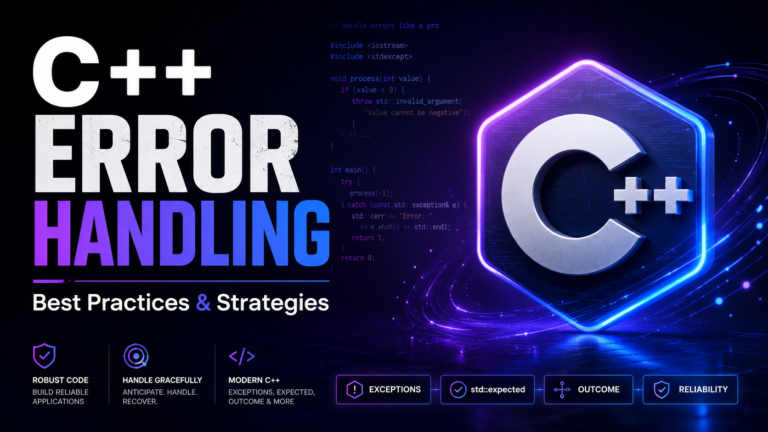
Created by Bjarne Stroustrup in 1979, C++ started as “C with Classes.” Today it is a massive language standardized by the ISO committee, with major revisions every three years. The latest standard, C++23, introduced modules improvements, std::print, and ranges enhancements. The upcoming C++26 is already being drafted.
If you have never programmed before, C++ is a demanding first language — but it rewards you with a deep understanding of how computers actually work. If you already know C, JavaScript, or Python, learning C++ will sharpen your mental model of memory, types, and performance in ways those languages cannot.
The History of C++ — From C with Classes to C++23
Understanding where C++ came from helps you understand why it looks the way it does today. Every feature in the language exists because a real programmer hit a real problem that the previous version could not solve elegantly.
Bjarne Stroustrup and the Birth of C++
In 1979, Bjarne Stroustrup was a PhD graduate working at Bell Labs — the same research lab where Dennis Ritchie and Ken Thompson created C and Unix. Stroustrup needed a language that had the simulation capabilities of Simula (the first object-oriented language) but the raw speed of C. Rather than building something from scratch, he extended C.
His first version, called “C with Classes,” added classes, inheritance, strong type checking, inline functions, and default arguments to C. The preprocessor Cpre translated this extended syntax into plain C, which was then compiled normally. By 1983, the language had been renamed “C++” — a programmer joke, since ++ is the increment operator in C.
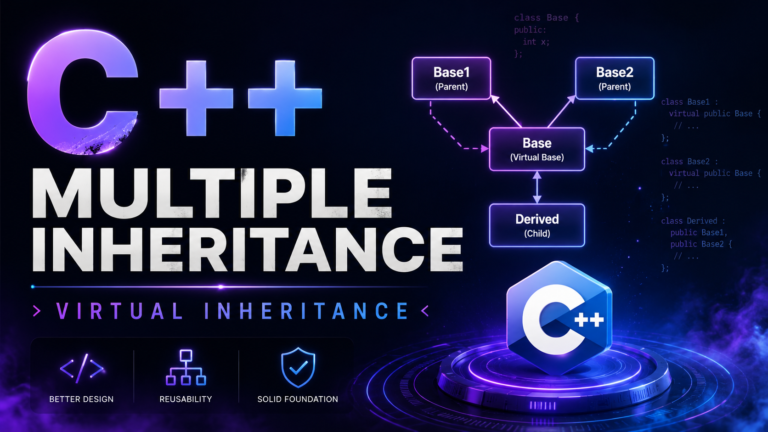
The first commercial release, Cfront 1.0, shipped in 1985 alongside Stroustrup’s book The C++ Programming Language. By 1989, C++ 2.0 added multiple inheritance, abstract classes, static member functions, and const member functions.
The C++ Standard Evolution
C++ was standardized by ISO in 1998. Here is every major standard and what it brought:
- C++98 (1998): The first ISO standard. Templates, exceptions, the Standard Template Library (STL), namespaces,
booltype, RTTI, and thestd::stringclass. This was the C++ most people learned in the 2000s. - C++03 (2003): A bug-fix release. No new features — just defect corrections for C++98.
- C++11 (2011): The game changer.
auto, range-basedfor, lambdas, smart pointers (unique_ptr,shared_ptr), move semantics,nullptr,constexpr, threads, variadic templates, andstd::array. C++11 modernized the language so dramatically that code written before and after it looks like two different languages. - C++14 (2014): Polished C++11 — generic lambdas, relaxed
constexpr,std::make_unique, variable templates. - C++17 (2017): Structured bindings,
std::optional,std::variant,std::any,std::filesystem,if constexpr, fold expressions, and class template argument deduction (CTAD). - C++20 (2020): Concepts, ranges, coroutines, modules, the spaceship operator (
<=>),std::format, and calendar/timezone support. Another massive release. - C++23 (2023):
std::print,std::expected,std::flat_map, deducingthis, multidimensional subscript operator, and ranges improvements.
The committee operates on a strict three-year cycle. C++26 is being drafted right now with reflection, contracts, and pattern matching as headline features.
Key Features of C++
C++ is not one thing — it is several programming paradigms bolted onto a performance-critical foundation. Here are the features that define it.
Zero-Cost Abstractions
The most important design principle in C++ is the zero-overhead principle: you do not pay for what you do not use, and what you do use could not be hand-coded more efficiently. This is not just a slogan — it is the guiding philosophy behind every feature in the language.
Consider a std::vector. It gives you dynamic arrays with bounds-safe access, automatic memory management, and iterator support. Yet the compiled machine code for iterating a std::vector<int> is identical to iterating a raw int* pointer. The abstraction has zero runtime cost. Here is a simple example:
#include <vector>
#include <iostream>

int main() {
    std::vector<int> nums = {10, 20, 30, 40, 50};

    // This compiles to the same assembly as a raw pointer loop
    for (int n : nums) {
        std::cout << n << " ";
    }
    std::cout << "\n";
    return 0;
}
// Output: 10 20 30 40 50
Compare that to Java’s ArrayList<Integer>, which boxes every integer as a heap object, or Python’s lists, which store everything as heap-allocated PyObject pointers. C++ pays nothing extra for the abstraction.
Multi-Paradigm Programming
C++ supports four major programming paradigms — and you can mix them freely:
// 1. Procedural (C-style)
int add(int a, int b) { return a + b; }

// 2. Object-Oriented
class Shape {
public:
    virtual double area() const = 0;
    virtual ~Shape() = default;
};

class Circle : public Shape {
    double radius;
public:
    Circle(double r) : radius(r) {}
    double area() const override { return 3.14159 * radius * radius; }
};

// 3. Generic (Templates)
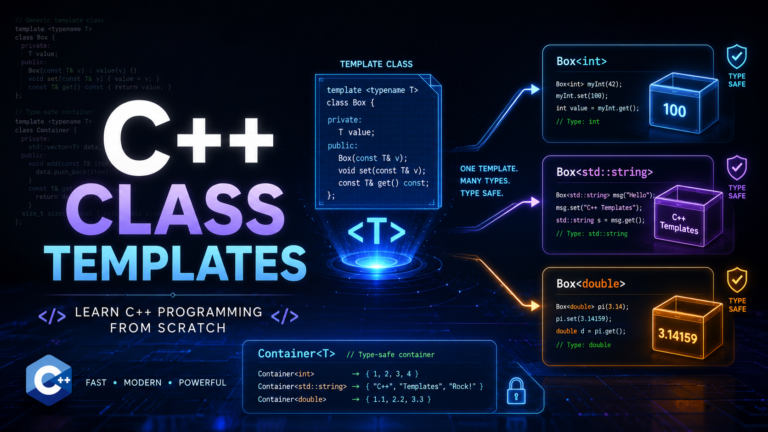
template<typename T>
T maximum(T a, T b) { return (a > b) ? a : b; }

// 4. Functional (Lambdas)
#include <algorithm>
#include <vector>
void example() {
    std::vector<int> v = {3, 1, 4, 1, 5};
    std::sort(v.begin(), v.end(), [](int a, int b) { return a > b; });
    // v is now {5, 4, 3, 1, 1}
}
No other mainstream language gives you all four paradigms at full power with zero runtime overhead. Rust comes close but lacks inheritance-based OOP. Java and C# have OOP and lambdas but cannot do compile-time template metaprogramming. Python has everything except performance.
The Memory Model — RAII and Deterministic Destruction
C++ does not have a garbage collector. Instead, it uses RAII — Resource Acquisition Is Initialization. When an object goes out of scope, its destructor runs immediately and deterministically. This is not just about memory. It applies to file handles, network sockets, mutex locks — any resource.
#include <fstream>
#include <string>

void readConfig() {
    std::ifstream file("config.txt");  // File opens here (constructor)

    if (!file.is_open()) {
        return;  // If open fails, destructor still runs safely
    }

    std::string line;
    while (std::getline(file, line)) {
        // process each line
    }
    // file automatically closes here (destructor runs when 'file' goes out of scope)
    // No close() call needed. No try/finally. No garbage collector.
}
In Java, you need try-with-resources. In Python, you need with statements. In Go, you need defer. In C++, resource cleanup is automatic and guaranteed the moment scope ends — at compile time, not runtime.
C++ vs C — What C++ Adds
If you have already completed the C programming course on SudoFlare, you know C gives you raw power but makes you manage everything yourself. C++ adds:
- Classes and objects — Encapsulation, inheritance, polymorphism, access control.
- Templates — Write code once, use it with any type. No more
void*hacks. - Exceptions — Structured error handling instead of checking every return code.
- RAII and destructors — Automatic resource cleanup without manual
free()calls. - The Standard Library —
std::string,std::vector,std::map, algorithms, filesystem, threads — all battle-tested and optimized. - Operator overloading — Make your types work with
+,-,==,<<naturally. - Namespaces — Avoid the name collision nightmare that plagues large C projects.
- References — Safer aliases than pointers for function parameters.
- Smart pointers —
std::unique_ptrandstd::shared_ptreliminate memory leaks without a garbage collector.
// C version — manual everything
#include <stdio.h>
#include <stdlib.h>
#include <string.h>

typedef struct {
    char* name;
    int age;
} Person;

Person* createPerson(const char* name, int age) {
    Person* p = (Person*)malloc(sizeof(Person));
    p->name = (char*)malloc(strlen(name) + 1);
    strcpy(p->name, name);
    p->age = age;
    return p;
}

void freePerson(Person* p) {
    free(p->name);
    free(p);
}

// C++ version — clean and safe
#include <string>
#include <iostream>

class Person {
    std::string name;
    int age;
public:
    Person(std::string n, int a) : name(std::move(n)), age(a) {}
    void greet() const {
        std::cout << "Hi, I'm " << name << ", age " << age << "\n";
    }
};
// No manual memory management needed — std::string handles its own memory
// Person's destructor automatically cleans up when it goes out of scope
C++ vs Other Languages (Rust, Java, Python)
Where does C++ fit in the modern language landscape?
C++ vs Rust: Rust prevents memory bugs at compile time with its borrow checker. C++ gives you more freedom but requires discipline. Rust has no inheritance; C++ has full OOP. C++ has a massive ecosystem and 40 years of libraries. Rust is growing fast but is still catching up. For new projects with safety as the top priority, Rust is compelling. For projects that need to integrate with existing C++ codebases — which is most real-world software — C++ remains the practical choice.
C++ vs Java: Java runs on a virtual machine with garbage collection. C++ compiles to native code with deterministic destruction. Java is easier to learn; C++ is 10-50x faster for compute-heavy tasks. Java dominates enterprise backends; C++ dominates systems programming, games, and embedded.
C++ vs Python: Python is the language you use when developer time matters more than runtime. C++ is the language you use when nanoseconds matter. Many Python libraries — NumPy, TensorFlow, PyTorch — are actually C++ under the hood. Learning C++ shows you what Python is hiding.
Where C++ is Used in 2026
C++ is not a legacy language. It is the backbone of modern technology:
- Game engines: Unreal Engine 5, Unity’s native core, CryEngine, Godot’s renderer — all C++. Every AAA game title ships as compiled C++.
- Operating systems: Windows kernel components, macOS/iOS frameworks, ChromeOS, Android’s native layer — all use C++.
- Browsers: Chrome (Blink engine), Firefox (Gecko), Safari (WebKit) — written in C++.
- AI/ML frameworks: PyTorch‘s C++ backend (LibTorch), TensorFlow‘s core, ONNX Runtime, llama.cpp — C++ powers AI inference.
- Databases: MySQL, PostgreSQL (partially), MongoDB, ClickHouse, ScyllaDB — C++.
- Finance: High-frequency trading systems at Goldman Sachs, Jane Street, Citadel — where microseconds mean millions — run C++.
- Embedded systems: Automotive ECUs, aerospace flight controllers, medical devices, IoT firmware.
- Compilers: GCC, Clang/LLVM, MSVC — the tools that compile your code are themselves written in C++.
The TIOBE Index consistently ranks C++ in the top 3 programming languages. The Stack Overflow Developer Survey shows C++ used by roughly 20% of professional developers. There is no sign of this declining.
Your First Look at C++ Code
Let us look at a simple but complete C++ program. You do not need to understand every detail yet — we will cover each concept in dedicated lessons.
#include <iostream>   // Input/output library
#include <string>     // String class
#include <vector>     // Dynamic array

int main() {
    // Variables with type inference
    auto greeting = std::string("Welcome to C++!");
    auto numbers = std::vector<int>{1, 2, 3, 4, 5};

    // Output
    std::cout << greeting << "\n";

    // Range-based for loop
    int sum = 0;
    for (int n : numbers) {
        sum += n;
    }
    std::cout << "Sum: " << sum << "\n";

    // Lambda function
    auto square = [](int x) { return x * x; };
    std::cout << "5 squared: " << square(5) << "\n";

    return 0;
}
// Output:
// Welcome to C++!
// Sum: 15
// 5 squared: 25
Even this tiny program showcases features that C does not have: auto type deduction, std::string (no manual memory management), std::vector (no manual array sizing), range-based for, and lambda expressions. All of this compiles to machine code that runs as fast as hand-written C.
Here is another example showing classes:
#include <iostream>
#include <string>
#include <memory>   // For smart pointers

class Animal {
protected:
    std::string name;
public:
    Animal(std::string n) : name(std::move(n)) {}
    virtual void speak() const = 0;   // Pure virtual — must be overridden
    virtual ~Animal() = default;
};

class Dog : public Animal {
public:
    Dog(std::string n) : Animal(std::move(n)) {}
    void speak() const override {
        std::cout << name << " says: Woof!\n";
    }
};

class Cat : public Animal {
public:
    Cat(std::string n) : Animal(std::move(n)) {}
    void speak() const override {
        std::cout << name << " says: Meow!\n";
    }
};

int main() {
    // Smart pointers — no manual delete needed
    auto animals = std::vector<std::unique_ptr<Animal>>();
    animals.push_back(std::make_unique<Dog>("Rex"));
    animals.push_back(std::make_unique<Cat>("Whiskers"));
    animals.push_back(std::make_unique<Dog>("Buddy"));

    for (const auto& a : animals) {
        a->speak();  // Polymorphism in action
    }
    return 0;
}
// Output:
// Rex says: Woof!
// Whiskers says: Meow!
// Buddy says: Woof!
This demonstrates inheritance, polymorphism, smart pointers, and RAII — all core C++ concepts you will master throughout this course.
Why Learn C++ in 2026?
Here are the practical reasons:
Performance-critical careers pay the most. C++ developers consistently rank among the highest-paid programmers. Roles in game development, quantitative finance, autonomous vehicles, and systems programming all require C++ and pay $150K-$400K+ at top companies. Google, Microsoft, Apple, Meta, Bloomberg, and Jane Street all hire C++ engineers aggressively.
Understanding C++ makes you a better programmer in any language. When you understand how memory actually works — stack vs heap, cache locality, pointer indirection, object lifetime — you write better code in every language. Python’s memory model, Java’s garbage collector, Rust’s borrow checker — they all make more sense once you understand the problems C++ solves manually.
AI is moving to C++ for inference. Training AI models happens in Python with PyTorch. But deploying them for real-time inference — in self-driving cars, phones, edge devices — increasingly uses C++. llama.cpp demonstrated that a single C++ implementation can run large language models on consumer hardware. The AI inference stack is C++.
C++ is not going anywhere. With C++26 on the horizon bringing reflection, contracts, and pattern matching, the language continues to evolve. The codebase is too massive, the ecosystem too deep, and the performance advantage too real for C++ to be replaced. Learning it now is an investment that pays off for decades.
Summary
C++ is a compiled, multi-paradigm, performance-first programming language created by Bjarne Stroustrup in 1979. It gives you high-level abstractions — classes, templates, smart pointers, lambdas — with zero runtime overhead. It has been standardized by ISO since 1998, with major revisions every three years bringing modern features like auto, move semantics, concepts, ranges, and modules.
C++ powers game engines, operating systems, browsers, AI frameworks, databases, financial systems, and compilers. It is one of the most in-demand and highest-paying programming skills in 2026. In the next lesson, we will set up your development environment and write your first C++ program.