C++ Type Casting: static_cast, dynamic_cast, const_cast & reinterpret_cast Guide
C-style casts are a loaded gun with no safety. You write (int)myFloat and it compiles. You write (Animal*)randomPointer and it compiles. You write something that quietly destroys const-correctness, strips away type safety, and reinterprets raw bits — and it still compiles. No warning. No error. Just undefined behavior waiting to detonate at 3 AM in production.
C++ type casting exists because the language designers looked at C’s single-syntax cast and decided it was doing too many unrelated things under one roof. The result: four distinct cast operators, each with a specific purpose and a specific set of guarantees. If you’ve been writing C++ using C-style casts, you’re writing C with classes — and leaving money on the table in terms of safety, readability, and debuggability.
This lesson breaks down all four cast operators, covers the modern std::bit_cast from C++20, and shows you exactly which one to reach for in every scenario. If you need a refresher on how types work in C++, start with variables and types before diving in.
Why C++ Has Four Cast Operators
The core problem with C-style casts is that they’re semantically overloaded. When you write (TargetType)expression, the compiler silently tries up to five different conversion strategies in order, picking the first one that works. You have zero visibility into which conversion actually happened.
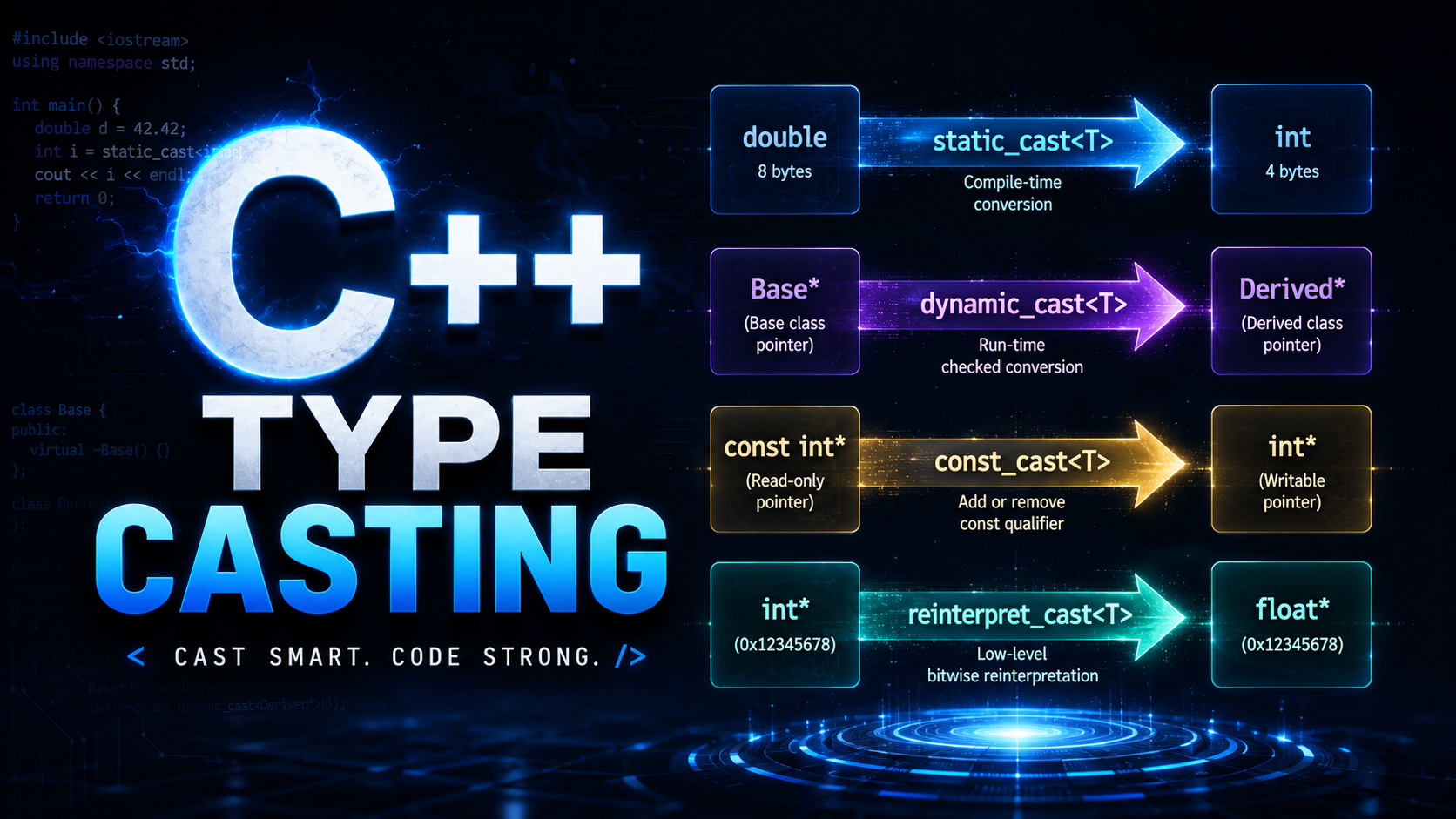
Bjarne Stroustrup addressed this directly in his FAQ: the named casts were introduced to make conversions explicit, searchable, and self-documenting. Each cast operator maps to one category of conversion:
static_cast— Compile-time checked, “reasonable” conversions between related typesdynamic_cast— Runtime-checked downcasting in polymorphic hierarchiesconst_cast— Adding or removingconst/volatilequalifiers onlyreinterpret_cast— Raw bit-level reinterpretation with no type safety
The design philosophy is simple: the name of the cast tells you the danger level. A static_cast in code review barely warrants a second glance. A reinterpret_cast demands an explanatory comment and a very good reason. Try getting that signal from (int*).
static_cast — The Workhorse
static_cast handles conversions the compiler can verify at compile time. It covers the vast majority of casting you’ll ever need: numeric conversions, enum conversions, upcasting, downcasting in known hierarchies, and void* round-trips.
Numeric Conversions
The most common use case. When you convert between numeric types, static_cast makes the narrowing or widening explicit:
double pi = 3.14159;
int truncated = static_cast<int>(pi);  // 3, truncation is explicit

int large = 100000;
short small = static_cast<short>(large);  // potential data loss — but you've acknowledged it

unsigned int u = static_cast<unsigned int>(-1);  // 4294967295 on 32-bit — intentional
Without the cast, most compilers emit narrowing warnings. With static_cast, you’re telling both the compiler and future readers: “Yes, I know this might lose data. I’ve thought about it.”
Enum Conversions
Converting between enums and integers requires static_cast when using scoped enums (enum class):
enum class Color : uint8_t { Red = 0, Green = 1, Blue = 2 };

uint8_t raw = static_cast<uint8_t>(Color::Green);  // 1
Color c = static_cast<Color>(2);                     // Color::Blue

// Unscoped enums implicitly convert to int (no cast needed going out)
enum OldStyle { A = 10, B = 20 };
int val = A;  // fine, implicit
OldStyle os = static_cast<OldStyle>(10);  // cast needed going in
Upcasting and Downcasting
In inheritance hierarchies, static_cast handles both directions. Upcasting (derived to base) is always safe and actually happens implicitly. Downcasting (base to derived) compiles but provides no runtime check — you’d better be right:
class Animal {
public:
    virtual ~Animal() = default;
    virtual void speak() const { std::cout << "...\n"; }
};

class Dog : public Animal {
public:
    void speak() const override { std::cout << "Woof!\n"; }
    void fetch() { std::cout << "Fetching!\n"; }
};

Dog rex;
Animal* base = &rex;                             // implicit upcast
Dog* dog = static_cast<Dog*>(base);              // downcast — works because base IS a Dog
dog->fetch();                                     // fine

Animal generic;
Dog* bad = static_cast<Dog*>(&generic);          // compiles! but UB if you use Dog-specific members
// bad->fetch();  // undefined behavior — generic is NOT a Dog
Use static_cast for downcasting only when you’re absolutely certain of the dynamic type. If there’s any doubt, reach for dynamic_cast instead.
void* Conversion
C++ requires static_cast to convert void* back to a typed pointer (unlike C, where the conversion is implicit):
int value = 42;
void* generic = &value;                           // implicit conversion to void*
int* restored = static_cast<int*>(generic);       // must cast back explicitly
std::cout << *restored << "\n";                   // 42

// Common in C callback APIs
void callback(void* user_data) {
    auto* config = static_cast<MyConfig*>(user_data);
    config->process();
}
dynamic_cast — Runtime Safety Net
dynamic_cast is the only cast that performs a runtime type check. It uses RTTI (Run-Time Type Information) to verify that a downcast is valid before performing it. This makes it the correct choice when you’re working with polymorphic types and you don’t know the concrete type at compile time.
Downcasting with Pointers
When dynamic_cast fails on a pointer, it returns nullptr instead of giving you a garbage pointer:
class Shape {
public:
    virtual ~Shape() = default;
    virtual double area() const = 0;
};

class Circle : public Shape {
public:
    double radius;
    Circle(double r) : radius(r) {}
    double area() const override { return 3.14159 * radius * radius; }
};

class Rectangle : public Shape {
public:
    double width, height;
    Rectangle(double w, double h) : width(w), height(h) {}
    double area() const override { return width * height; }
};

void processShape(Shape* shape) {
    // Safe downcast — check before use
    if (auto* circle = dynamic_cast<Circle*>(shape)) {
        std::cout << "Circle with radius " << circle->radius << "\n";
    } else if (auto* rect = dynamic_cast<Rectangle*>(shape)) {
        std::cout << "Rectangle " << rect->width << "x" << rect->height << "\n";
    } else {
        std::cout << "Unknown shape\n";
    }
}
Downcasting with References
References can’t be null, so dynamic_cast throws std::bad_cast on failure instead:
#include <typeinfo>

void processShapeRef(Shape& shape) {
    try {
        Circle& circle = dynamic_cast<Circle&>(shape);
        std::cout << "Circle radius: " << circle.radius << "\n";
    } catch (const std::bad_cast& e) {
        std::cout << "Not a circle: " << e.what() << "\n";
    }
}
Requirements and Costs
There are two hard requirements for dynamic_cast to work:
- The base class must have at least one virtual function (typically a virtual destructor). Without this, there’s no RTTI, and the compiler will reject the cast.
- RTTI must be enabled in your compiler settings. Some codebases (notably parts of LLVM and some game engines) disable RTTI with
-fno-rttifor performance, which makesdynamic_castunavailable. The cppreference documentation covers the full specification.
Performance-wise, dynamic_cast is not free. It walks the type hierarchy at runtime, which can be measurably slow in tight loops. According to benchmarks compiled by the ISO C++ FAQ, a dynamic_cast typically costs 2-10x more than a static_cast depending on hierarchy depth. In performance-critical code, consider alternatives like the visitor pattern or storing a type enum.
const_cast — Stripping Const Safely (or Not)
const_cast is the only cast that can add or remove const and volatile qualifiers. It cannot change the underlying type — just the cv-qualification. Understanding when it’s legitimate versus when it’s undefined behavior is critical.
Legitimate Use: Working Around Legacy APIs
The most defensible use of const_cast is interfacing with older C or C++ code that isn’t const-correct but doesn’t actually modify the data:
// Legacy C function that takes char* but doesn't modify the string
extern "C" void legacy_print(char* str);  // should be const char*, but isn't

void modernWrapper(const std::string& message) {
    // We know legacy_print won't modify the data
    legacy_print(const_cast<char*>(message.c_str()));
}
Legitimate Use: Avoiding Duplication
Scott Meyers’ “const_cast + as-if” pattern avoids duplicating logic in const/non-const overloads. If you’re not familiar with references, review those first:
class TextBuffer {
    std::string data_;
public:
    // The const version does the real work
    const char& charAt(size_t index) const {
        if (index >= data_.size()) throw std::out_of_range("Index out of bounds");
        return data_[index];
    }

    // Non-const version delegates to const version
    char& charAt(size_t index) {
        return const_cast<char&>(
            static_cast<const TextBuffer&>(*this).charAt(index)
        );
    }
};
The Undefined Behavior Trap
Here’s the rule that trips people up: if an object was originally declared as const, modifying it through a const_cast-ed pointer or reference is undefined behavior. The compiler is allowed to place const objects in read-only memory, and writing to them can crash or silently corrupt data:
const int original = 42;
int* p = const_cast<int*>(&original);
*p = 99;  // UNDEFINED BEHAVIOR — original was declared const

// The compiler might have placed 'original' in .rodata
// Or it might optimize reads of 'original' to always return 42
// Either way, this code is broken

// This is fine — the object wasn't originally const:
int mutable_value = 42;
const int* cp = &mutable_value;
int* mp = const_cast<int*>(cp);
*mp = 99;  // OK — the underlying object is non-const
The cppreference page on const_cast specifies this distinction clearly. The cast itself is always legal; it’s the modification that can be UB.
reinterpret_cast — The Nuclear Option
reinterpret_cast performs raw, bit-level reinterpretation of types. It makes no attempt to convert data — it simply tells the compiler to treat the same bits as a different type. This is inherently dangerous but sometimes necessary in systems programming.
Pointer-to-Integer and Back
#include <cstdint>

int x = 42;
uintptr_t addr = reinterpret_cast<uintptr_t>(&x);
std::cout << "Address of x: 0x" << std::hex << addr << "\n";

int* restored = reinterpret_cast<int*>(addr);
std::cout << "Value: " << *restored << "\n";  // 42
Type Punning (Pre-C++20)
Before C++20, reinterpret_cast was commonly used for type punning — inspecting the bit representation of a value as a different type. This is technically undefined behavior due to strict aliasing violations, but it was widely used:
// DON'T DO THIS — strict aliasing violation (UB)
float f = 3.14f;
uint32_t bits = *reinterpret_cast<uint32_t*>(&f);

// The only legal pre-C++20 type pun uses memcpy:
uint32_t bits_safe;
std::memcpy(&bits_safe, &f, sizeof(float));
Hardware Register Access
In embedded systems and OS development, reinterpret_cast maps typed structures onto hardware memory addresses:
struct UARTRegisters {
    volatile uint32_t data;
    volatile uint32_t status;
    volatile uint32_t control;
};

// Map the UART peripheral at a known hardware address
auto* uart = reinterpret_cast<UARTRegisters*>(0x4000'1000);
uart->control = 0x03;  // configure the peripheral
If you’re not writing drivers, kernel code, or network protocol parsers, you probably don’t need reinterpret_cast. If you find yourself reaching for it in application code, reconsider your design.
C-Style Casts vs C++ Casts
When you write (TargetType)expression, the compiler doesn’t just do one thing. According to the C++ standard’s explicit cast rules, a C-style cast tries the following operations in order, using the first one that succeeds:
const_caststatic_caststatic_castfollowed byconst_castreinterpret_castreinterpret_castfollowed byconst_cast
This means a single C-style cast can silently perform a reinterpret_cast combined with a const_cast — the two most dangerous operations — and you’d never know without reading the generated assembly:
class Base { public: virtual ~Base() = default; };
class Unrelated { public: int x; };

Base b;
// What does this actually do?
Unrelated* u = (Unrelated*)&b;

// It's a reinterpret_cast — no compiler error, no warning
// With C++ casts, you'd have to write:
Unrelated* u2 = reinterpret_cast<Unrelated*>(&b);
// Which screams "danger" in code review
C-style casts also have a superpower that even C++ named casts lack: they can cast to inaccessible base classes. A static_cast respects private and protected inheritance; a C-style cast ignores it entirely. This alone is reason enough to ban them — that access control exists for a reason.
The practical argument is searchability. You can grep for reinterpret_cast in a million-line codebase and find every dangerous cast in seconds. Try finding all the dangerous C-style casts — you’d match every function-call-like expression in the codebase.
std::bit_cast (C++20) — Type Punning Done Right
C++20 introduced std::bit_cast to solve the type punning problem that reinterpret_cast never handled correctly. It copies the bit representation of a value into a new type, with compile-time safety checks and zero undefined behavior. The cppreference documentation covers the full specification.
#include <bit>
#include <cstdint>

// Legal, well-defined type punning
float f = 3.14f;
uint32_t bits = std::bit_cast<uint32_t>(f);
std::cout << "IEEE 754 bits: 0x" << std::hex << bits << "\n";
// Output: 0x4048f5c3

// Round-trip is guaranteed
float restored = std::bit_cast<float>(bits);
// restored == 3.14f exactly
Requirements
std::bit_cast enforces rules that reinterpret_cast doesn’t:
- Source and destination must be the same size (
sizeof) - Both types must be trivially copyable
- It’s
constexpr— usable in compile-time computations
// Compile-time type punning — not possible with memcpy or reinterpret_cast
constexpr uint32_t pi_bits = std::bit_cast<uint32_t>(3.14f);
static_assert(pi_bits == 0x4048F5C3);

// Won't compile — sizes don't match
// auto bad = std::bit_cast<uint64_t>(3.14f);  // error: different sizes

// Practical: extracting sign, exponent, mantissa from a float
struct FloatParts {
    uint32_t mantissa : 23;
    uint32_t exponent : 8;
    uint32_t sign     : 1;
};
static_assert(sizeof(FloatParts) == sizeof(float));

FloatParts parts = std::bit_cast<FloatParts>(3.14f);
std::cout << "Sign: " << parts.sign
          << " Exp: " << parts.exponent
          << " Mantissa: " << parts.mantissa << "\n";
If you’re writing C++20 or later, std::bit_cast should replace every reinterpret_cast you were using for type punning, and every memcpy hack too.
User-Defined Conversions
Beyond the built-in casts, classes can define their own conversion behavior through two mechanisms: conversion operators and conversion constructors.
Conversion Operators
class Fraction {
    int numerator_, denominator_;
public:
    Fraction(int n, int d) : numerator_(n), denominator_(d) {}

    // Implicit conversion to double
    operator double() const {
        return static_cast<double>(numerator_) / denominator_;
    }

    // Explicit conversion to bool (C++11)
    explicit operator bool() const {
        return numerator_ != 0;
    }
};

Fraction half(1, 2);
double d = half;       // implicit conversion: 0.5
// bool b = half;      // error — conversion is explicit
if (half) { /* OK — explicit bool works in boolean contexts */ }
bool b = static_cast<bool>(half);  // OK — explicit cast
Conversion Constructors
Any constructor that can be called with a single argument acts as a conversion constructor, unless marked explicit:
class Distance {
    double meters_;
public:
    // Implicit conversion from double
    Distance(double m) : meters_(m) {}

    // Explicit conversion from int (won't happen implicitly)
    explicit Distance(int cm) : meters_(cm / 100.0) {}

    double meters() const { return meters_; }
};

Distance d1 = 5.0;   // OK — implicit conversion from double
// Distance d2 = 500; // error — int constructor is explicit
Distance d3(500);     // OK — direct initialization
Distance d4 = static_cast<Distance>(500);  // OK — explicit cast
The explicit keyword is one of the most underused features in C++. The C++ Core Guidelines (C.46) recommend marking single-argument constructors explicit by default unless implicit conversion genuinely makes the API better. Unmarked conversion constructors are a common source of bugs — the compiler silently creates temporary objects you never asked for.
Common Casting Mistakes
Object Slicing Through Casts
When you static_cast a derived object to a base value (not pointer or reference), you get slicing — the derived-class data is stripped away:
class Base {
public:
    virtual void identify() { std::cout << "Base\n"; }
    virtual ~Base() = default;
};

class Derived : public Base {
    int extra_ = 42;
public:
    void identify() override { std::cout << "Derived: " << extra_ << "\n"; }
};

Derived d;
Base b = static_cast<Base>(d);  // SLICED — b is now a plain Base
b.identify();                     // prints "Base", not "Derived: 42"

// Use pointers or references to preserve polymorphism
Base& ref = d;
ref.identify();  // prints "Derived: 42"
Invalid Downcasts
class Cat : public Animal {
public:
    void purr() { std::cout << "Purrr\n"; }
};

Animal* a = new Dog();
Cat* cat = static_cast<Cat*>(a);  // compiles — but a is a Dog, not a Cat
// cat->purr();  // undefined behavior

// dynamic_cast catches this:
Cat* safe_cat = dynamic_cast<Cat*>(a);  // returns nullptr
if (!safe_cat) {
    std::cout << "Not a cat!\n";
}

delete a;
const_cast on Truly Const Objects
const std::string GLOBAL_NAME = "SudoFlare";

void dangerousModify(const std::string& s) {
    auto& mutable_s = const_cast<std::string&>(s);
    mutable_s += " hacked";  // UB if s refers to GLOBAL_NAME
}

// If the caller passes GLOBAL_NAME, this is undefined behavior.
// The compiler may have placed GLOBAL_NAME in read-only memory.
// Even if it doesn't crash, the modification might be invisible
// because the compiler cached the original value.
Casting Away Volatile Incorrectly
volatile int hardware_register = 0;

// Removing volatile defeats its purpose — the compiler will
// optimize away repeated reads, missing hardware state changes
int* bad_ptr = const_cast<int*>(&hardware_register);
// Reads through bad_ptr may be cached by the compiler
Best Practices — Choosing the Right Cast
Here’s the decision flowchart. Memorize it, print it, tattoo it — whatever works:
- Do you need a cast at all? Often, you can redesign your code to avoid casting entirely. Use templates, virtual functions, or
std::variantinstead. - Converting between numeric types? Use
static_cast. - Upcasting in a hierarchy? Don’t cast — it’s implicit.
- Downcasting and you know the type for certain? Use
static_cast. - Downcasting and you’re not sure of the type? Use
dynamic_castand check the result. - Need to remove const for a legacy API that won’t modify the data? Use
const_cast. - Need to inspect raw bits of a value? Use
std::bit_cast(C++20) orstd::memcpy. - Working with hardware addresses or cross-type pointer aliasing in systems code? Use
reinterpret_castwith a comment explaining why. - None of the above? Reconsider your design. If you truly need a C-style cast’s power to bypass access control, you have a design problem.
Code Review Rules
- Ban C-style casts. Enable
-Wold-style-cast(GCC/Clang) or use/W4(MSVC). Many teams enforce this via clang-tidy’s readability-casting check. - Every
reinterpret_castneeds a comment. If you can’t explain why it’s safe, it’s not safe. - Every
const_castneeds documentation of why the underlying object isn’t truly const. - Prefer
dynamic_castoverstatic_castfor downcasts unless profiling proves the RTTI cost matters. - Use
expliciton single-argument constructors and conversion operators unless implicit conversion is genuinely part of the API design.
Quick Reference Table
| Cast | Compile-Time Check | Runtime Check | Can Remove const | Can Reinterpret Bits | Risk Level |
|---|---|---|---|---|---|
static_cast |
Yes | No | No | No | Low |
dynamic_cast |
Yes | Yes | No | No | Low |
const_cast |
Yes | No | Yes | No | Medium |
reinterpret_cast |
Minimal | No | No | Yes | High |
std::bit_cast |
Yes (size) | No | No | Yes (safe) | Low |
C-style (T)x |
Varies | No | Yes | Yes | Unknown |
C++ gives you four cast operators because one wasn’t enough to express intent. Use them. Each named cast is a contract with the reader: static_cast says “this conversion is reasonable.” dynamic_cast says “I’m checking at runtime.” const_cast says “I’m deliberately stripping const.” reinterpret_cast says “I know exactly what I’m doing with these bits.” And a C-style cast? It says nothing — which is exactly the problem.
In the next lesson, we’ll explore smart pointers — another area where modern C++ dramatically improves safety over raw pointer manipulation. The same philosophy applies: be explicit about ownership, just as you should be explicit about conversions.