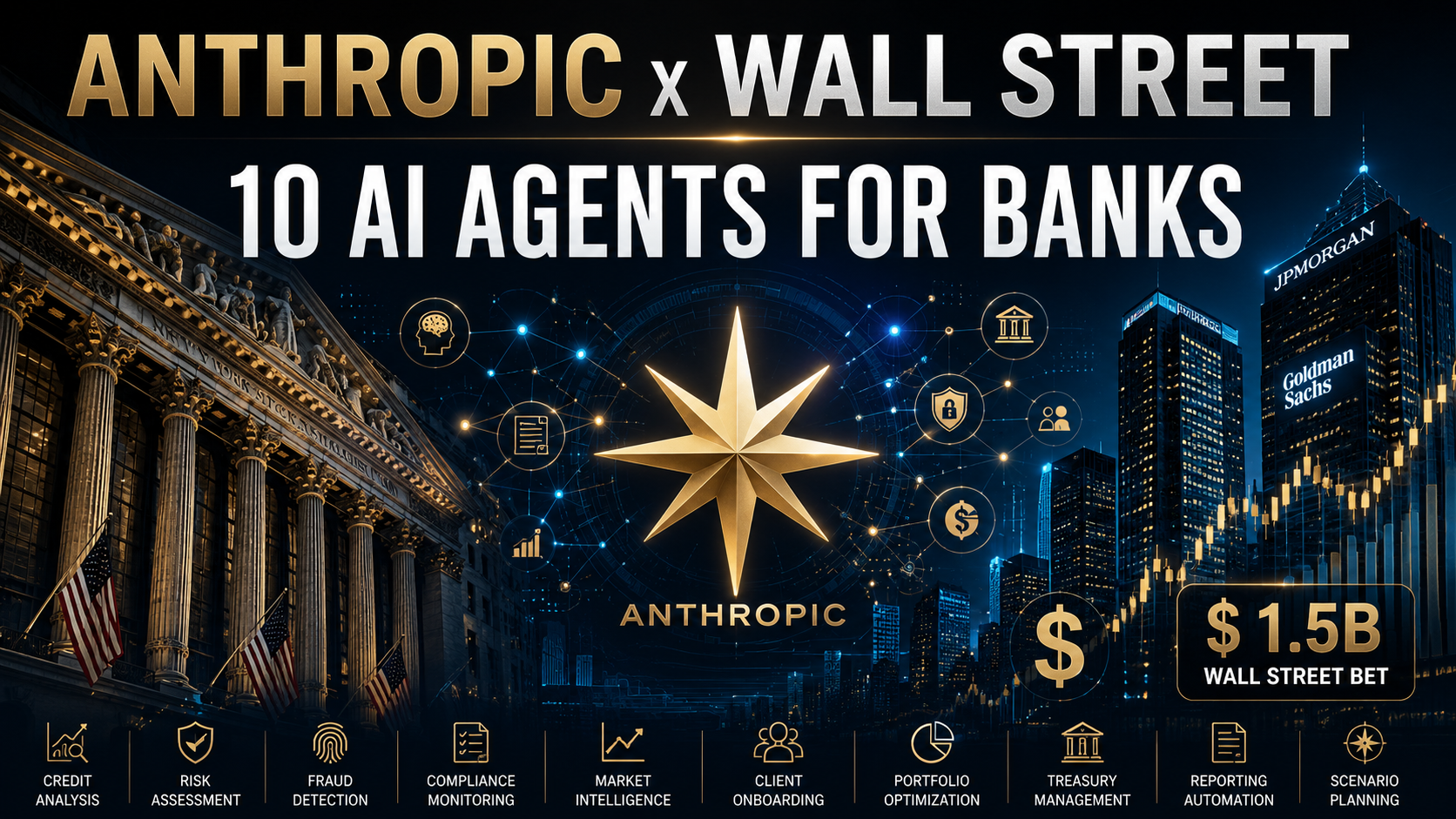
Anthropic Launches 10 AI Agents for Banks — $1.5B Wall Street Bet With Blackstone and Goldman Sachs
Wall Street Gets Its AI Workforce
Anthropic just made its biggest enterprise play yet. On May 5, 2026, at an invite-only event in New York, the company unveiled 10 purpose-built AI agents designed specifically for financial services — targeting the most tedious, time-consuming work in banking, insurance, and asset management.
These are not chatbots. They are autonomous agents that can build pitchbooks in PowerPoint, screen KYC files, reconcile general ledgers, and close the books at month-end. Each one ships as a plugin in Claude Cowork and Claude Code, and as a cookbook for Claude Managed Agents. Financial teams can deploy them on real work in days, not months.
But the agents were just one piece of a coordinated offensive. Anthropic also launched Claude Opus 4.7 — its most capable model for financial analysis — a $1.5 billion joint venture with Blackstone, Goldman Sachs, and Hellman & Friedman, a native Moody’s MCP integration covering 600 million entities, an FIS-built AML agent already live at BMO, and full Microsoft 365 add-ins for Excel, PowerPoint, and Word.
Financial institutions already make up about 40% of Anthropic’s top 50 customers. This announcement is Anthropic saying: we are not just an AI lab anymore. We are a Wall Street infrastructure company.
All 10 Agents: What They Actually Do
Here is the full lineup of Anthropic’s finance agents and what each one handles:
| Agent | Function | Output |
|---|---|---|
| Pitch Builder | Generates comparable company models from filings and data feeds | Comps model in Excel, pitchbook in PowerPoint, cover note in Outlook |
| Meeting Preparer | Pulls client history, market data, and recent news before meetings | Briefing document with talking points |
| Earnings Reviewer | Reads earnings transcripts and flags relevant model updates | Annotated summary with key changes |
| Model Builder | Constructs financial models from filings and data feeds | Working Excel model with assumptions |
| Market Researcher | Scans market data, research reports, and news for sector trends | Research brief with sourced data points |
| KYC Screener | Assembles entity files, reviews source documents | Packaged escalations for compliance review |
| Valuation Reviewer | Cross-checks valuation assumptions against market data | Flagged discrepancies and adjustment recommendations |
| General Ledger Reconciler | Matches transactions across accounts and flags exceptions | Reconciliation report with exception items |
| Month-End Closer | Automates closing procedures, journal entries, and reviews | Close checklist with status tracking |
| Statement Auditor | Reviews financial statements for errors and inconsistencies | Audit report with flagged items |
The Pitch Builder alone would have taken a junior analyst 15-20 hours of work. The agent produces a comps model in Excel, drafts the pitchbook in PowerPoint, and prepares the cover note in Outlook — all in one workflow. Context carries automatically between Microsoft applications, so the agent does not need to re-process information as it moves between tools.
Each agent includes long-running sessions, per-tool permissions, managed credential vaults, and a full audit log in the Claude Console. Compliance and engineering teams can inspect every tool call and decision the agent made — a critical requirement for regulated industries.
Claude Opus 4.7: Built for Finance
Alongside the agents, Anthropic released Claude Opus 4.7 — the most capable model in their lineup for financial work. On core financial analyst tasks, Opus 4.7 posts 64.37% accuracy, leading all competing models.
This is the model powering the 10 finance agents. It was specifically tuned for the kind of work that dominates enterprise AI deployments: reading dense financial documents, building multi-sheet Excel models, understanding regulatory language, and maintaining accuracy across long-running workflows that touch multiple data sources.
The model release was not a coincidence. Anthropic timed it to coincide with the agent launch because the agents need a model that can handle complex, multi-step financial reasoning without hallucinating numbers or losing context mid-workflow.
$1.5 Billion Joint Venture With Wall Street Giants
One day before the agent launch, Anthropic dropped another bomb: a $1.5 billion joint venture with Blackstone, Hellman & Friedman, and Goldman Sachs to create a new AI-native enterprise services company.
The funding breakdown:
- Anthropic: ~$300 million
- Blackstone: ~$300 million
- Hellman & Friedman: ~$300 million
- Goldman Sachs: ~$150 million
- Additional consortium (General Atlantic, Leonard Green, Apollo, GIC, Sequoia Capital): remaining capital
The new firm is a standalone entity with Anthropic engineering and partnership resources embedded directly within its team. Its job is to work with companies — especially those in the portfolio networks of Blackstone and Hellman & Friedman — to rapidly bring Claude into core business operations.
This is Anthropic’s answer to the consulting industry. Instead of hiring McKinsey or Accenture to do an “AI transformation,” companies can work with this new entity to deploy Claude agents directly into their workflows. The venture has access to hundreds of portfolio companies through its founding partners, giving it a built-in customer pipeline that most startups would kill for.
Moody’s Brings 600 Million Entities to Claude
Moody’s launched a native Model Context Protocol (MCP) application that brings proprietary credit ratings and data directly into Claude’s environment.
The scale is staggering: 600 million entities, 2 billion ownership links, and interconnected risk intelligence — all accessible natively within Claude Desktop, Claude.ai, and Claude Enterprise. At launch, the Moody’s agents support credit analysis for financial institutions including memo generation, peer comparisons, and scorecard assessments, as well as compliance workflows spanning entity profiling, ownership structure mapping, adverse media screening, and sanctions checks.
All workflows render as interactive reports directly within Claude through the MCP integration. No switching between systems. The agent runs in Claude, pulls Moody’s data, and produces the output inline.
For compliance teams that spend hours manually pulling credit data and cross-referencing entity relationships, this is a fundamental workflow change. The KYC screener agent can now tap into Moody’s 600 million entity database directly, making entity verification and ownership mapping nearly instantaneous.
FIS Builds Anti-Money Laundering Agent
FIS — one of the largest financial technology providers in the world — built a Financial Crimes AI Agent on Claude that compresses anti-money laundering investigations from hours or days into minutes.
The agent assembles evidence across a bank’s core systems and surfaces the highest-risk cases for human review. BMO and Amalgamated Bank are the first live deployments, with broader availability planned for the second half of 2026.
FIS provided the financial data infrastructure, regulatory connectors, and bank-system integration. Anthropic provided Claude reasoning, agent orchestration, and an embedded engineering team. The result is an AML agent that understands how to navigate a bank’s internal systems, pull transaction data, cross-reference it against regulatory databases, and package the findings for a compliance officer.
This is significant because AML compliance is one of the most expensive operational burdens in banking. Banks spend billions annually on compliance teams manually reviewing transactions. An agent that can compress hours of investigation into minutes — while maintaining the audit trail regulators demand — could reshape how banks allocate compliance resources.
Microsoft 365 Integration: Excel to Outlook
Claude now works directly inside Microsoft Excel, PowerPoint, and Word through add-ins, with Outlook support coming soon. This is not a separate tool — it is Claude embedded inside the applications that finance professionals already use every day.
What makes this different from generic AI assistants is the context continuity. Work that starts in an Excel model carries over when the agent moves to build a PowerPoint deck, and then continues when drafting the cover email in Outlook. The agent does not lose context between applications.
In Excel, Claude can build financial models from filings and data feeds, audit formulas, and run sensitivity analyses. In PowerPoint, it drafts decks that update when underlying numbers change. In Word, it edits credit memos against firm templates. The cross-application workflow is what makes the Pitch Builder agent possible — it needs all three applications working together seamlessly.
Jamie Dimon: Worth the Trillion-Dollar Investment
JPMorgan Chase CEO Jamie Dimon stood next to Anthropic CEO Dario Amodei at the New York event and told Wall Street the AI buildout is worth every dollar.
Dimon shared that he had personally logged onto Claude Code over the weekend and in 20 minutes it created a dashboard about asset swaps and Treasury bid-ask spreads that was highly accurate. Coming from the CEO of the world’s largest bank by market capitalization, that is not a casual endorsement — it is a signal to every financial institution watching from the sidelines.
JPMorgan Chase, Goldman Sachs, Citi, AIG, and Visa are already running Claude in production. Anthropic first launched Claude for Financial Services in July 2025 and has been expanding the platform since. The Jamie Dimon endorsement at this event was clearly coordinated to give maximum credibility to the agent launch.
However, Dimon also struck a cautionary note on cybersecurity, characterizing the risks as “very heightened.” Dario Amodei echoed the concern, warning of a cyber “moment of danger” as AI systems expose thousands of vulnerabilities.
Anthropic vs OpenAI: The Wall Street Race
Anthropic is not the only AI company racing to own Wall Street’s backend. On the same day Anthropic announced its JV, OpenAI revealed its own financial services push — a partnership with PwC to build agents for forecasting, planning, reporting, procurement, payments, and treasury operations. OpenAI and its partners plan to invest up to $10 billion in their deployment entity.
The strategies are different. Anthropic is going direct — building the agents itself, partnering with data providers, and embedding its engineering team at customer sites. OpenAI is going through consulting firms, leveraging PwC’s existing enterprise relationships.
Both approaches have merits. Anthropic’s direct model gives it more control over quality and implementation. OpenAI’s consulting model gives it scale through PwC’s massive client base. But the message from both companies is the same: financial services is the most important enterprise AI battleground in 2026.
For banks evaluating their options, the choice may come down to ecosystem. Anthropic has Moody’s, FactSet, S&P Capital IQ, and FIS. OpenAI has PwC and Microsoft’s deeper enterprise relationships. The winner will be whoever can reduce the time from “we want AI” to “AI is doing real work” to the shortest period possible.
The Data Partner Ecosystem
Beyond Moody’s, Anthropic has assembled an impressive roster of financial data connectors. Claude now integrates with FactSet, S&P Capital IQ, MSCI, PitchBook, Morningstar, Chronograph, LSEG, and Daloopa — covering everything from market data and equity research to private equity deal flow and ESG ratings.
Additional connectors launched from Dun & Bradstreet, Fiscal AI, Financial Modeling Prep, Guidepoint, IBISWorld, SS&C IntraLinks, Third Bridge, and Verisk. These connections allow Claude agents to pull live data from multiple sources simultaneously, cross-reference information, and produce outputs grounded in real market data rather than training data alone.
All of these data feeds operate under governed access controls. Financial firms can configure exactly which data sources each agent can access, ensuring that sensitive information stays within appropriate boundaries. This is table stakes for regulated industries, but it is something that many AI vendors still get wrong.
What This Means for Banking Jobs
Let’s address the elephant in the room. Ten AI agents that can do the work of junior analysts, compliance officers, and accounting teams will inevitably raise questions about jobs.
Anthropic is positioning these agents as tools that handle “the most time-consuming work in financial services” — not replacements for financial professionals. The KYC screener packages escalations for compliance review, meaning a human still makes the final call. The Statement Auditor flags items, but a human reviews them.
But the reality is more nuanced. If an agent can compress 15-20 hours of pitchbook work into minutes, banks will not need the same number of junior analysts doing that work. The question is whether AI creates enough new types of work to offset the automation of existing roles. Based on what we have seen with previous waves of automation in banking, the answer is usually yes — but the transition is never painless.
The Bigger Picture
Anthropic’s finance push is the most aggressive enterprise play by any AI company in 2026. In a single week, they launched 10 agents, released a new model, formed a $1.5 billion joint venture with three of Wall Street’s biggest names, integrated with Moody’s and FIS, and got a public endorsement from Jamie Dimon.
This is not an incremental product update. It is Anthropic declaring that it intends to be the AI backbone of global financial services. With 40% of its top customers already in finance and Claude running in production at JPMorgan, Goldman, and Citi, the company has the traction to back up the ambition.
The arms race with OpenAI for Wall Street’s AI spend is now fully underway. For developers, financial professionals, and anyone building in the enterprise AI space, the next 12 months will determine which company’s agents become the industry standard — and which approach, direct or through consulting firms, wins out.
One thing is clear: the era of AI doing real financial work — not demos, not proofs of concept, but actual production workflows at the world’s largest banks — has officially begun.