Floating AI Data Centers: Panthalassa Raises $140M From Peter Thiel in 2026
Floating AI data centers on the ocean may sound like science fiction, but Panthalassa is making it real with $140 million in funding. What if AI data centers didn’t need land, power grids, or cooling systems? What if they just floated in the ocean, powered by waves, cooled by seawater, and connected by satellite?
That’s not science fiction anymore. Panthalassa, an Oregon-based startup, just raised $140 million in a Series B round led by Peter Thiel — the billionaire co-founder of PayPal and Palantir — to build exactly that: floating AI data centers powered by ocean wave energy.
The concept sounds insane. But when you understand the AI industry’s crippling power crisis, it starts to make perfect sense.
Table of Contents
What Is Panthalassa?
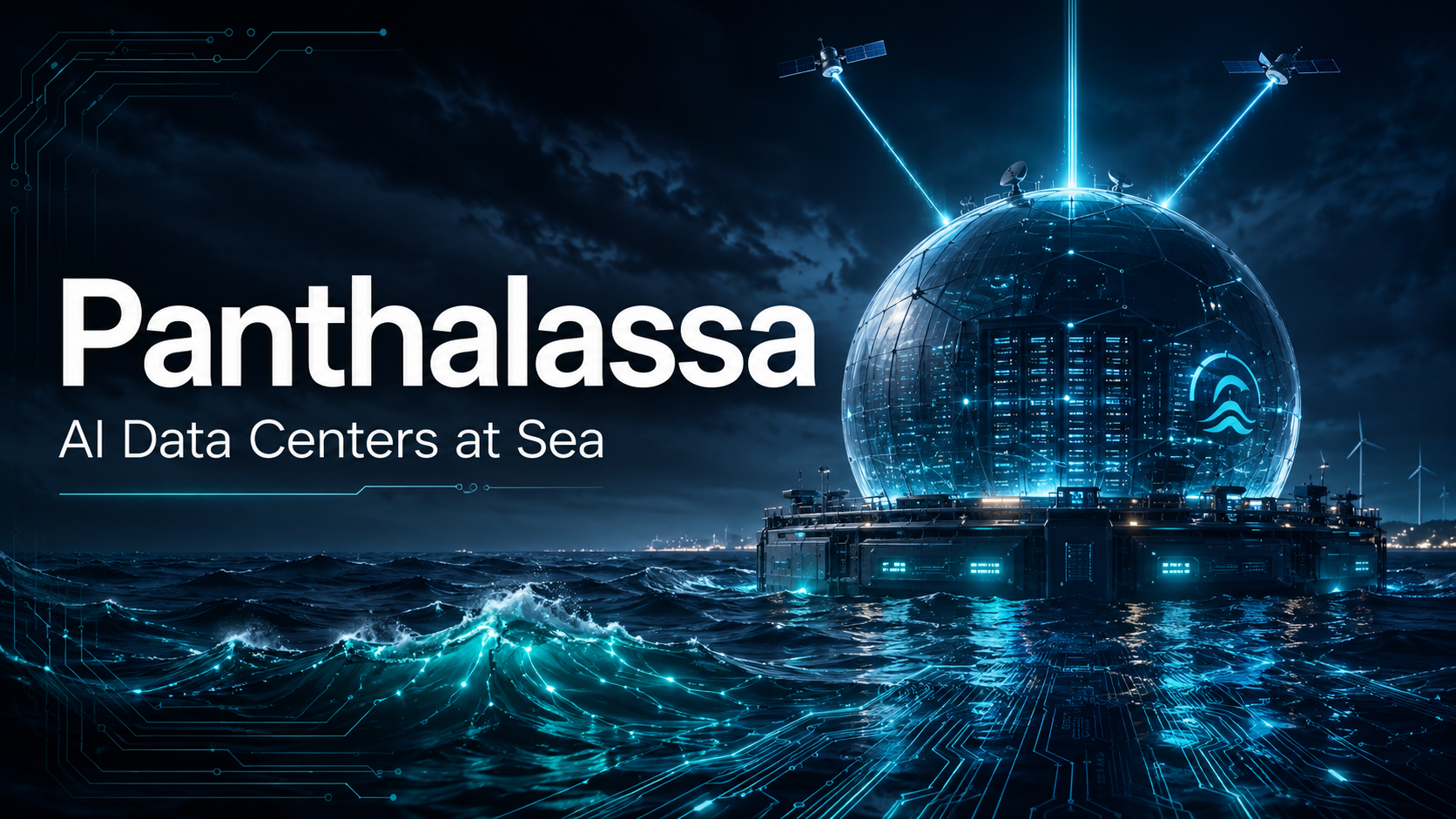
Panthalassa is a renewable energy and ocean technology company building self-propelled, autonomous floating compute nodes that capture wave energy and use it to run AI workloads onboard. Data is transmitted back to shore via low-Earth-orbit (LEO) satellites.
Think of it as a floating AI factory that doesn’t need a power grid, doesn’t need a cooling tower, and doesn’t need a building permit. Each node is roughly 85 meters in diameter — about the length of a Boeing 747 — and is mass-produced from plate steel in coastal factories.
The company was founded in Portland, Oregon and currently has 120 employees. With this new funding, Panthalassa plans to finish building its pilot manufacturing facility near Portland and deploy its first Ocean-3 pilot node in the northern Pacific Ocean in 2026.
How Do Floating AI Data Centers Work?
Each Panthalassa node has a distinctive “lollipop” shape — a buoyant spherical head connected to a long, submerged vertical tube and structural frame. Here’s how the system works:
- Wave Energy Capture: The node harnesses ocean waves to generate electricity by forcing water through an internal turbine. No solar panels, no wind turbines, no connection to any grid.
- Onboard AI Compute: Instead of transmitting energy to shore (which loses efficiency over distance), Panthalassa uses the power directly onboard to run AI inference chips. The nodes process already-trained AI models and send results back as inference tokens.
- Ocean Water Cooling: The surrounding cold ocean water provides natural cooling for the computing hardware — eliminating the massive cooling infrastructure that terrestrial data centers require.
- Satellite Data Transfer: Processed data is transmitted to land via LEO satellite networks, making the nodes completely untethered from shore infrastructure.
The elegance of this approach is that it solves three problems simultaneously: power generation, cooling, and land scarcity — the three biggest bottlenecks in AI infrastructure scaling.
Who’s Funding Panthalassa?
The $140 million Series B round assembled an absurdly impressive investor lineup:
- Peter Thiel — Lead investor, co-founder of PayPal and Palantir
- John Doerr — Legendary VC, chairman of Kleiner Perkins
- Marc Benioff — Salesforce CEO, via TIME Ventures
- Max Levchin — PayPal co-founder, via SciFi Ventures
- Dylan Field — Figma CEO
- Super Micro Computer — Major AI server manufacturer
- Hanwha Group — South Korean industrial conglomerate
- Fortescue Ventures — Mining giant’s investment arm
When Peter Thiel, John Doerr, and Marc Benioff all write checks for the same startup, it’s worth paying attention. These aren’t people who invest in gimmicks.
Why the AI Industry Desperately Needs This
The AI industry has a massive power problem. Training and running large language models requires enormous amounts of electricity, and data center demand is growing faster than the power grid can handle.
Consider these numbers:
- A single NVIDIA H100 GPU consumes up to 700 watts
- A typical AI training cluster uses tens of megawatts
- The global data center industry is projected to consume 8% of all electricity by 2030
- Major tech companies are literally building their own power plants to feed AI demand
Land-based solutions are hitting walls. Utility companies can’t approve new grid connections fast enough. Data center developers are waiting years for power allocations. Some regions are placing moratoriums on new data center construction entirely.
Panthalassa’s ocean nodes bypass all of this. No grid connection needed. No land permits. No cooling water permits. No NIMBY opposition. Just deploy the node in international waters and start computing.
Panthalassa vs Traditional Data Centers
| Feature | Panthalassa Ocean Node | Traditional Data Center |
|---|---|---|
| Power Source | Wave energy (renewable) | Grid power (often fossil fuels) |
| Cooling | Ocean water (free) | Chillers + cooling towers ($$$) |
| Land Required | None | Massive land footprint |
| Grid Connection | None needed | Multi-year approval process |
| Deployment Time | Manufactured and deployed | 3-5 years construction |
| Environmental Impact | Zero carbon emissions | Significant carbon footprint |
| Scalability | Deploy more nodes | Limited by land and power |
| Best For | AI inference workloads | All workloads |
What Are the Risks?
Of course, building data centers in the middle of the ocean comes with serious challenges:
- Harsh Ocean Conditions: Storms, saltwater corrosion, and extreme weather could damage or destroy nodes. Marine engineering at this scale is incredibly difficult.
- Maintenance Access: When something breaks 200 miles offshore, you can’t just send a technician. Maintenance logistics could be a nightmare.
- Satellite Latency: While LEO satellites offer much lower latency than traditional satellites, they still add milliseconds compared to fiber connections. This limits Panthalassa to inference workloads rather than latency-sensitive applications.
- Regulatory Uncertainty: Operating computing infrastructure in international waters raises complex jurisdictional questions. Which country’s laws apply? Who regulates data processing in the ocean?
- Environmental Concerns: Despite being “green,” deploying hundreds of large floating structures could affect marine ecosystems, shipping lanes, and ocean habitats.
When Will Panthalassa Deploy?
The timeline is aggressive but concrete:
- 2026: Complete pilot manufacturing facility near Portland, deploy Ocean-3 pilot node in the northern Pacific
- 2027: Begin commercial deployments with paying customers
- Long-term: Scale to fleets of hundreds of nodes across multiple ocean regions
The 2026 pilot deployment will be the critical proof point. If Panthalassa can demonstrate reliable AI inference from an ocean-based node, it could fundamentally change how the industry thinks about compute infrastructure.
The Future of Floating AI Data Centers
The market for floating AI data centers is still nascent, but the demand signals are unmistakable. Global data center capacity needs to triple by 2030 to meet AI compute demand, and land-based facilities are running into power constraints, water scarcity issues, and community opposition.
Floating AI data centers solve several of these problems simultaneously. They have access to unlimited cooling water, can be positioned near undersea cable landing points for low-latency connectivity, and don’t compete with residential communities for land and power. The economics of floating AI data centers improve as the cost of marine engineering decreases and the premium for power-constrained compute increases.
If Panthalassa can prove that floating AI data centers work at commercial scale, they could unlock a new frontier in compute infrastructure — one that covers 70% of the Earth’s surface that we currently ignore.
The AI infrastructure race is heating up everywhere. See how IREN acquired Mirantis for $625M to build AI cloud platforms, how Foxconn AI servers surpassed iPhones in revenue, and the Pentagon’s massive AI deals.
Panthalassa floating data centers sound like something out of a sci-fi novel, but the underlying logic is sound. The AI industry is desperate for power and cooling. The ocean has virtually unlimited supplies of both. The question is whether the engineering can deliver on the vision.
With $140 million from some of the smartest investors in tech, 120 engineers working on the problem, and a pilot deployment planned for later this year, we’ll know soon enough. If it works, Panthalassa won’t just be a data center company — it’ll be the beginning of a new era where AI infrastructure moves off land and into the sea.
The ocean covers 71% of Earth’s surface. Maybe it’s time we used it for more than shipping containers and cruise ships.