America Is Selling Nvidia H200 Chips to China With a 25% Cut — The Most Controversial Tech Deal of 2026
Table of Contents
Table of Contents
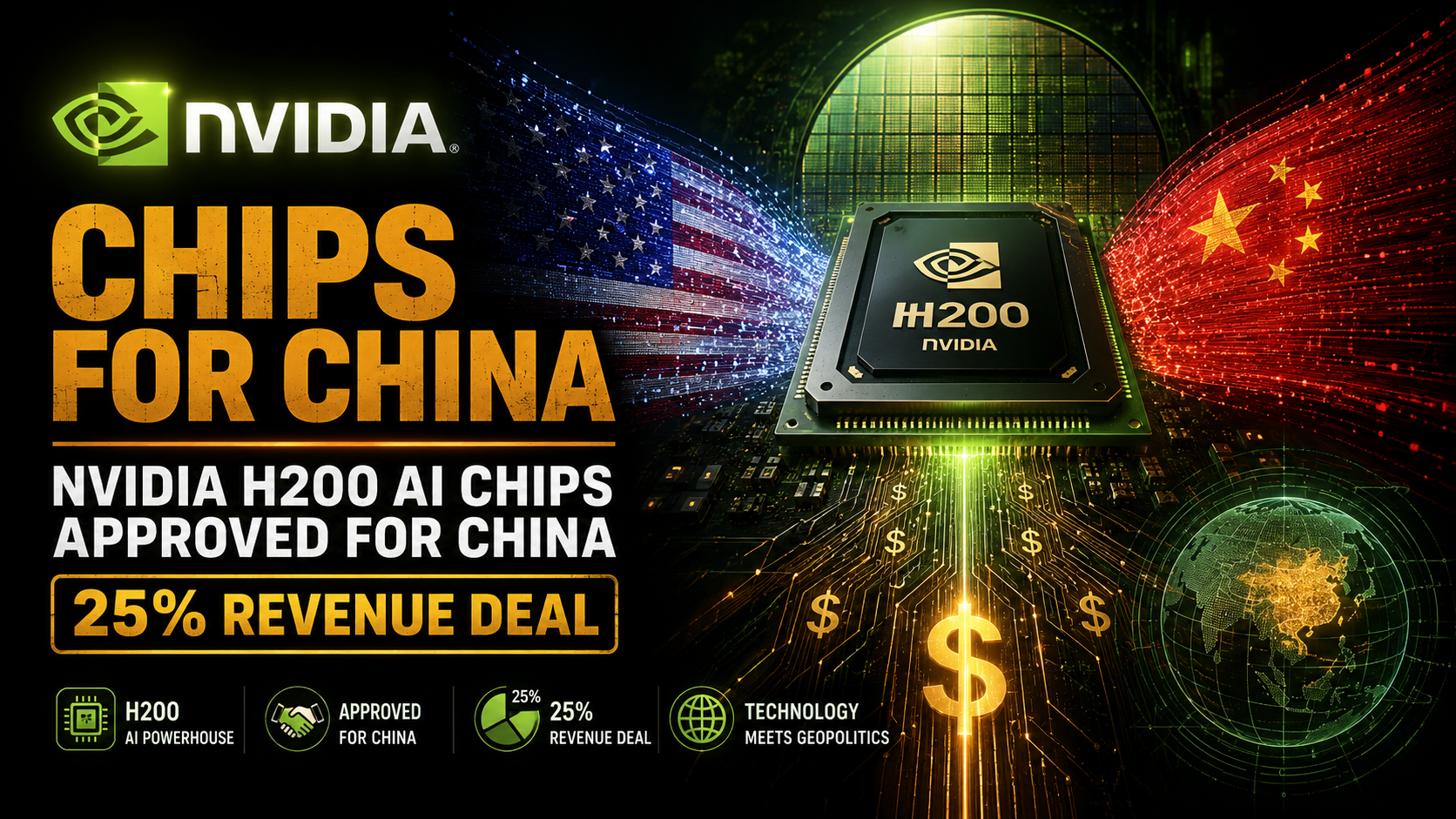
After years of escalating semiconductor export restrictions, the United States is now selling Nvidia H200 AI chips to China’s largest tech companies — and taking a cut. The Trump administration approved the sale of Nvidia H200 processors to approximately ten major Chinese technology companies, including Alibaba, Tencent, ByteDance, and JD.com, through a controlled licensing framework that demands a 25% revenue surcharge on each chip sold. It’s a deal that manages to simultaneously anger national security hawks, frustrate Nvidia investors, and leave Chinese companies uncertain about whether the chips will actually arrive. Welcome to AI chip geopolitics in 2026.
The policy shift began taking shape in January 2026, when the US Department of Commerce revised its semiconductor license review policy to allow case-by-case licensing for H200 and similar processors. CNBC reported on May 14, 2026 that despite the licensing approvals, Nvidia has yet to generate revenue from H200 sales to China — because it remains unclear whether Chinese customs will actually allow the chips to be imported. The approvals exist; the revenue doesn’t. Not yet.
What Actually Happened: The H200 China Approval Story
The story of Nvidia H200 chips in China is a study in bureaucratic complexity. When the Biden administration implemented sweeping AI chip export controls in 2022 and 2023, Nvidia was barred from selling its most powerful AI accelerators to China. The company responded by creating China-specific chips — the A800 and H800 — that were technically compliant with export controls. When those chips were also banned, Nvidia created the H20, an even lower-performance variant specifically for the Chinese market.
The Trump administration’s approach in 2026 is fundamentally different: rather than banning advanced chips, it’s creating a controlled sales channel with financial conditions. The H200 — which is significantly more powerful than the H20 — can now be sold to approved Chinese companies, but only within strict parameters. Each approved customer can purchase up to 75,000 H200 units. The US government receives a 25% surcharge on the revenue. And the chips must meet specific security requirements related to deployment and access controls.
This approach reflects a different strategic calculation: rather than preventing China from obtaining AI compute entirely — which increasingly appears impossible given domestic Chinese chip development — the US is attempting to control and monitor the channel through which China accesses advanced AI hardware, while generating revenue and maintaining some visibility into deployment.
The 25% Surcharge Deal: Who Gets the Money?
The 25% revenue surcharge is the most controversial element of the deal. President Trump announced this mechanism in December 2025, framing it as the US government receiving compensation for allowing the technology transfer. In practical terms, it means Nvidia sells H200 chips to approved Chinese customers, and 25 cents of every dollar goes to the US Treasury.
The financial implications are significant. The H200 SXM5 — the high-performance server variant — retails for approximately $30,000-$40,000 per unit. At 75,000 chips per approved customer, and ten approved customers, the theoretical maximum transaction value runs into the tens of billions of dollars. A 25% surcharge on that volume would represent billions in US government revenue. Critics note that this makes the US government financially incentivized to approve chip sales — a conflict of interest that undermines the security rationale for export controls in the first place.
National security researchers and some lawmakers have raised significant concerns about this approach. The argument is straightforward: the H200’s AI capabilities are the reason export controls existed. The chip can train and run the kind of large-scale AI models that have both commercial and military applications. Adding a financial mechanism doesn’t change the underlying technology transfer — it just makes the US government a beneficiary of it.
This tension — between economic benefits and national security concerns — is central to every major tech policy debate of 2026. As we reported on earlier this year, the Pentagon’s AI procurement decisions have similarly had to navigate these competing pressures.
Which Chinese Companies Got H200 Approval
The approximately ten Chinese companies approved for H200 purchases reportedly include some of China’s largest and most strategically significant technology companies:
- Alibaba Cloud — China’s largest cloud provider and a major AI infrastructure investor
- Tencent Cloud — the cloud arm of the WeChat/gaming giant with significant AI research operations
- ByteDance — TikTok’s parent company, which has been investing heavily in AI model development
- JD.com — e-commerce and logistics giant with growing AI operations
- Additional companies whose identities have not been publicly confirmed
Notably absent from reports about approvals: Huawei, which remains under comprehensive sanctions, and any company with direct ties to the People’s Liberation Army. The approved companies are primarily commercial technology enterprises, though critics note that the boundaries between Chinese commercial technology and state/military applications are far from clear.
Nvidia’s Problem: Approvals Without Actual Revenue
Here’s the irony of the situation: despite having US government approval to sell H200 chips to China, Nvidia hasn’t made money from it yet. CNBC reported on May 14, 2026 that Nvidia’s CFO confirmed the company has yet to generate any revenue from H200 sales in China. The reason? It’s not clear whether Chinese customs authorities will actually allow the approved chips to enter China.
China’s government hasn’t publicly endorsed or rejected the framework. Chinese state media has been largely silent on the approvals. And Chinese companies — despite the approvals — haven’t publicly confirmed orders. This creates a bizarre situation where the US has approved technology exports that may not actually be exported, to customers who may not actually buy them, for strategic reasons that neither side wants to fully articulate.
For Nvidia investors, this uncertainty is frustrating but not devastating. The company’s AI data center business remains enormous — driven by demand from US hyperscalers including Google, Microsoft, Amazon, and Meta. As we covered in our big tech financial analysis, AI infrastructure spending continues to accelerate regardless of the China situation. But China represents a potential $10-15 billion annual market that Nvidia is currently leaving on the table, and the H200 approval framework is the administration’s attempt to capture at least some of that opportunity.
The Geopolitical Stakes of Selling AI Chips to China
The H200 approval decision cannot be separated from the broader US-China technology competition. China has been investing massively in domestic semiconductor development — SMIC, Huawei’s HiSilicon, and dozens of smaller chipmakers are all racing to produce competitive AI accelerators without US technology. How successful those efforts have been is genuinely disputed, with estimates ranging from “they’re 5 years behind” to “they’re closer than we think.”
The Trump administration’s bet appears to be that controlled H200 sales are preferable to a scenario where China develops fully independent AI chip capabilities. If Chinese AI companies become dependent on approved US-sourced H200 chips, the US retains a chokepoint. If export controls push China to fully self-sufficient domestic production, that chokepoint disappears entirely and the only thing that changed is that Nvidia lost billions in revenue.
It’s a strategic gamble with enormous consequences. The same H200 chips that power commercial AI applications — recommendation algorithms, language models, video generation — can also accelerate research into AI systems with military applications. Where exactly the line falls is a question that export control lawyers, national security officials, and AI researchers are actively debating with no clear consensus.
What This Means for the Global AI Arms Race in 2026
The H200 China deal signals that the US government has effectively accepted that pure export control strategies cannot prevent China from accessing capable AI hardware indefinitely. The question has shifted from “can we stop them” to “can we control and monetize the access while maintaining strategic visibility.”
For the global AI industry, this creates some clarity after years of uncertainty. Nvidia can plan around a framework for China sales. Chinese cloud providers can plan around accessing advanced hardware through official channels. And both governments have a financial stake in the arrangement continuing — which actually makes it more stable than either a pure ban (which creates pressure to circumvent) or unrestricted sales (which creates political pressure to restrict).
The 25% surcharge mechanism, whatever its strategic merits, establishes a precedent: technology transfers can be allowed with financial conditions attached. Expect this model to be applied to other sensitive technology categories as the US-China tech competition continues to evolve.
For now, watch whether Chinese companies actually place orders and whether the chips actually ship. That practical outcome will tell us more about the deal’s real significance than any policy announcement. The approvals exist — but in AI chip geopolitics, paperwork and reality are often very different things.
Sources: CNBC | Built In | Alpha Spread | Defense News | Nextgov