Aflac Breach Exposes 22.7 Million: SSNs, Health Records, Everything Gone
Table of Contents
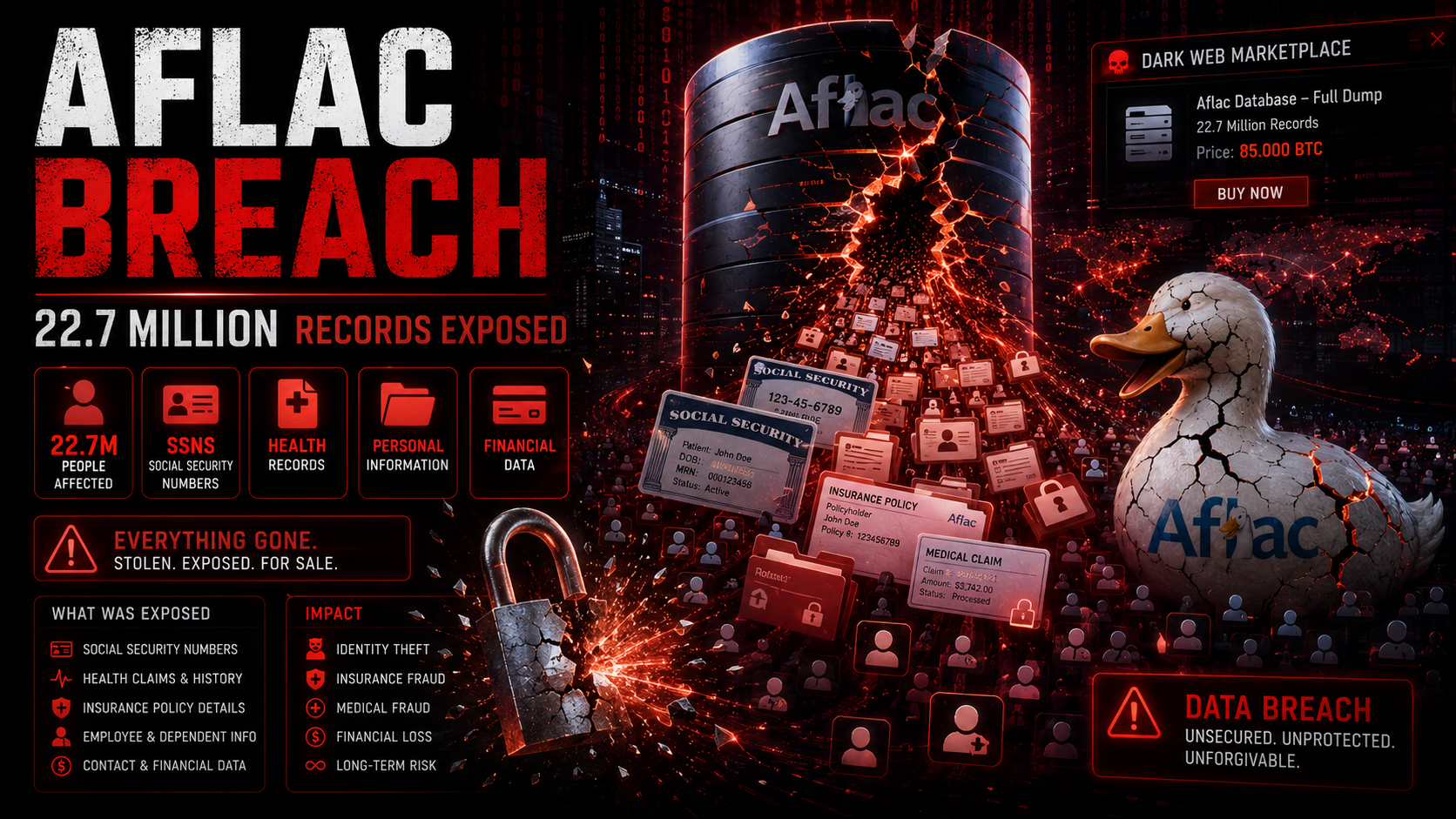
The Aflac data breach just exposed 22.65 million people. That’s not a typo — twenty-two million, six hundred fifty thousand customers, employees, and agents had their Social Security numbers, health claim records, and personal contact details stolen in a social engineering attack that Aflac claims it “stopped within hours.” Here’s the problem: 22.7 million records were already out the door by the time they pulled the plug.
Aflac is calling this a contained incident. We’re calling it one of the largest health insurance data breaches in American history. When your company stores the most sensitive data imaginable — medical claims, SSNs, health records — and attackers walk away with nearly 23 million records, “we stopped it quickly” is not the reassuring statement you think it is. Let’s break down what happened, what was stolen, and what you need to do if you’re affected.
Aflac Data Breach: 22.7 Million Records Gone
Aflac, America’s largest supplemental insurance provider, disclosed that a breach detected in June 2026 resulted in the theft of personal information belonging to 22.65 million individuals. The affected population includes Aflac policyholders (customers), current and former employees, and independent agents who sell Aflac products.
To put 22.65 million in perspective: Aflac reported approximately 50 million policyholders globally as of its last annual filing. This Aflac data breach potentially affects nearly half of their entire customer base, plus their workforce and agent network. It’s a staggering number that places this incident among the top 10 largest data breaches in U.S. healthcare history, alongside the Anthem breach (78.8M, 2015), Optum/Change Healthcare breach (100M, 2024), and Premera Blue Cross (11M, 2015).
The investigation, which Aflac says concluded on December 4, 2026, determined that the intrusion was a targeted social engineering attack. Notification letters began going out to affected individuals in early 2026, roughly six months after the initial incident — a timeline that’s become unfortunately standard in the industry but no less frustrating for the millions of people whose data was exposed during that gap.
What Data Was Stolen in the Aflac Breach
Here’s what makes the Aflac data breach especially dangerous — it’s not just emails and passwords. The stolen data includes:
- Social Security Numbers (SSNs) — The master key to identity theft
- Health insurance claim details — Including types of claims filed, diagnosis codes, and coverage information
- Personal contact information — Full names, addresses, phone numbers, email addresses
- Dates of birth
- Policy and account numbers
- Employment information (for employees and agents)
This combination is an identity thief’s dream haul. SSNs alone enable credit fraud, tax fraud, and account takeovers. But health claim data adds another dimension: medical identity theft. Criminals can use stolen health insurance information to file fraudulent claims, obtain prescription drugs, or receive medical treatment under someone else’s identity. Victims may not discover the fraud until they receive unexpected medical bills or find incorrect diagnoses on their health records — which can affect everything from future insurance coverage to employment.
The presence of health claim data also raises HIPAA implications. As a covered entity under the Health Insurance Portability and Accountability Act, Aflac is subject to specific breach notification requirements and potential penalties from the Department of Health and Human Services Office for Civil Rights (OCR). Given the scale, regulatory investigations are all but certain.
Aflac Data Breach Timeline: Stopped Within Hours
Aflac’s official statement emphasizes that the intrusion was “detected and stopped within hours.” Let’s examine that claim critically.
The breach was detected in June 2026 when security monitoring tools flagged unusual data access patterns. Aflac’s security team identified the unauthorized access and terminated the connection. According to Aflac, the total duration of the intrusion from initial access to containment was measured in hours, not days or weeks.
On one hand, “hours” is genuinely fast for breach detection. The industry average dwell time (time between initial compromise and detection) is 16 days according to Mandiant’s latest M-Trends report. IBM’s Cost of a Data Breach Report 2025 puts it even higher at 204 days. By those benchmarks, Aflac’s detection was exceptional.
On the other hand: 22.65 million records were exfiltrated in those “hours.” That means either the attackers had automated, high-throughput data extraction tools running from the moment they gained access, or “hours” is underselling the actual timeline. Either way, the speed of exfiltration reveals a terrifying reality about modern data breaches — when attackers target centralized databases containing millions of records, they don’t need days. They need minutes.
This pattern of rapid mass exfiltration is becoming the norm. As we reported in our analysis of AI-assisted attacks rising in 2026, modern threat actors increasingly use automated tools that can identify, compress, and exfiltrate target data at wire speed. By the time any human sees an alert, the data is already gone.
Social Engineering: How the Aflac Breach Started
The initial attack vector was social engineering — specifically, a targeted operation against Aflac personnel with access to internal systems. While Aflac hasn’t disclosed the exact technique used, social engineering in the context of enterprise breaches typically involves:
- Spear phishing: Highly personalized emails that trick specific employees into revealing credentials or installing malware
- Vishing (voice phishing): Phone calls impersonating IT support, executives, or business partners to extract passwords or MFA codes
- MFA fatigue attacks: Bombarding an employee’s phone with authentication prompts until they approve one
- SIM swapping: Taking over an employee’s phone number to intercept SMS-based multi-factor authentication codes
The social engineering angle is notable because it means Aflac’s technical defenses — firewalls, intrusion detection, encryption — weren’t bypassed through a software vulnerability. A human was manipulated into providing access. You can have the best security technology in the world, and a single phone call to the right employee can render it all meaningless.
This is the same fundamental challenge facing every organization. The Big Tech layoffs of 2026 have actually made this problem worse — fewer security staff means less training, slower response times, and more overworked employees who are likely to make mistakes when confronted with a sophisticated social engineering attack.
Aflac Data Breach Response: 2 Years of Identity Protection
Aflac is offering affected individuals two years of complimentary identity protection and credit monitoring services. A dedicated call center has been established at 1-855-361-0305 for breach-related inquiries. Notification letters include instructions for enrolling in the identity protection program.
Two years of identity monitoring has become the standard corporate response to data breaches. It’s also widely criticized as inadequate. Here’s why: stolen SSNs don’t expire. Your Social Security number is the same today as it will be in 5, 10, or 20 years. Two years of monitoring means Aflac is protecting you for a limited window against a permanent exposure. After those two years, you’re on your own with a compromised SSN.
The real cost of this breach will be borne by the 22.65 million affected individuals who now need to remain vigilant indefinitely. Credit freezes, fraud alerts, tax identity protection PINs from the IRS, health insurance statement monitoring — these are lifetime commitments resulting from a single company’s failure to prevent a social engineering attack.
Class action lawsuits are almost certainly coming. Breaches of this scale involving healthcare data and SSNs consistently result in major litigation. The Anthem breach settlement ultimately paid $115 million. The Equifax breach settlement reached $700 million. Given the sensitive nature of the data involved, the Aflac data breach could result in settlements in the hundreds of millions.
Why 22 Million Records in Hours Is Terrifying
The math doesn’t lie. If Aflac’s “stopped within hours” claim is accurate and we generously assume the intrusion lasted 6 hours, that means approximately 3.77 million records were exfiltrated per hour. That’s 62,900 records per minute, or about 1,050 records per second.
This rate is technically plausible — structured database records with SSNs, names, and policy data would be relatively compact, perhaps 1-2 KB per record. At that size, 22.65 million records total roughly 22-45 GB. On a modern network connection, that can be transmitted in under an hour. The attackers likely compressed the data and streamed it to cloud storage or an offshore server.
The implication is disturbing: current data loss prevention (DLP) tools may not be fast enough to catch bulk exfiltration in real-time when attackers use efficient extraction methods. Traditional DLP looks for known patterns — credit card numbers in emails, SSNs in file uploads. But when an attacker with legitimate credentials queries a database and streams the results through an encrypted tunnel, many DLP tools see nothing unusual until the volume triggers an alert.
This connects to a broader trend in cybersecurity. The cPanel zero-day that compromised 44,000 servers demonstrated how quickly attackers can scale their operations. When you combine automated exploitation tools with the speed of modern networks, traditional detection and response timelines are simply too slow.
Health Insurance Breaches: The Data Goldmine
Health insurance companies are disproportionately targeted because they hold the most valuable data in existence. On underground markets, stolen health records sell for $250-$1,000 per record — 10 to 40 times the price of stolen credit card numbers ($5-$25 each). Why? Because health data enables a wider variety of fraud and is much harder to change or cancel than a credit card.
Consider what an attacker can do with a complete health insurance record: file fraudulent insurance claims for expensive procedures, obtain prescription medications (including controlled substances), create fake identities backed by real SSNs and health histories, and commit tax fraud using SSNs and personal details. A stolen credit card gets canceled within days. A stolen SSN and health record remain exploitable for years.
The Aflac data breach joins a growing list of healthcare mega-breaches that have collectively exposed hundreds of millions of Americans. At this point, if you’ve had health insurance in the United States at any time in the past decade, your data has almost certainly been compromised in at least one breach. That’s not cynicism — it’s statistics.
The industry needs fundamental change. Centralized databases holding millions of unencrypted or poorly-segmented records are ticking time bombs. Tokenization, data minimization, zero-trust architectures, and — controversially — mandatory cyber insurance requirements could help, but they require investment that many companies resist until after they’ve been breached. As we’ve seen with the $629 million in crypto hacks in April 2026, the financial incentives for attackers far outweigh the current costs of inadequate security.
Aflac Data Breach: What Affected Users Should Do
If you’re among the 22.65 million affected by the Aflac data breach, here are immediate steps to protect yourself:
- Enroll in the free identity protection. Call 1-855-361-0305 or follow the instructions in your notification letter. It’s free — use it, even if it’s only two years.
- Freeze your credit. Contact all three credit bureaus (Equifax, Experian, TransUnion) and place a security freeze. This is the single most effective action against identity theft. It’s free and prevents anyone from opening new accounts in your name.
- Request an IRS Identity Protection PIN. Go to irs.gov/ippin to get a unique PIN that prevents someone from filing a fraudulent tax return using your SSN.
- Monitor your health insurance statements. Review every Explanation of Benefits (EOB) for services you didn’t receive. Medical identity theft can go undetected for months.
- Set up fraud alerts. Place an initial fraud alert with any one credit bureau — they’re required to notify the other two.
- Document everything. Save your Aflac notification letter and all communications. If you experience identity theft, this documentation supports insurance claims and legal actions.
The Aflac data breach is a catastrophic failure of data stewardship. Storing 22.65 million records in a way that allows complete exfiltration in hours suggests inadequate data segmentation, insufficient rate limiting on bulk queries, and over-reliance on perimeter security. “We stopped it quickly” means nothing when the damage was done before anyone noticed. For 22.7 million Americans, the consequences of this breach will last far longer than Aflac’s two-year monitoring offer.