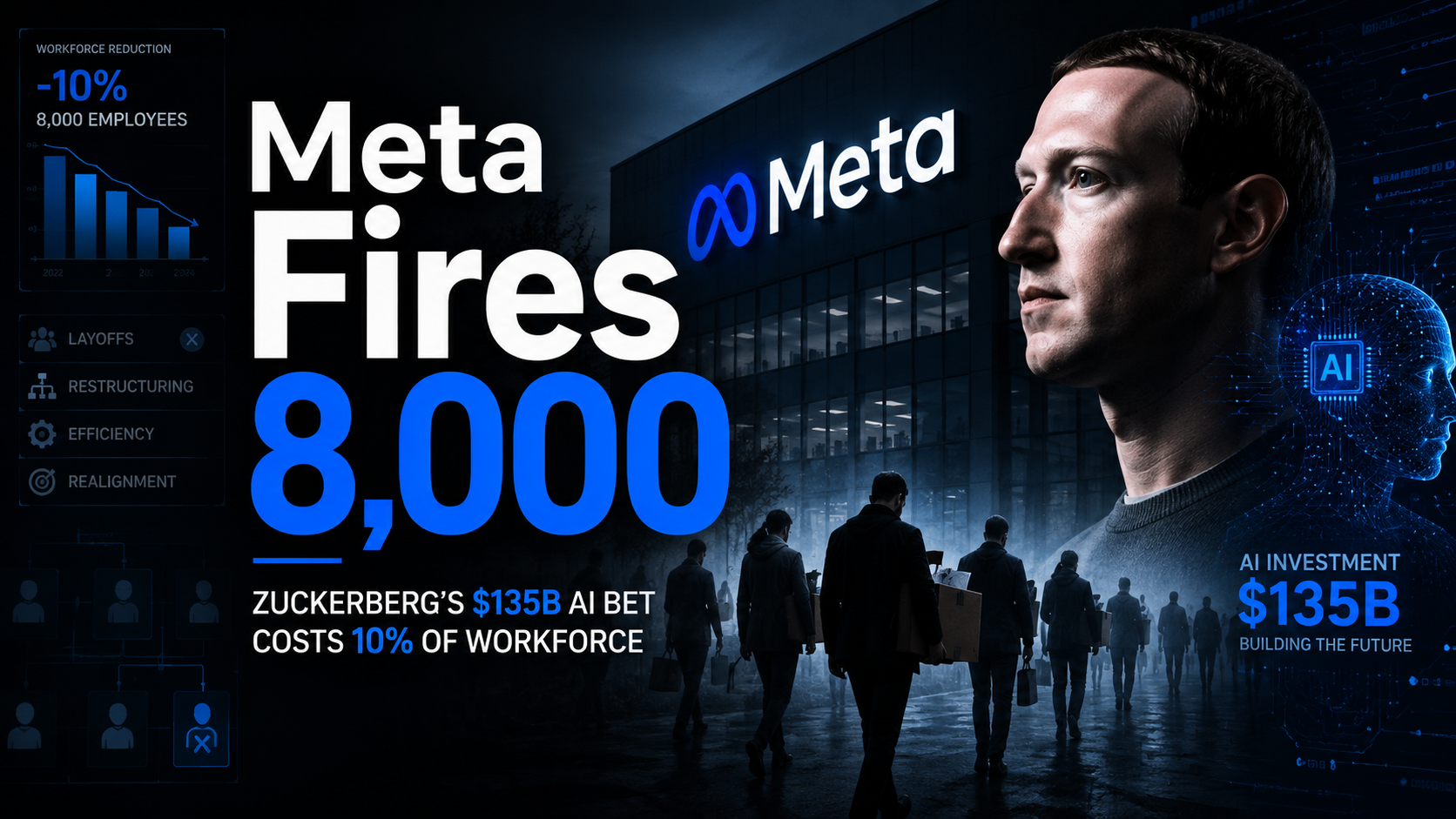
Meta Fires 8,000 Employees TODAY: Zuckerberg’s $135B AI Bet Costs 10% of Workforce
Table of Contents
Table of Contents
Today is the day. May 20, 2026 — the date Meta employees marked in red on their calendars since April. This morning, Meta officially began firing approximately 8,000 employees, roughly 10% of its entire global workforce of 78,865 people. Another 6,000 open job requisitions have been cancelled, bringing the total effective headcount reduction to 14,000 positions. This is one of the largest single-day layoff events in tech history — and the reason behind it is as blunt as a sledgehammer: AI.
Mark Zuckerberg isn’t apologizing. He’s doubling down.
What’s Happening Today: The Scale of the Cuts
The May 20 round of layoffs targets employees across Reality Labs, the Facebook social division, recruiting, sales, and global operations. Every major business unit is affected. Teams are being reconstituted from the ground up into AI-focused “pods” under Meta’s newly formed Superintelligence Labs division, led by new Chief AI Officer Alexandr Wang.
Wang — who co-founded Scale AI before joining Meta — is now the architect of Meta’s entire AI strategy. Under his direction, the company is restructuring away from traditional product teams and toward vertically integrated AI squads that each own a full AI stack: data, training, inference, and product.
This isn’t just a headcount reduction. It’s a complete organizational identity change. Meta is no longer a social media company that uses AI. It’s becoming an AI company that happens to run social media.
Why $135 Billion in AI Is Forcing 8,000 Layoffs
The math is brutal. Meta raised its 2026 capital expenditure forecast to $125–$145 billion — roughly double the $72.2 billion it spent last year, and more than its combined capex for 2024 and 2025. That kind of spending requires an equally dramatic reduction in operating costs.
The components of that spending include:
- Over 1 gigawatt of custom AI chips developed with Broadcom
- Significant AMD chip deployments alongside existing Nvidia systems
- New data center builds across multiple continents
- Acquisition costs for AI talent and startups
Zuckerberg’s rationale: “AI advances are forcing the company to rethink optimal headcount.” In plain language: AI can do much of what humans currently do, and the humans who remain need to be AI builders, not AI users.
Meta also halted share buybacks in Q2 2026 as a result of the capex surge pressuring free cash flow — a notable sacrifice given that buybacks had been a key tool for rewarding shareholders during Meta’s “Year of Efficiency” comeback in 2023–2024. This is Big Tech’s most aggressive AI bet yet, dwarfing even the infrastructure spending we analyzed in our Big Tech layoffs report.
Who Got Cut — and Who Survived
The departments hit hardest are:
- Reality Labs — Meta’s VR/AR division continues to bleed. Despite billions invested, Quest headsets haven’t achieved mainstream adoption. Cuts here are deep.
- Recruiting — Ironic but predictable. You don’t need a large recruiting team when you’re cutting 14,000 positions.
- Sales and Global Operations — Roles that can be handled by AI tools are being eliminated.
- Facebook Social — The legacy social team is being thinned as Zuckerberg focuses resources on AI-native experiences.
Survivors are largely engineers, AI researchers, infrastructure specialists, and product managers who can work within the new pod-based AI structure. Meta is specifically retaining talent focused on Llama model development, AI infrastructure, and agentic AI systems.
What Departing Employees Get
Meta is offering affected employees:
- 16 weeks of base pay as severance
- An additional 2 weeks per year of service beyond 1 year
- Healthcare coverage continuation through September 2026
- Accelerated vesting for upcoming RSU tranches
- Outplacement services and career support
The package is better than most layoffs in the current climate, but that’s cold comfort when you’re one of 8,000 people losing their job to fund AI infrastructure.
More Layoffs Planned: August and Fall 2026
This is not the end. Meta has already telegraphed additional cuts: a potential round in August 2026 and another in the autumn. When you add today’s 8,000 to Meta’s prior rounds since 2022, the company will have eliminated roughly 25,000 positions total — while simultaneously growing more profitable than ever.
Meta posted $56 billion in quarterly revenue in Q1 2026 — record profits. The layoffs aren’t happening because Meta is in trouble. They’re happening because Meta is making a generational bet that AI can generate more value than the humans it’s replacing. Whether that bet pays off, and what it means for the tech job market broadly, remains to be seen.
This pattern of record profits alongside mass layoffs is exactly the contradiction we highlighted in our analysis of Big Tech’s efficiency drive — and it’s only accelerating.
Industry Reaction: Fear, Anger, and Inevitability
Tech workers across the industry are watching closely. Meta’s move sends a signal that even the most profitable companies in human history will ruthlessly cut headcount to fund AI infrastructure. LinkedIn is flooded today with Meta employees announcing their status as “open to work.”
Critics argue that the cuts are premature — that AI productivity gains haven’t been proven at the scale needed to justify eliminating 14,000 positions. Supporters counter that Zuckerberg is simply being honest about the transition that every major tech company will eventually be forced to make.
One thing is certain: with AI reshaping the cybersecurity landscape and AI chip companies going public at billion-dollar valuations, the AI displacement of knowledge workers is no longer a future concern. It’s happening today — 8,000 pink slips at a time.
Bottom Line: The AI Restructuring Era Has Begun
Meta’s May 20 layoffs are a watershed moment. This isn’t a struggling company cutting costs to survive — it’s one of the most profitable companies in the world deliberately choosing AI over people. The message to the rest of the tech industry is unmistakable: adapt your workforce for the AI era, or get outcompeted by those who do.
If you work in tech and your job doesn’t involve building, deploying, or maintaining AI systems, today should be a wake-up call. The restructuring era has officially begun.