Microsoft Majorana 2: Quantum Chip 1,000x More Reliable Changes Everything
Table of Contents
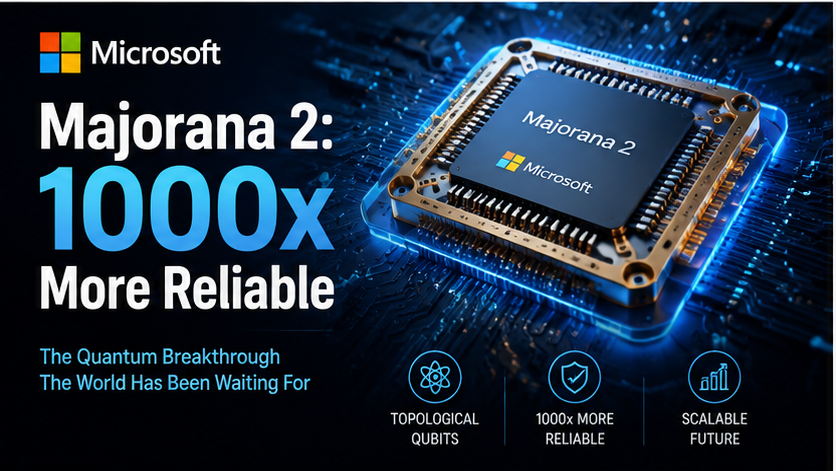
Microsoft just dropped a quantum computing bombshell. At Build 2026, the company unveiled Majorana 2 — a second-generation topological quantum chip that is 1,000 times more reliable than its predecessor. Microsoft now says a commercially viable quantum computer could arrive by 2029, cutting its original timeline in half.
Here is what Majorana 2 actually achieves, why AI helped build it, and what it means for encryption, Bitcoin, and the future of computing.
What Is Majorana 2?
Majorana 2 is Microsoft’s second-generation quantum processor based on topological qubits. Unlike the superconducting qubits used by Google (Willow) and IBM (Heron), topological qubits use exotic quantum states that are inherently more resistant to errors — the fundamental problem that has kept quantum computers from being useful.
The original Majorana 1 chip, unveiled in February 2025, demonstrated that topological qubits were physically possible. Majorana 2 proves they can be practical. The chip uses a lead-based topological superconductor replacing the aluminum-based design in Majorana 1, which better protects qubits from environmental interference.
Microsoft announced Majorana 2 at Build 2026 in San Francisco on June 2, positioning it alongside their MAI model family and the 11,000-model Foundry catalog as pillars of Azure’s future computing platform.
1,000x Reliability Improvement Explained
The headline number — 1,000x more reliable — refers to qubit coherence and error rates. Specifically, Majorana 2 achieves:
- Mean qubit lifetime of 20 seconds — up from milliseconds in the first generation
- Peak qubit lifetimes exceeding one minute in some instances
- 1,000-fold improvement in error rates compared to Majorana 1
To put this in context: Google’s Willow chip achieves qubit lifetimes in the microsecond to millisecond range. IBM’s best qubits last tens of milliseconds. A 20-second average lifetime is orders of magnitude beyond what any competitor has demonstrated publicly. If these numbers hold up under independent verification, Majorana 2 represents the single biggest leap in qubit quality ever achieved.
The caveat is that Microsoft has not yet published peer-reviewed papers on Majorana 2’s full performance characteristics. Majorana 1’s claims were controversial in the physics community, with some researchers questioning whether Microsoft had truly demonstrated topological protection. Majorana 2’s more dramatic claims will face even more scrutiny.
AI Helped Build This Quantum Chip
In a fascinating twist, Microsoft used AI to help design Majorana 2. The company’s Microsoft Discovery platform — an AI-driven scientific research environment — employed agent-based systems to analyze decades of accumulated quantum physics research, identify promising material combinations, and simulate potential chip designs before fabrication.
This is one of the first confirmed cases of AI agents contributing directly to a breakthrough in fundamental physics hardware. The lead-based topological superconductor material stack that gives Majorana 2 its reliability improvement was identified through AI-assisted materials science research — a process that would have taken years using traditional methods.
The meta-implication: AI is now accelerating the development of quantum computing, which will in turn accelerate AI. This feedback loop between AI and quantum hardware could compress decades of progress into years.
The 2029 Commercial Quantum Timeline
Microsoft now says it expects to achieve a scalable commercial quantum computer by 2029. The previous timeline was “sometime in the 2030s.” Majorana 2’s reliability improvements are the primary reason for the acceleration.
A commercial quantum computer means one that can solve problems faster or cheaper than classical computers for specific workloads. The target applications include large-scale optimization problems, molecular simulation for drug discovery, materials science, financial modeling, and — critically — cryptographic applications.
Microsoft’s roadmap connects quantum to Azure’s AI infrastructure, positioning Azure as the cloud provider for the first quantum-AI hybrid workloads. The vision: use quantum computers for problems that are computationally intractable for classical hardware, and use AI for everything else. Azure becomes the unified platform for both.
What This Means for Bitcoin and Encryption
Every quantum computing announcement triggers the same question: is Bitcoin dead? The short answer: not from Majorana 2, but the timeline is tightening.
Breaking Bitcoin’s elliptic curve cryptography requires approximately 4,000 error-corrected logical qubits running for hours. Majorana 2 has demonstrated improved individual qubits but has not demonstrated the thousands of entangled qubits needed for cryptographic attacks. Microsoft’s 2029 commercial target focuses on useful computation, not breaking encryption.
However, the 2029 timeline should concern anyone relying on current encryption standards for long-term security. Data encrypted today with RSA-2048 or similar algorithms could be stored by adversaries now and decrypted when quantum computers arrive — the “harvest now, decrypt later” threat. Organizations handling sensitive data with multi-decade relevance (healthcare records, government secrets, financial data) should already be transitioning to post-quantum cryptography standards published by NIST.
How Majorana 2 Compares to Google and IBM
The quantum computing race has three main contenders, each using different approaches:
Microsoft (Majorana 2): Topological qubits. Fewest physical qubits but theoretically most error-resistant. Longest qubit lifetimes. Least proven at scale. 2029 commercial target.
Google (Willow): Superconducting qubits. Demonstrated “quantum supremacy” in 2019 and confirmed below-threshold error correction in 2024. More proven technology but requires massive error correction overhead. Currently running 105-qubit systems.
IBM (Heron): Superconducting qubits with modular architecture. Running 1,121-qubit Condor systems. Most qubits deployed but higher error rates than Google. Targeting “quantum advantage” in specific enterprise workloads by 2027-2028.
Microsoft’s bet is that topological qubits, while harder to create, will ultimately require fewer physical qubits to build a useful quantum computer. If Majorana 2’s numbers hold, Microsoft could leapfrog both Google and IBM despite starting later.
Should You Care Yet?
Honest assessment: “within striking distance of commercially useful” is not the same as having a commercial quantum computer. Quantum computing has a long history of milestone announcements that turned out to be further from viability than the press release suggested.
The 1,000x reliability improvement is real and meaningful. What it means for when Microsoft delivers a commercially useful quantum computer — and what that enables for AI specifically — remains unproven. File under: watch closely, invest accordingly, believe when you see production deployments.
For developers and cybersecurity professionals, the actionable takeaway is clear: start learning post-quantum cryptography now. The timeline from “interesting research” to “breaking your encryption” is shrinking faster than anyone expected three years ago. Majorana 2 just shrank it further.