4 Chinese AI Labs Dropped Open-Weight Coding Models in 12 Days — And the West Is Barely Paying Attention in 2026
Table of Contents
Table of Contents
The mainstream AI press spent last week covering ChatGPT updates and Apple’s Siri news. Meanwhile, something remarkable happened that received almost no coverage in Western outlets: four Chinese AI laboratories released competitive open-weight coding models in a single 12-day window, all of them matching the Western frontier on agentic engineering benchmarks at meaningfully lower inference cost. If you’re not watching what’s happening in Chinese AI research right now, you’re going to be surprised when the consequences arrive.
The four models — Z.ai’s GLM-5.1, MiniMax’s M2.7, Moonshot AI’s Kimi K2.6, and DeepSeek V4 — didn’t just appear. They landed within days of each other, all targeting roughly the same capability ceiling on agentic coding tasks, and all with open weights that anyone can download, fine-tune, and deploy. The coordination — whether intentional or coincidental — represents a significant escalation in the Chinese AI industry’s strategy for competing with OpenAI, Anthropic, and Google on the global market.
What Happened in 12 Days: A Timeline
The release sequence began in early May 2026 and unfolded with remarkable speed:
- Day 1-2: Z.ai releases GLM-5.1, an update to the GLM (General Language Model) series with significantly improved agentic coding performance and extended context handling
- Day 4-5: MiniMax releases M2.7, their largest and most capable coding-focused model, with benchmark scores comparable to GPT-4o on software engineering tasks
- Day 8-9: Moonshot AI releases Kimi K2.6, an update to their Kimi family with particular strength in multi-step code generation and debugging
- Day 11-12: DeepSeek releases V4, the latest in the series that has been raising alarm bells in Western AI circles since DeepSeek R1 demonstrated China’s ability to produce frontier-class models at dramatically lower cost
The fact that all four releases targeted the same capability tier — agentic coding and engineering tasks — suggests these labs are watching the same benchmarks and racing toward the same goalposts. The agentic coding market is where the near-term commercial value lies: software companies that can automate portions of their engineering workflows have a massive competitive advantage, and AI coding assistants that actually work on complex multi-step tasks are the technology that enables it.
The Four Models: What Makes Each One Distinctive
GLM-5.1 from Z.ai (formerly Zhipu AI) continues the GLM series that has been one of China’s most consistent performers. GLM-5.1 notably improves on its predecessor’s handling of long context windows — a critical capability for agentic coding tasks that require the model to maintain coherent understanding across thousands of lines of existing code. The GLM series is particularly strong on Chinese-language programming documentation, which matters for the large Chinese developer market but also gives it an interesting niche for multilingual codebases.
MiniMax M2.7 is the most surprising of the four. MiniMax has been a lower-profile player in the Chinese AI landscape compared to giants like Baidu and Alibaba, but M2.7 demonstrates that smaller, focused labs can produce competitive frontier models. MiniMax has particularly emphasized efficient inference — M2.7 runs faster and cheaper than comparable Western models while maintaining competitive benchmark scores. The company reports that M2.7 achieves similar scores to GPT-4o on the SWE-bench coding benchmark at approximately one-third the inference cost per token.
Kimi K2.6 from Moonshot AI builds on the success of the Kimi family, which became known for exceptional long-context handling. K2.6 improves specifically on multi-turn code generation — the ability to generate, test, iterate, and fix code across multiple exchanges while maintaining coherent understanding of what’s been built. This is the capability that matters for real-world AI coding assistants: not writing code once, but working through the debugging and refinement cycle that software development actually involves.
DeepSeek V4 is the name that will get Western AI researchers’ attention most immediately. DeepSeek’s previous releases — particularly R1 — demonstrated that Chinese labs could produce frontier-class reasoning models at a fraction of the training cost of Western equivalents, which sent genuine shockwaves through the AI industry earlier in 2026. V4 continues that trajectory, with reported improvements in coding-specific benchmarks and maintained leadership in inference efficiency. DeepSeek V4 comes with fully open weights, making it immediately available for enterprise fine-tuning and on-premise deployment — exactly the use case that has driven adoption of Chinese open-source models globally.
Benchmark Reality: How Good Are These Models Actually?
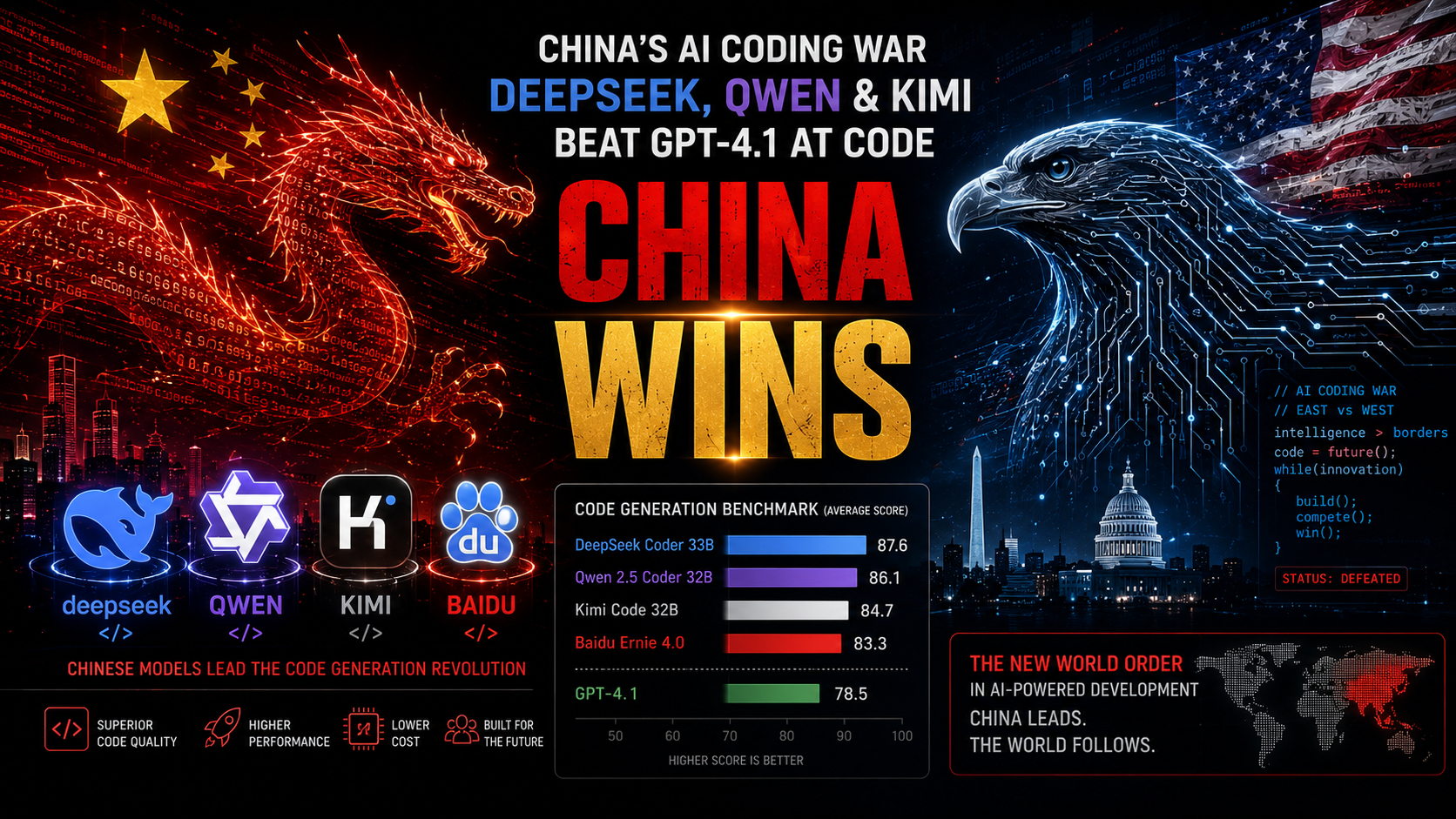
The claims made for AI models and the reality of using them in production often diverge significantly. For the four Chinese coding models, the honest assessment is nuanced. On standardized benchmarks — SWE-bench, HumanEval, and similar agentic coding evaluations — all four models do indeed cluster at the same capability tier as GPT-4o and Claude 3.7 on specific code generation tasks. The gap between Western frontier models and Chinese competitive models has genuinely closed for coding.
However, benchmarks measure specific capabilities under controlled conditions. Real-world software engineering involves context, judgment, understanding of existing codebases, and the ability to navigate ambiguity in requirements — capabilities that are harder to benchmark. Western developers who have tested these models report that for well-defined coding tasks, the Chinese models perform comparably. For complex architectural decisions and nuanced requirement interpretation, Claude and GPT-4o still maintain advantages that benchmarks don’t fully capture.
For the specific use case of agentic coding — where an AI agent writes code, runs tests, observes failures, and iterates — the gap is narrower than it was six months ago. This is the capability area where Google’s Gemini 3.1 has also made dramatic improvements, as we covered when Gemini 3.1 launched earlier this year. The frontier is genuinely moving, and Chinese labs are at the frontier.
The Cost Advantage That Changes the Competitive Equation
If benchmark parity were the only thing happening here, this would be interesting but not alarming. What changes the equation is cost. All four Chinese models are either fully open-weight (downloadable and deployable without API fees) or offered at significantly lower API pricing than Western equivalents. DeepSeek V4 API pricing is reportedly 60-70% cheaper than GPT-4o for equivalent tasks. MiniMax M2.7 self-reported inference costs come in at roughly one-third of comparable Western models.
For enterprise customers making AI infrastructure decisions, a model that performs at 95% of the quality benchmark at 30% of the cost is not a minor consideration — it’s the decision. Especially when the model comes with open weights that allow on-premise deployment, eliminating data privacy concerns about sending code to cloud APIs. This is directly relevant to the questions raised by big tech’s AI spending patterns — enterprises are becoming more cost-conscious about AI, and cheap, capable alternatives to OpenAI and Anthropic APIs are increasingly attractive.
Why Open Weights? China’s Strategic Play Explained
All four of these models share a critical characteristic: they’re open-weight, meaning anyone can download and run the model parameters. This is a deliberate strategic choice, not just a technical preference. Open weights accomplish several things simultaneously for Chinese AI labs.
First, open weights bypass Western export controls on AI capabilities. The US government can restrict the export of Nvidia H200 chips (as we covered in today’s piece on the H200 China chip deal), but it cannot easily restrict the global distribution of model weights published on Hugging Face or GitHub. Once published, a model is available globally, indefinitely.
Second, open weights build ecosystem and community. Developers who fine-tune and build on Chinese models become advocates for those models. Startups that build products on top of DeepSeek V4 have a financial interest in that model’s continued success. This is exactly how Meta has used open-source Llama models to build an ecosystem — and Chinese labs have studied that playbook carefully.
Third, open weights demonstrate technical credibility in a way that closed models cannot. When a lab publishes model weights, the global research community can inspect, test, and validate the capabilities. This scrutiny makes performance claims more credible — and Chinese labs have benefited from that credibility boost as researchers around the world have validated DeepSeek’s efficiency claims.
What Western AI Teams Should Be Worried About Right Now
The coordinated release of four competitive open-weight coding models in 12 days should prompt some honest questions in Western AI organizations. If Chinese labs can now match Western frontier coding capability at lower cost with open weights, what is the sustainable competitive advantage of closed Western models?
The honest answer is that the advantages are real but shrinking. OpenAI and Anthropic maintain leads in model safety, alignment research, enterprise support infrastructure, and — arguably — judgment and reasoning on complex ambiguous tasks. Google brings multimodal capabilities and integration with its existing product ecosystem. These advantages matter, but they’re increasingly being competed away by Chinese labs that are moving faster than anyone predicted.
For developers choosing a coding AI stack in 2026, the four Chinese models add serious options that weren’t available a year ago. For enterprises evaluating AI vendors, the cost-performance profile of Chinese open-weight models is increasingly hard to ignore. And for the US government’s AI export control strategy, the continued production of frontier-capable models by Chinese labs using Chinese-developed hardware raises fundamental questions about the long-term efficacy of chip-based restrictions as a primary containment strategy.
Twelve days, four models, one clear message: the AI competition is genuinely global, and the Western lead is narrower than most people realize.
Sources: LLM Stats AI News | Air Street Press – State of AI May 2026 | Open Source AI News May 2026 | Kersai AI Breakthroughs | IM Founder AI Updates May 2026