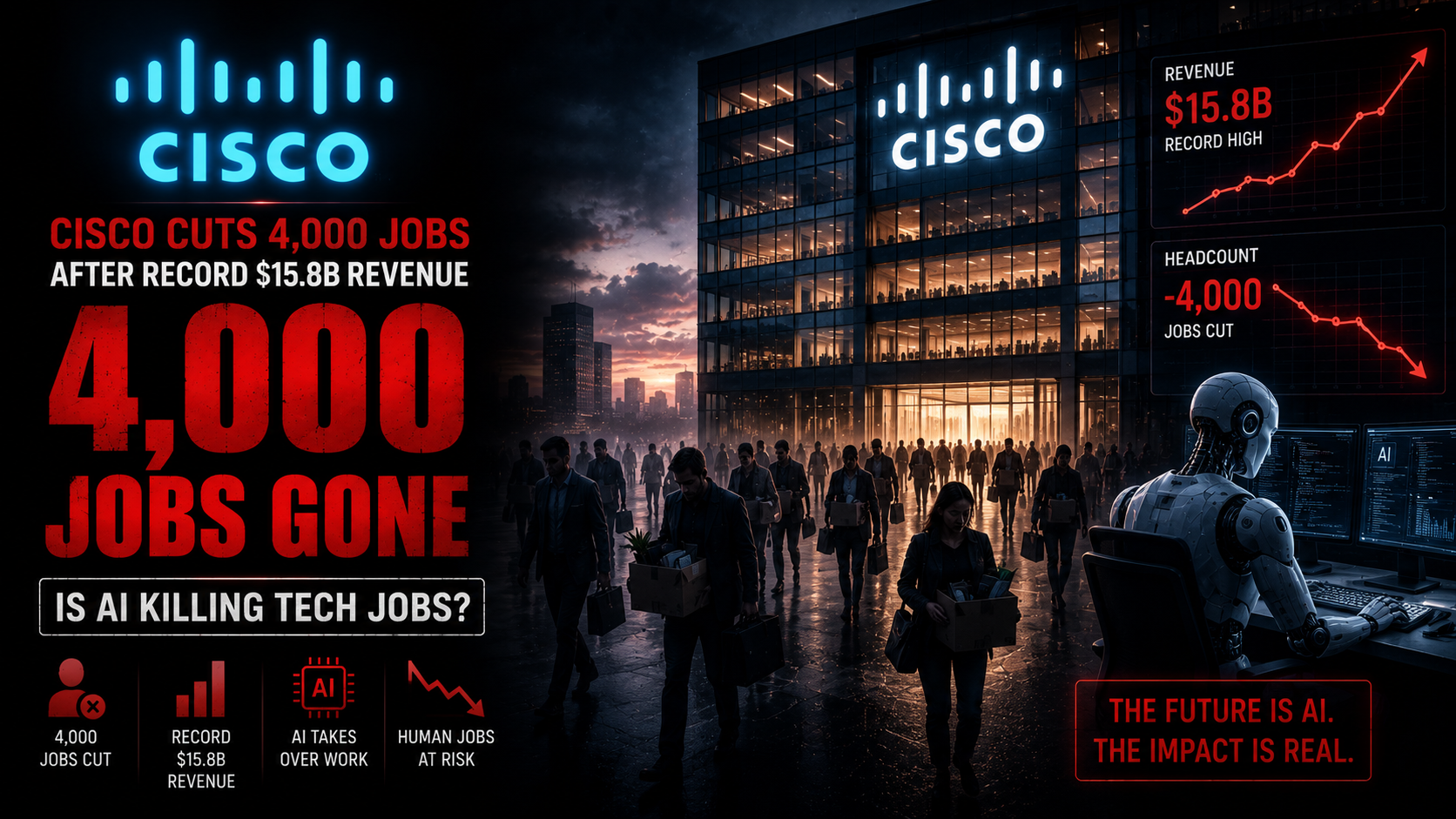
Cisco Cuts 4,000 Jobs After Record $15.8B Revenue: Is AI Killing More Jobs Than It Creates in 2026?
Table of Contents
Table of Contents
On May 14, 2026, Cisco Systems pulled off a move that perfectly captures the contradictions of the AI era: the networking giant announced its highest quarterly revenue in company history — $15.84 billion — and in the very same breath told nearly 4,000 employees they no longer have a job. If that sounds like something out of a dystopian tech satire, welcome to the Cisco layoffs 2026 story. And it’s one every person in tech needs to understand.
This isn’t a struggling company making hard choices. This is a thriving company making strategic choices — and those choices are being made at the expense of thousands of workers, in the name of artificial intelligence. Sound familiar? It should. We’ve seen this playbook before with Big Tech’s 2026 layoffs-while-profitable trend, but Cisco’s move is especially jarring in its scale and timing.
The Cisco Shock: Record Profits, Mass Layoffs — Same Day
Let’s set the scene. On the evening of May 13, 2026, Cisco CFO Scott Herren and CEO Chuck Robbins got on a call with analysts to celebrate a remarkable quarter. Revenue of $15.84 billion — up 12% year over year. Adjusted EPS of $1.06, beating the $1.04 consensus. Full-year guidance raised. AI infrastructure orders revised upward to $9 billion from $5 billion. Stock surged 13-20% in after-hours trading.
Then, simultaneously, an internal memo went out to Cisco’s 86,200+ employees. CEO Chuck Robbins and the Executive Leadership Team announced that fewer than 4,000 employees — less than 5% of the global workforce — would be receiving layoff notifications beginning May 14. The reason cited: a strategic shift to redirect investment into AI, silicon, optics, security, and enterprise tools.
This is the new normal of 2026 tech: record profits and mass layoffs aren’t contradictions anymore — they’re a package deal. The Cisco layoffs 2026 announcement is just the latest data point in a trend that shows no signs of slowing down.
Breaking Down the $15.8B Quarter: What Drove Record Revenue
To understand why Cisco is both thriving and cutting jobs, you need to understand where its money is coming from. The Q3 FY2026 results weren’t evenly distributed — they were driven by a very specific tailwind: AI infrastructure demand from hyperscalers.
- Total Revenue: $15.84 billion (+12% YoY), vs. $15.56 billion analyst estimate
- Adjusted EPS: $1.06, beat the $1.04 consensus
- Networking product orders: Up more than 50% year over year
- Data center switching orders: Up more than 40%
- Hyperscaler AI orders (Q3 alone): $1.9 billion in a single quarter
- Full-year AI order forecast: Raised from $5 billion to $9 billion
- AI revenue forecast: Raised from $3 billion to $4 billion for FY2026
The companies writing those massive checks? Amazon, Microsoft, Google, and Meta — the four hyperscalers building the AI data centers that power everything from ChatGPT to Google’s Gemini. These giants are choosing Cisco’s Silicon One networking chips and Acacia optical products to wire up their massive AI training clusters. And Cisco is selling its pluggable optics to all of them simultaneously.
This is exactly the kind of infrastructure boom we analyzed in our coverage of Cerebras’ $26.6B IPO, where the AI chip wars are generating enormous wealth at the infrastructure layer while disrupting everything above it.
The $9 Billion AI Order Bonanza Cisco Can’t Stop Talking About
The most jaw-dropping number from Cisco’s Q3 earnings isn’t the revenue figure — it’s the AI order trajectory. At the start of FY2026, Cisco’s leadership projected $5 billion in full-year AI infrastructure orders from hyperscalers. A reasonable, ambitious target.
By the time Q3 closed, they had already accumulated $5.3 billion in AI orders year-to-date — and the year wasn’t over. So they revised the full-year target to $9 billion. That’s nearly double the original forecast, revised upward mid-year. Hyperscaler orders, in particular, grew at triple-digit rates during the quarter — meaning they more than doubled.
Chuck Robbins characterized this moment as a “networking supercycle” — a once-in-a-generation shift in infrastructure spending driven by AI. And he’s not wrong. The last time Cisco saw this kind of sustained infrastructure investment was during the dot-com boom of the late 1990s, when the internet buildout caused similar triple-digit order growth. We know how that story ended — but the AI cycle, Robbins argues, is fundamentally different because it’s driven by actual enterprise revenue, not speculative hype.
Whether you believe that framing or not, the numbers are real. CNBC’s earnings coverage confirmed every data point, and the stock market reaction — a 13-20% post-earnings surge — signals that institutional investors bought the story completely.
Who Gets Cut? Inside Cisco’s 4,000-Person Restructuring
The Cisco layoffs 2026 will affect fewer than 4,000 employees globally, with notifications starting May 14. The company has not publicly specified which divisions or geographies will bear the brunt, but the logic is embedded in the strategic rationale itself.
Cisco is doubling down on: AI infrastructure hardware, Silicon One chip development, Acacia optical networking, cybersecurity, and enterprise AI tooling. That means roles in legacy enterprise networking, traditional routing/switching sales, and older product lines are at risk. The company is essentially performing a controlled demolition of its old identity as a router-and-switch company to rebuild itself as an AI infrastructure powerhouse.
The financial cost? Up to $1 billion in restructuring charges — approximately $450 million recognized in Q4 FY2026, with the remainder hitting fiscal 2027. Affected employees will receive:
- Pro-rated FY2026 bonuses
- Severance support packages
- Access to Cisco’s internal job placement services
That’s cold comfort for 4,000 people losing their jobs at a company that just reported record revenue. But this is the AI era’s defining paradox: companies have never been more profitable, and workers have never been more expendable.
This mirrors the pattern we documented in our analysis of Pentagon AI contract awards in 2026 — enormous institutional investment flowing into AI at the infrastructure level, while individual workers are squeezed out. And the recent Mandiant M-Trends 2026 report made clear that AI isn’t just changing who gets hired — it’s changing the entire nature of what organizations need from human workers.
Silicon One G300 and Acacia Optics: Cisco’s AI Hardware Bet
What exactly is Cisco redirecting its capital and human talent toward? The answer lies in two critical technology bets that underpin the entire AI infrastructure market.
Silicon One G300
Cisco’s Silicon One G300 is the company’s next-generation networking chip, designed specifically for AI data center workloads. AI model training — especially for large language models — requires enormous bandwidth between GPU clusters. Traditional networking hardware can’t keep up. Silicon One G300 is Cisco’s answer: a purpose-built chip that delivers the throughput and low latency that hyperscalers need when they’re running hundreds of thousands of GPUs in parallel.
The hyperscalers are choosing it. That’s not a marketing claim — it’s reflected in Cisco’s order books. Cisco’s official announcement of the G300 specifically framed it as infrastructure for the “Agentic Era” — positioning Cisco at the center of the AI agent boom that companies like Apple are just beginning to tap into.
Acacia Optical Networking
Cisco acquired Acacia Communications in 2021 for $4.5 billion. At the time, it seemed like an expensive bet on a niche optical networking company. In 2026, that bet looks like genius. Acacia’s pluggable optical transceivers are now being sold to all four major hyperscalers — Amazon, Microsoft, Google, and Meta — to handle the massive data flows inside their AI data centers.
Every AI model that trains, every inference query that runs, every GPU that communicates with another GPU — all of that data travels through optical fibers. Acacia’s transceivers make that possible at the speeds and densities AI requires. It’s an invisible but critical layer of the AI stack, and Cisco now owns it.
Chuck Robbins’ “Networking Supercycle” Thesis Explained
In a CNBC interview on May 14, CEO Chuck Robbins made a bold claim: we are entering a networking supercycle. It’s the kind of statement that sounds like executive hype until you look at the numbers behind it.
His argument: AI doesn’t just require more compute (GPUs, TPUs). It requires dramatically more networking. When you’re training a large AI model across 100,000+ GPUs, those GPUs need to communicate constantly, at extremely high speeds, with minimal latency. That communication runs on networking hardware. The more AI scales, the more networking hardware is needed — and Cisco is uniquely positioned to supply it.
Robbins also cited “design wins” — meaning hyperscalers have chosen Cisco’s Silicon One and Acacia products for their next-generation builds. This is different from spot purchases. Design wins represent multi-year commitments embedded into the hyperscalers’ infrastructure roadmaps. Once a hyperscaler designs Silicon One into their data center, they’ll buy Silicon One for the next several years. That’s sticky, recurring, high-margin revenue.
As Robbins put it: “The companies that will win in the AI era will be those with focus, urgency, and the discipline to continuously shift investment toward the areas where demand and long-term value creation are strongest.” The 4,000 layoffs are that discipline in action — brutal, but strategically coherent.
For developers interested in understanding what’s being built on this infrastructure, our 2026 guide to building AI agents in Python covers how the application layer sits atop exactly the kind of networking infrastructure Cisco is now racing to dominate.
The Uncomfortable Pattern: Big Revenue, Bigger Layoffs, Always AI
Cisco isn’t an isolated case. It’s a data point in a pattern that’s defining 2026 tech:
- Microsoft: Record cloud and AI revenues, thousands of layoffs in non-AI divisions
- Google: Ad revenue records, workforce reductions across non-AI product teams
- Meta: Aggressive AI investment, “Year of Efficiency” job cuts
- Cisco: Record $15.84B revenue, 4,000 layoffs to fund AI pivot
The pattern is clear: AI investment is being funded, in part, by human capital reallocation. Companies aren’t just spending new money on AI — they’re converting existing workforce costs into AI infrastructure costs. A software engineer’s salary becomes a fraction of a Silicon One G300 chip. A sales team’s compensation becomes a data center rack.
This creates a deeply uncomfortable question that no tech executive wants to answer publicly: Is AI creating more jobs than it destroys? The evidence from 2026 is decidedly mixed. Yes, Cisco is hiring in AI-adjacent roles. But it’s hiring fewer people than it’s laying off, and those new hires require dramatically different skill sets. The workers being let go — many of them in traditional networking sales, legacy product support, and enterprise account management — can’t simply retrain into silicon engineers overnight.
For context on the cybersecurity dimension of this AI arms race, our analysis of AI’s growing role in high-stakes domains shows that the technology is simultaneously creating enormous value and extraordinary disruption across industries.
TechCrunch’s analysis captured the central irony well: Cisco spent years diversifying away from its dependence on hardware. Now it’s racing back toward hardware — but AI hardware, which is in a different universe of demand from the traditional enterprise networking gear that built the company.
Business Standard noted that the restructuring plan’s $1 billion cost is almost entirely offset by the productivity gains and margin improvements Cisco expects from shifting from lower-margin legacy products to higher-margin AI infrastructure contracts with hyperscalers.
Verdict: Should You Be Worried or Excited?
The Cisco layoffs 2026 story is a Rorschach test for how you see the AI economy. Here are both honest readings:
The Optimist Case
Cisco is investing aggressively in the technologies that will define the next decade of computing. Silicon One and Acacia optical products are genuine technical achievements. The hyperscaler AI boom is real, and Cisco is positioned at its infrastructure core. The 4,000 jobs lost may be partially offset by new AI-focused hiring, and the company’s long-term health is significantly improved by this strategic clarity. A more focused Cisco, with $9 billion in AI orders flowing in, is a company that can fund R&D, retain top talent in key areas, and remain a cornerstone of global tech infrastructure.
The Realist Case
Cisco posted $15.84 billion in revenue — it could absolutely afford to retain more of those 4,000 employees while still making its AI investments. This is a choice to maximize shareholder returns, not a necessity. The stock surge (15-20%) after the announcement tells you everything about who benefits: institutional investors, not workers. And the $1 billion restructuring charge — while painful in the short term — will be used as a tax-reduction mechanism while those same workers navigate unemployment in a job market that’s increasingly hostile to non-AI skills.
The truth, as always, is somewhere in the middle. Cisco is making rational decisions for its competitive position. Those decisions have real human costs. Both things are true simultaneously. Invezz captured this tension clearly: the stock is rising, but the workers being cut didn’t choose to work in a world where AI infrastructure would cannibalize their roles.
What’s certain: this will not be the last time a profitable tech company announces massive layoffs alongside record earnings in 2026. Cisco is the template. Seeking Alpha’s coverage already framed this as a model other enterprise tech companies will follow. Watch for similar announcements from networking, storage, and traditional software companies in the coming months.
The AI era is here. It’s profitable. It’s powerful. And it’s expensive — just not for the companies making the pivot.
SudoFlare covers tech news with an investigative, data-backed perspective. Follow us for daily coverage of the AI economy, cybersecurity, and the technologies reshaping the world.