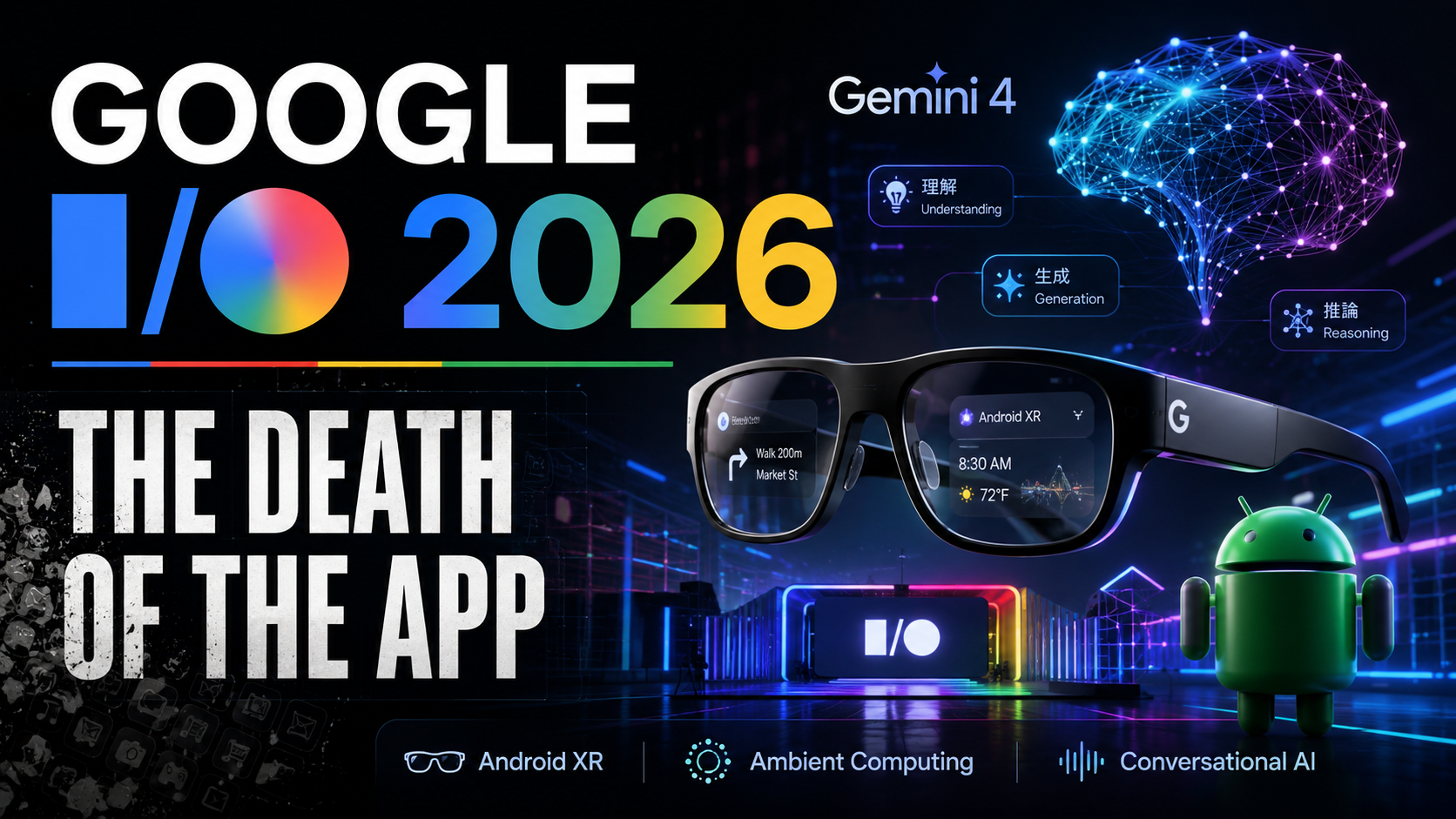
Google I/O 2026 Preview: Gemini 4, Android XR Glasses, and the Death of ChromeOS
Table of Contents
Table of Contents
In three days, on May 19, 2026, Google will take the stage at the Shoreline Amphitheatre for what promises to be its most consequential developer conference in years. Google I/O 2026 comes at a pivotal moment: OpenAI is spending $122 billion and threatening to reshape every product category Google owns, Apple is preparing its own AI reboot, and Google’s Gemini models need to prove they can hold their ground against an increasingly crowded frontier. Here’s everything you need to know about what’s coming.
When and How to Watch Google I/O 2026
The opening keynote kicks off on May 19 at 10:00 AM Pacific Time and will stream live on Google’s YouTube channel, the official I/O website, and Google TV. The keynote is expected to run approximately two hours, with virtually the entire runtime dedicated to AI announcements — a stark contrast to the hardware-heavy keynotes of Google I/O’s past. Developer sessions and technical deep-dives will run through May 20.
Unlike previous years where I/O served double duty as both a developer conference and a consumer product launch event, 2026’s version is almost entirely focused on the AI-first future. Expect minimal hardware announcements — that’s what Made by Google events in the fall are for — and maximum AI content.
Gemini 4.0: The AI Model Upgrade Everyone Is Waiting For
The centerpiece of Google I/O 2026 will almost certainly be a new version of Gemini. Reports and leaks suggest it will be a major overhaul rather than a minor point release — possibly receiving the Gemini 4.0 designation, marking Google’s most significant AI model update since the original Gemini Ultra launch.
We already saw a taste of what’s coming when Google launched Gemini 3.1 Pro and Gemma 4 earlier this year. But I/O 2026 is expected to go further. According to sources cited by Android Authority, the new Gemini is expected to show dramatic improvements in complex reasoning, coding, and multimodal capabilities — particularly video and real-time audio understanding.
The competitive pressure is intense. OpenAI has been shipping model updates at a pace that has kept Google playing defense. Anthropic’s Claude Mythos raised the bar on safety and reasoning. Google needs a Gemini 4.0 announcement that genuinely shifts the narrative back in its favor — and sources suggest it has the goods to do exactly that.
Android 17: What’s Coming to Your Phone
Android 17 will be officially previewed at I/O 2026, with the final release expected in the fall alongside the Pixel 10 line. The headline feature is deep Gemini integration throughout the operating system — moving AI from an app you open to an intelligence layer that pervades everything your phone does.
Expect announcements around:
On-device AI processing: Google has been building toward running meaningful AI workloads entirely on-device, reducing latency and protecting privacy. Android 17 is expected to push this significantly further with expanded on-device Gemini Nano capabilities.
Cross-app AI actions: Building on the Gemini Intelligence features announced at the Android Show earlier this month, Android 17 will let Gemini reach across apps to complete complex tasks — booking a reservation from your email, building a shopping cart from a conversation, summarizing documents from multiple sources simultaneously.
Improved Circle to Search: The feature that lets you circle anything on screen to search it is getting AI upgrades. Expect it to become significantly more capable, potentially understanding complex queries and returning structured answers rather than just search results.
Android XR Glasses: Google’s AR Bet Goes Live
Google confirmed before I/O that it will preview Android XR glasses at the event. This is Google’s return to augmented reality eyewear — a category it famously pioneered and abandoned with Google Glass in 2013. But this isn’t your grandfather’s Google Glass.
Android XR is a full operating system platform designed for both headsets and glasses, with Gemini AI as the core intelligence layer. The glasses are expected to feature a small display element visible through the lens, always-on Gemini access, and camera integration for real-time scene understanding. Think of it as Gemini Live but for the physical world — you point your gaze at something and get instant information, translation, navigation, or assistance.
Partners building Android XR hardware include Samsung (ironic, given their current labor troubles — see our Samsung strike coverage), which has been working on Project Moohan, a mixed-reality headset running Android XR. Google’s own first-party glasses are expected to follow later in 2026 or early 2027.
The timing is deliberate. Apple’s Vision Pro has been on the market for a year and a half, establishing the premium end of the spatial computing market. Meta’s Ray-Ban smart glasses have proven there’s consumer appetite for lighter, cheaper AI-enabled eyewear. Google is positioning Android XR glasses to hit between those two markets: smarter than Ray-Bans, far cheaper than Vision Pro.
Aluminium OS: ChromeOS Is Being Replaced
One of the most significant longer-term announcements expected at I/O 2026 is an update on Aluminium OS — Google’s next-generation operating system that merges Android and ChromeOS into a single, AI-first platform. This has been in development under the codename “Fuchsia” and related projects for years, and I/O 2026 is expected to be the first time Google formally acknowledges Aluminium OS publicly and gives a roadmap for its rollout.
What does this mean in practice? ChromeOS devices — Chromebooks — will eventually transition to Aluminium OS. The new platform runs Android apps natively (no compatibility layer), integrates the Chrome browser environment, and has Gemini AI built in at the foundation rather than bolted on. For the hundreds of millions of Chromebook users — particularly in education — this represents a significant change in their device’s capabilities.
The transition is expected to take years, not months. Don’t panic if you have a Chromebook — Google has been typically good about extended support timelines. But the message is clear: the ChromeOS era is ending, and Aluminium OS is what comes next.
Googlebook: The AI Laptop That Kills the Chromebook
Google already announced Googlebook at the Android Show on May 12, but I/O 2026 is expected to bring the full reveal: specs, pricing, launch partners, and a release timeline. The Googlebook is a new category of laptop built from the ground up around Gemini Intelligence, running the new Aluminium OS (combining Android’s app ecosystem with ChromeOS’s browser architecture).
Manufacturing partners include Acer, ASUS, Dell, HP, and Lenovo — the same OEMs that have sold Chromebooks for years. The distinguishing feature of every Googlebook is a “Glowbar” — a lit strip on the device that signals AI activity and device status, serving as both a hardware branding element and a functional AI indicator.
Key Googlebook features include Magic Pointer (AI that understands what’s on screen and helps you act on it), deep Android phone integration (access phone files instantly without transfers), and Gemini-powered custom widgets. First Googlebooks are expected to ship in fall 2026, priced to compete with premium Chromebooks rather than MacBooks — putting them somewhere in the $500-$900 range.
Gemini Intelligence: AI That Works Across Every App
The most practically important announcement of I/O 2026 may not be a new model or device — it may be Gemini Intelligence, the framework for AI that works proactively across your entire Google ecosystem. Already previewed for Android, Gemini Intelligence at I/O will be expanded to cover Gmail, Google Drive, Calendar, Photos, Maps, and third-party apps through a new AI extension API.
The vision: instead of asking Gemini a question, Gemini understands what you’re trying to accomplish and proactively helps — surfacing relevant documents before a meeting, suggesting calendar blocks based on email threads, organizing photos by event without you asking. This is the “ambient AI” model that every major tech company is racing toward, and Google’s advantage is the depth of its data ecosystem. Nobody else has Gmail, Drive, Maps, Search, and YouTube all in one place to draw from.
This directly competes with Apple Intelligence (coming in iOS 27 later this year), which similarly aims to make AI pervasive across Apple’s ecosystem. The difference: Google’s ecosystem spans devices and platforms that Apple doesn’t — you can use Gemini Intelligence on Android, on Googlebook, in Chrome on Windows, and through web apps. Apple Intelligence is Apple-only. For enterprise users with mixed device fleets, Google’s cross-platform play is potentially decisive.
Google Cloud and Agentic AI
The developer portion of I/O 2026 will include significant Google Cloud announcements around agentic AI — the same theme that dominated Google Cloud Next 2026. Expect new Vertex AI agent features, expanded Model Garden with more open and proprietary models, and deeper integration between Google Workspace and agentic workflows.
For developers building on top of AI infrastructure, the I/O sessions on Vertex AI agents and the new Gemini API are the ones to watch. Google has been making significant moves to become the preferred cloud for AI workloads — a direct challenge to AWS and Azure’s current dominance. The growing AI agent ecosystem is a key battleground, and Google will have a lot to say about it on May 19 and 20.
Why Google I/O 2026 Matters More Than Ever
Google I/O has always been important. But 2026 feels different. This is the event where Google either proves it can compete with OpenAI’s relentless shipping pace and Apple’s ecosystem lock-in, or shows cracks in the strategy. Gemini 4.0, Android XR, Aluminium OS, Googlebook — these aren’t incremental updates. They represent Google’s bet on what computing looks like in five years.
If Google nails the keynote on May 19 — a compelling Gemini 4.0 demo, credible AR glasses, a clear path to Aluminium OS, and exciting Googlebook hardware — it could decisively re-establish itself as the AI leader in consumer devices. If it stumbles, the narrative that Google is perpetually playing catch-up will calcify further.
We’ll be covering the announcements live. Check back on May 19 for our full breakdown of everything Google announces. For background on the AI model race, see our coverage of Gemini 3.1 Pro and Claude Mythos. For more on the competitive landscape, Android Authority’s full preview and Tom’s Guide’s expectations piece are worth reading ahead of the keynote.