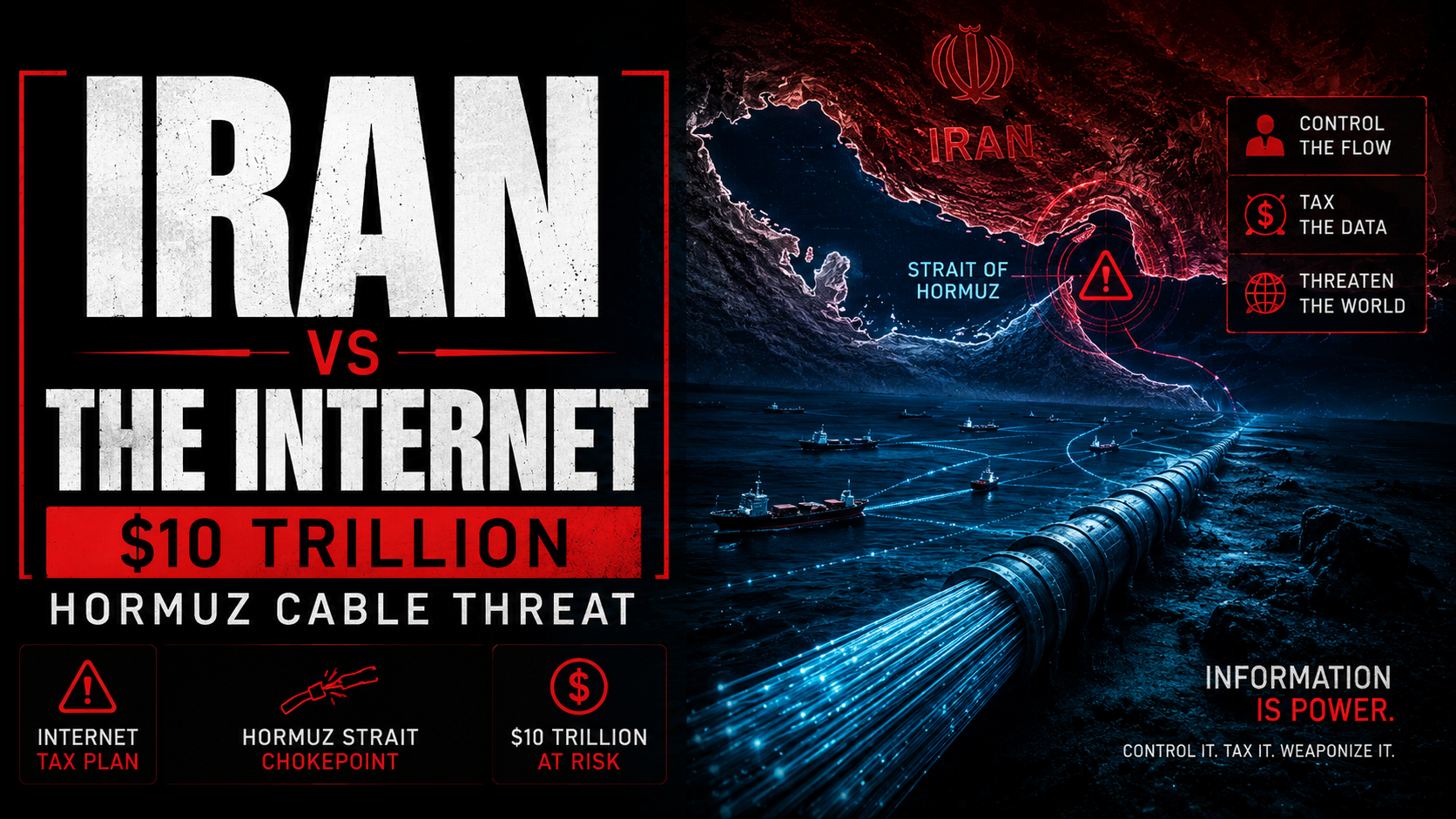
Iran Wants to Tax the Internet: $10 Trillion Hormuz Cable Threat Explained
Table of Contents
Table of Contents
Iran’s Revolutionary Guards-linked media has unveiled a plan that could shake the foundations of the global internet: charge transit fees on the submarine fibre-optic cables running beneath the Strait of Hormuz. The cables carry roughly 20% of the world’s internet traffic and more than $10 trillion in financial transactions every single day. If Tehran acts on these ambitions, Google, Meta, Microsoft, Amazon, and every major telecom on Earth could face a new geopolitical chokepoint — one far more powerful than any oil embargo.
This is not a fringe idea. It is being pushed by IRGC-affiliated Tasnim News Agency and is gaining traction inside Iran’s parliament. Here’s what it means for the tech industry and global internet infrastructure.
The $10 Trillion Digital Chokepoint
The Strait of Hormuz is already the world’s most critical oil chokepoint — about 20% of global petroleum flows through it. What most people don’t realize is that it is also a critical internet chokepoint. Multiple submarine fibre-optic cable systems cross the strait’s seabed, carrying traffic between Europe, the Middle East, South Asia, and East Asia.
According to Tom’s Hardware, the cables beneath Hormuz carry over $10 trillion in daily financial transactions — including SWIFT bank messaging, cloud service traffic, and a substantial portion of global internet exchange traffic. Disrupting or taxing them would be an act of economic warfare on the entire connected world.
Mostafa Taheri, a member of Iran’s parliamentary Industries Commission, put potential annual revenues from transit fees at up to $15 billion. That figure alone tells you how seriously Iran’s political establishment is considering this.
What Iran Is Actually Proposing
Tasnim News Agency — which is IRGC-affiliated — published a detailed plan with three components:
- Transit fees: Charge the international consortia that own and operate cables passing through Iranian territorial waters (which extend 12 nautical miles from the coast, encompassing part of the strait).
- Mandatory services: Require cable operators to use Iranian maintenance and monitoring services, funnelling revenue and technical access to Iranian entities.
- Data regulation: Require companies including Google, Meta, Microsoft, and Amazon to operate under Iranian data regulations — potentially allowing traffic monitoring by Iranian authorities.
The data regulation component is arguably the most alarming. The Hormuz cables carry SWIFT financial messaging systems, government communications, military logistics data, and private cloud traffic. Granting Iran surveillance rights over that traffic — or even the credible threat of such access — would be a geopolitical earthquake.
Is This Legal Under International Law?
Iran’s legal basis for imposing fees is thin at best. Radio Free Europe/Radio Liberty notes that while coastal states do retain sovereignty over their territorial seabed, the UN Convention on the Law of the Sea (UNCLOS) Article 79 explicitly protects the right to lay and maintain submarine cables in the exclusive economic zone and continental shelf.
Iran has technically not ratified UNCLOS — giving it some freedom to reject the treaty’s framework in its own courts. But attempting to enforce cable fees would almost certainly trigger international arbitration, WTO disputes, and potential sanctions from the US and EU. The legal path is murky, but so is Iran’s willingness to be deterred by legal norms it considers Western-imposed.
More practically: Iran would need physical enforcement capability over the cables on the seabed — something that requires naval assets the IRGC possesses but that would constitute an extraordinary act of aggression against global infrastructure.
The Tech Industry’s Response: Worried Silence
None of the major cable operators or tech hyperscalers have publicly responded to Iran’s proposal. The silence is notable. Companies like Google (which has invested heavily in private submarine cable infrastructure), Meta, and Microsoft have enormous assets transiting the Strait of Hormuz regularly. Public statements acknowledging the threat could be seen as provocative; silence risks looking complicit.
Privately, infrastructure security experts are alarmed. The Hormuz strait’s geography means there is no easy detour for cables already in place. Rerouting internet infrastructure to avoid Iran’s territorial waters would require years of planning, billions in investment, and potentially the construction of entirely new cable systems around the Arabian Peninsula or through alternative routing via Central Asia — none of which exist at scale today.
Why This Is Happening Now
The proposal emerges at a moment of maximum Iranian geopolitical leverage and minimum restraint. Sanctions have isolated Iran’s economy, the nuclear deal remains stalled, and Tehran is looking for new economic levers. Digital infrastructure — which Iran cannot easily build but can position itself to tax or disrupt — represents an asymmetric opportunity.
There is also a domestic political dimension. The IRGC-linked media pushing this proposal is playing to a nationalist audience that wants to see Iran extract value from the Western-dominated tech companies whose cables cross Iranian waters. Whether or not Tehran ever acts, the discourse itself signals a new front in the splinternet era — where geopolitics fragments the once-global internet into national and regional fiefdoms.
This aligns with broader trends we have covered: governments increasingly treating AI and internet infrastructure as strategic sovereign assets rather than neutral global commons.
What Happens If Iran Actually Does This
The scenarios range from manageable to catastrophic:
- Moderate scenario: Iran formally demands fees, cable operators ignore or challenge through arbitration, Iran lacks enforcement mechanism, dispute simmers for years. Internet traffic continues normally.
- Escalation scenario: Iran physically interferes with cables — cutting, tapping, or blocking maintenance ships. Disruption to 20% of global internet traffic triggers an international crisis far larger than any prior internet infrastructure incident.
- Negotiated scenario: Major tech companies quietly pay nominal fees through intermediaries to avoid escalation. This sets a precedent every other coastal state with cable routes will immediately exploit.
The negotiated scenario may be the most dangerous long-term. A world where internet cables are taxed at chokepoints by sovereign states is a world where the economics of global connectivity fundamentally change — and where authoritarian states gain a permanent revenue stream from the infrastructure they lack the capability to build.
The Infrastructure Resilience Wake-Up Call
For the tech industry, the Iran cable threat is the latest in a series of wake-up calls about submarine cable vulnerabilities. The 2022 Tonga volcanic eruption cut the island nation’s only cable link. In 2024, suspected Houthi-affiliated groups damaged multiple cables in the Red Sea. Russia has repeatedly made threatening statements about undersea NATO cables in the Baltic and Arctic.
The pattern is clear: the submarine cable network that carries 95% of international internet traffic was built for a world that no longer exists — one where geopolitical actors broadly accepted its neutral status. That consensus is gone. The question now is how quickly the industry and governments can build redundancy and resilience before the next chokepoint is weaponized.
Hormuz may be the moment that finally forces a serious answer.