Alibaba Just Released a Chip That’s 3x Faster Than Nvidia’s H20 — China’s AI Independence Is Closer Than You Think
Table of Contents
Table of Contents
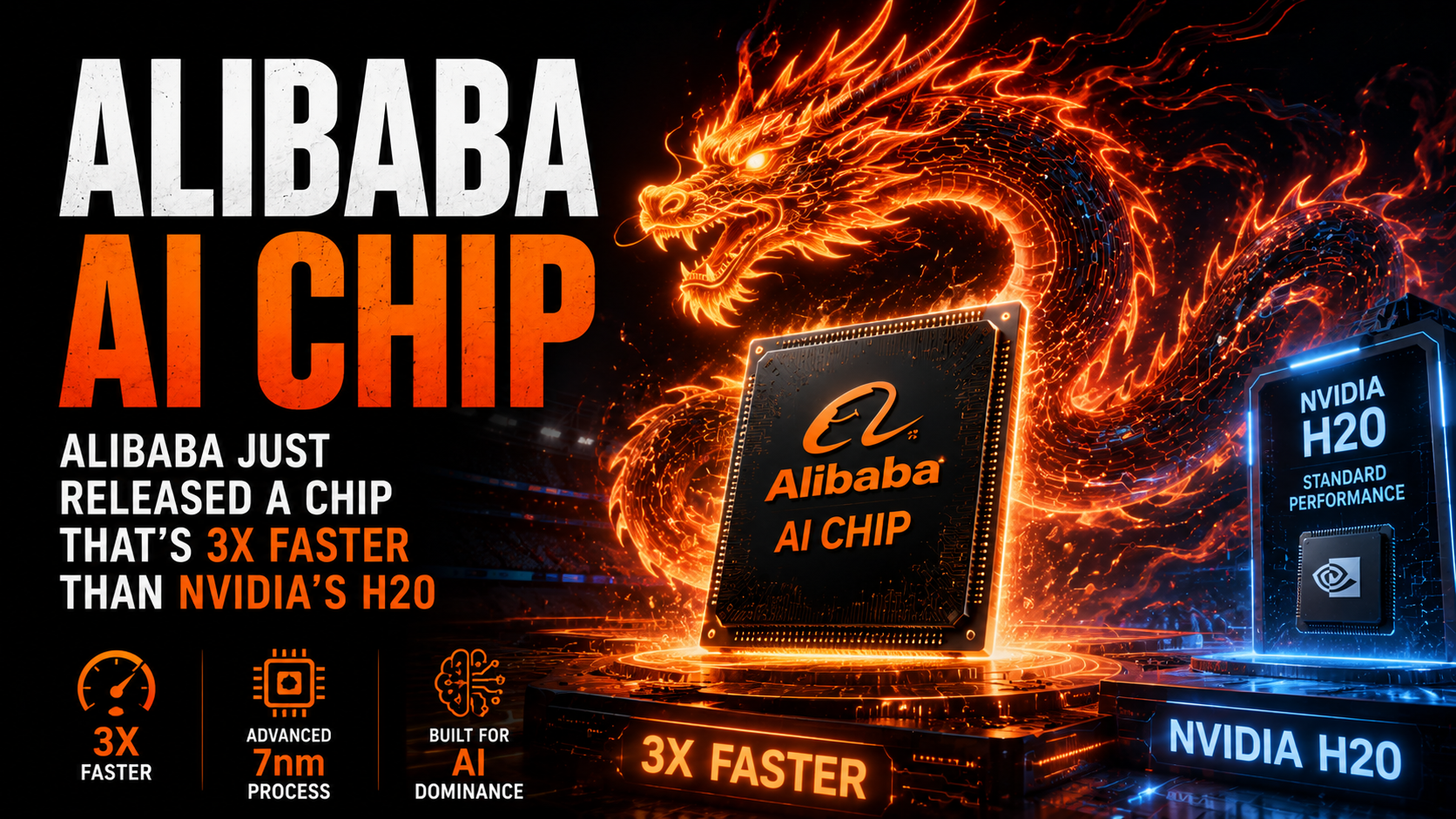
Alibaba just fired a warning shot at Nvidia. On May 21, 2026, the Chinese tech giant unveiled the Zhenwu M890 — a new AI chip developed by its semiconductor subsidiary T-Head — claiming it delivers three times the performance of Nvidia’s H20 chip on AI inference workloads. The M890 is immediately available through a new 128-accelerator server system, and Alibaba has already shipped 560,000 units to Chinese customers who can no longer access Nvidia’s most powerful hardware due to US export restrictions.
This matters beyond China’s borders. The Zhenwu M890 is the clearest sign yet that China’s AI chip industry is maturing far faster than Western analysts expected — and that US export controls, while painful for Chinese AI labs in the short term, may be accelerating the development of a fully independent Chinese AI hardware stack that could eventually compete globally.
Zhenwu M890: The Technical Specs
Let’s look at what the M890 actually delivers:
- Memory: 144 GB HBM3 — significantly more than the H20’s 96 GB
- Bandwidth: 800 GB/s memory bandwidth
- Compute: 0.6 PFLOPs of FP16 (half-precision) — comparable to Nvidia’s A100
- Claimed inference performance: 3x faster than the Nvidia H20 on AI inference tasks
- Deployment: Available in a 128-accelerator server rack configuration
Important context: the H20 is a downgraded chip that Nvidia designed specifically for the Chinese market to comply with US export restrictions. It’s substantially less powerful than the H100 or H200 that Nvidia sells globally. So “3x faster than the H20” is a more achievable benchmark than it sounds — but it’s still impressive, and it means Chinese AI labs can now deploy meaningful AI infrastructure domestically.
Why Alibaba Built This — And Why Now
The timing is not accidental. US export controls have progressively tightened the supply of advanced semiconductors flowing into China. In 2022, the Commerce Department blocked exports of the A100 and H100. Nvidia responded with the A800 and H800, which were then banned. The H20 was approved — but reports emerged earlier this year that those export licenses may be tightened further.
For Alibaba, building domestic alternatives isn’t just strategic — it’s existential. Alibaba Cloud is the dominant cloud provider in China, competing with Tencent Cloud and Huawei Cloud. If its AI infrastructure depends entirely on Nvidia hardware that can be cut off by Washington policy decisions, that’s an enormous business risk. The Zhenwu M890 is Alibaba’s answer: a credible, performant, domestically produced AI chip that Chinese cloud customers can rely on regardless of geopolitics.
This dynamic mirrors what Cerebras and other US startups are attempting from the other side — challenging Nvidia’s dominance through differentiated architecture. The difference is Alibaba has $53 billion committed to AI infrastructure investment and a captive domestic market of hundreds of millions of users.
The Competitive Landscape: M890 vs. H100 vs. H20
To put the M890 in perspective, here’s how it compares to Nvidia’s current product stack:
- vs. H20: 3x faster on inference (Alibaba’s claim), more memory (144 GB vs 96 GB)
- vs. H100: Still a significant gap — the H100 delivers roughly 4 PFLOPs of FP16 compute compared to M890’s 0.6 PFLOPs
- vs. H200: The H200 has 141 GB HBM3e and 4.8 PFLOPs — M890 has comparable memory but far lower compute
The M890 is not a match for Nvidia’s global top-of-stack products. But for the Chinese domestic market, where H100s and H200s are simply unavailable, it’s a transformative development. Chinese AI labs and cloud providers now have a credible path to building large-scale AI infrastructure without Nvidia.
Alibaba’s Roadmap: Getting More Competitive by 2028
Alibaba isn’t stopping with the M890. The company outlined a chip roadmap through 2028:
- V900 (Q3 2027): Updated architecture, 3x M890 performance, 216 GB memory, 1200 GB/s bandwidth
- Zhenwu J900 (Q3 2028): Further architectural improvements — performance specifications not yet disclosed
This roadmap suggests Alibaba is treating chip development as a long-term strategic investment, not a one-off. By 2028, if the V900 delivers on its promise, Chinese AI infrastructure could be genuinely competitive with whatever Nvidia is shipping globally — assuming Nvidia’s own roadmap doesn’t accelerate beyond current projections.
What This Means for the Global AI Hardware Race
The conventional Western wisdom has been that US export controls give American AI companies a permanent structural advantage — access to the best chips means training better models means building better products. The M890 challenges this assumption in two ways.
First, inference is becoming more important than training. The big expensive models have largely been trained. The money is now in running them efficiently at scale. For inference workloads, the M890’s profile — high memory, optimized for throughput — is competitive. Chinese AI labs may be able to deploy and run frontier models effectively even without access to Nvidia’s training-optimized hardware.
Second, the export control strategy may be backfiring. By cutting China off from advanced chips, the US created an existential incentive for China to build its own semiconductor industry. Companies like Alibaba (T-Head), Huawei (Ascend), and Baidu (Kunlun) are now years into serious chip development programs, with massive government support and captive domestic demand. The chips they’re producing now are not as good as Nvidia’s best — but they’re getting better, and fast.
For Nvidia investors and strategists, the Zhenwu M890 is a reminder that the AI infrastructure race is global, multi-player, and far from over. The company’s record profits today should not be mistaken for permanent dominance.
Sources: The Next Web — Alibaba Zhenwu M890 | WCCFTech — M890 specs vs H20 | Blockonomi — M890 market context