Russia’s FSB Turned Its Kazuar Backdoor Into a P2P Botnet — And Microsoft Just Exposed the Whole Thing
The Turla Kazuar P2P botnet has been fully exposed by Microsoft’s threat intelligence team, revealing one of the most sophisticated Russia FSB backdoor operations ever documented. This Turla Kazuar P2P botnet analysis shows how Russia’s premier hacking group evolved a simple backdoor into a resilient Turla Kazuar P2P botnet that’s nearly impossible to take down. The Turla Kazuar P2P botnet has become a defining example of modern cyber espionage.
Microsoft Exposes Kazuar’s Full Architecture
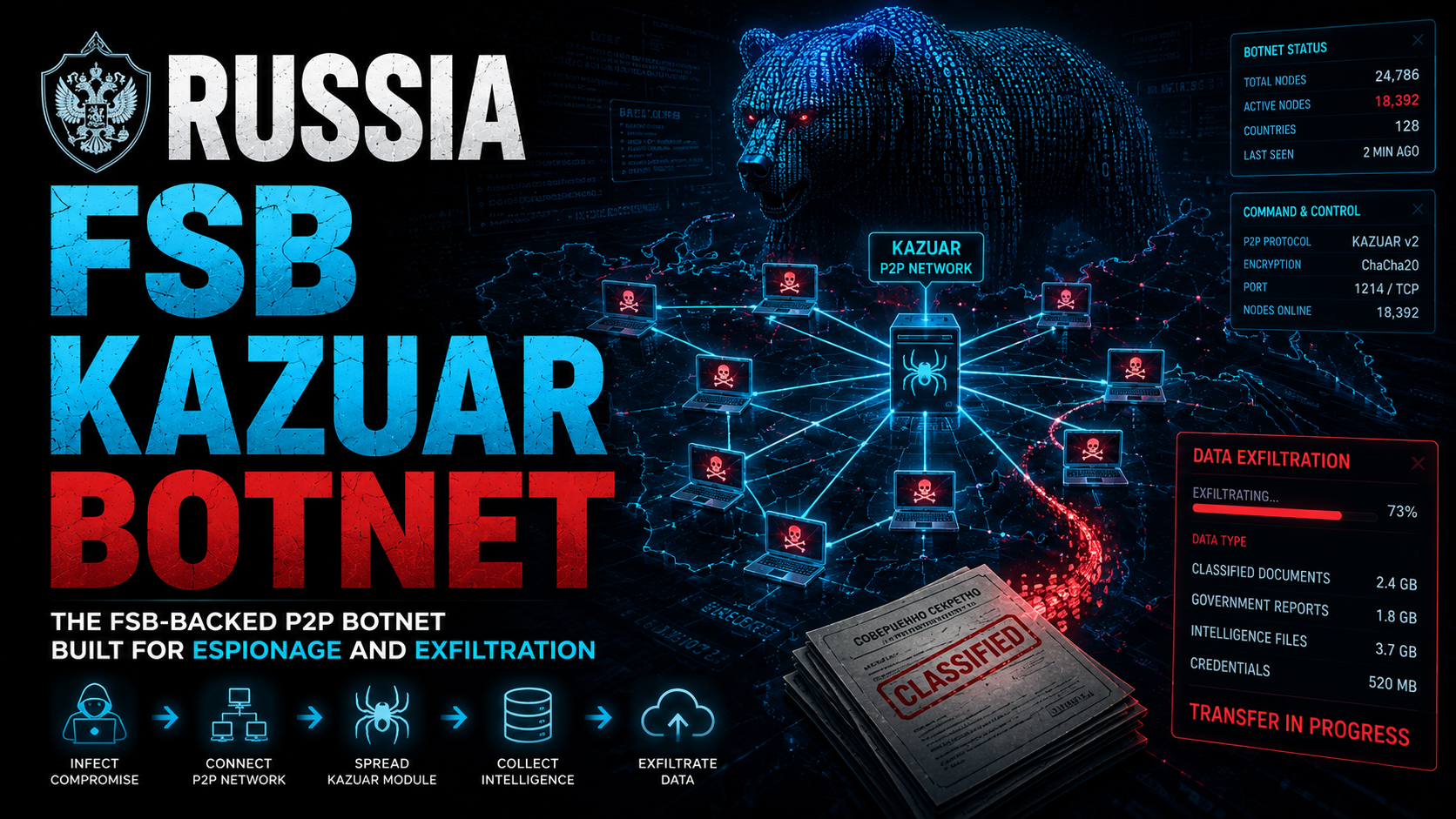
Microsoft’s Threat Intelligence team just published one of the most detailed technical analyses of a nation-state malware platform in recent memory. Their target: Kazuar, a sophisticated .NET backdoor operated by Turla, a Russian state-sponsored hacking group that the U.S. government has formally linked to Center 16 of Russia’s Federal Security Service (FSB).
The headline finding is alarming. Turla has quietly transformed Kazuar from a conventional backdoor — the kind that phones home to a single command-and-control server — into a fully modular peer-to-peer (P2P) botnet capable of operating even when its C2 infrastructure is taken down. It’s the kind of upgrade that turns a surveillance tool into a resilient military-grade cyber weapon.
The research, published on May 14, 2026, charts Kazuar’s evolution from its earliest known deployments in 2017 to its current form — and what Microsoft found should concern every government, diplomatic, and defense organization in Europe and Central Asia.
Who Is Turla? Russia’s Most Sophisticated Hacking Group
Turla isn’t just another APT group. It’s widely considered one of the most technically capable state-sponsored hacking operations in the world, with a track record stretching back over two decades. The group goes by at least a dozen names across different threat intelligence vendors: Secret Blizzard (Microsoft’s designation), Snake, Venomous Bear, Waterbug, Uroburos, SUMMIT, Pensive Ursa, Iron Hunter, Blue Python, ATG26, and WRAITH.
CISA formally assessed Turla as affiliated with Center 16 of Russia’s FSB — the signals intelligence branch responsible for foreign intelligence collection. That puts Turla in the same organizational bucket as the unit that conducts some of Russia’s most sensitive cyber espionage operations.
Turla’s operational history includes some of the most notable cyber espionage campaigns ever documented: compromising the Pentagon’s classified networks, breaching European government ministries, and infiltrating satellite communications systems to hide their traffic. Their tooling has always been a step ahead, and Kazuar’s latest evolution continues that pattern.
Kazuar’s Evolution: From Backdoor to Botnet
When Kazuar first appeared in 2017, it was what Microsoft describes as a “monolithic” framework — a single executable that handled command-and-control communication, task execution, data collection, and exfiltration all in one package. It was effective but inflexible. If defenders identified and blocked the C2 server, the implant became useless.
The version Microsoft documented in their latest research is fundamentally different. Turla has decomposed Kazuar into a modular ecosystem with three distinct component types, each with well-defined roles. This isn’t just a software update — it’s an architectural redesign that reflects years of operational experience and adaptation to defender capabilities.
The shift from a centralized C2 model to P2P communication is particularly significant. In a traditional botnet, taking down the command server cripples the entire network. In a P2P architecture, each compromised machine can relay commands to others, meaning the network can survive the loss of any individual node — including the operator’s own infrastructure.
The Three-Module Architecture
Microsoft’s analysis reveals three core components that make up the modern Kazuar botnet:
Kernel Module: This is the foundation layer. The Kernel handles initial infection persistence, system enumeration, and secure communication channel establishment. It’s the first component deployed on a compromised machine and is responsible for bootstrapping the rest of the ecosystem. The Kernel module is designed to be as small and quiet as possible, minimizing its footprint to avoid detection by endpoint security products.
Bridge Module: The Bridge is what enables the P2P functionality. It manages connections between compromised nodes, routes commands and data through the peer network, and handles the encryption and authentication protocols that keep the communications secure. The Bridge module is what makes Kazuar resilient — even if defenders take down C2 servers or block known malicious domains, the bot network can continue operating through peer connections.
Worker Module: Workers are the task execution engines. They receive instructions through the Bridge network and carry out specific operations: keylogging, screenshot capture, file exfiltration, credential harvesting, and lateral movement. Because Workers are modular, Turla can deploy different combinations of capabilities depending on the target, reducing the malware’s overall signature and making attribution harder.
This three-tier architecture means that compromising or analyzing one component doesn’t necessarily reveal the others. Each module can be updated independently, and different nodes in the botnet can run different versions — a nightmare for defenders trying to write comprehensive detection signatures.
P2P Communication: Why It Matters
The P2P architecture is arguably the most important aspect of Kazuar’s evolution. Traditional C2 models create a single point of failure that defenders can exploit. Identify the C2 server, sinkhole its domain, or block its IP address, and the entire botnet goes dark.
P2P eliminates that weakness. In Kazuar’s implementation, every infected machine can act as both a client and a relay. Commands from the operators can enter the network through any node and propagate to their intended targets through multiple hops. Data exfiltration follows the same pattern — stolen information bounces through several intermediary nodes before reaching the operators, making network-level attribution extremely difficult.
This approach also provides natural resilience against takedown operations. Law enforcement and security researchers have gotten increasingly good at coordinating botnet disruptions, but P2P networks are fundamentally harder to dismantle. You can’t just seize a server — you’d need to clean every single infected machine simultaneously, which is practically impossible at scale.
Targets and Victims
Kazuar’s targeting is consistent with Turla’s known priorities: government, diplomatic, and defense organizations in Europe and Central Asia. These are the institutions that hold the intelligence Russia’s FSB wants most — foreign policy communications, military planning documents, diplomatic cables, and defense procurement details.
Microsoft’s report notes that Turla specifically targets endpoints that have been previously compromised by Aqua Blizzard (also known as Gamaredon or Actinium) — a separate Russian threat actor assessed to be operated by Russia’s FSB Center 18. This piggyback strategy is a hallmark of sophisticated intelligence operations: use a noisier, more aggressive tool for initial access, then deploy a stealthier platform for long-term collection.
Turla Kazuar P2P Botnet and the Gamaredon Connection
The relationship between Turla and Gamaredon is one of the most fascinating aspects of Russian cyber operations. Gamaredon (Aqua Blizzard) is a prolific but relatively unsophisticated group that conducts high-volume phishing campaigns against Ukrainian targets. Their malware is noisy, frequently detected, and often quickly remediated.
But Turla has found a use for Gamaredon’s reckless approach. By monitoring machines that Gamaredon has already compromised, Turla can identify high-value targets and deploy Kazuar on systems where initial access has already been achieved. It’s a remarkably efficient division of labor: Gamaredon does the dirty work of mass exploitation, and Turla cherry-picks the most valuable victims for persistent, stealthy collection.
This operational model — where two state-sponsored groups from the same country coordinate (or at least interoperate) on targeting — represents a level of organizational sophistication that defense agencies worldwide are still struggling to counter.
Why the Turla Kazuar P2P Botnet Is So Hard to Detect
Kazuar’s modular design creates multiple detection challenges. The Kernel module maintains a minimal footprint, using legitimate system services for persistence and blending its network traffic with normal Windows communication patterns. The P2P Bridge module disguises its traffic as standard protocols, and the Worker modules are only deployed when needed — they don’t run continuously, reducing the window for behavioral detection.
The .NET framework choice is also strategic. .NET binaries can be heavily obfuscated while remaining functional, and they blend in naturally on Windows systems where .NET is a standard runtime component. Unlike custom C/C++ implants that might trigger heuristic detections, a .NET assembly that calls standard framework methods looks largely innocuous to automated analysis tools.
Microsoft’s report also highlights Kazuar’s anti-analysis capabilities, including detection of virtual machines and sandboxes, time-based execution delays to evade automated analysis, and the ability to selectively deploy capabilities based on the target environment — running full capabilities only on confirmed high-value targets while maintaining minimal presence elsewhere.
Defending Against Nation-State Botnets
Defending against something like Kazuar requires a different mindset than defending against commodity malware. Standard antivirus and even next-generation EDR solutions may miss components of the modular architecture, especially if the Kernel module establishes persistence before the EDR agent is fully operational.
Microsoft recommends several defensive measures: enabling enhanced logging on endpoints, particularly for .NET assembly loading and PowerShell execution; monitoring for unusual P2P network patterns within internal networks; implementing network segmentation to limit lateral movement; and conducting regular threat hunts specifically targeting nation-state TTPs.
Organizations in Turla’s target set — government agencies, diplomatic missions, defense contractors, and think tanks — should assume they are targets and invest in detection capabilities accordingly. The cost of a Kazuar compromise isn’t just data loss — it’s the silent, long-term extraction of strategic intelligence that can shift geopolitical outcomes.
Final Thoughts on the Turla Kazuar P2P Botnet
Microsoft’s exposure of Kazuar’s modular P2P architecture is a significant intelligence contribution to the defender community. But it also serves as a stark reminder of the resources and sophistication that nation-state actors bring to cyber operations. Turla has been active for over 20 years, and the Kazuar evolution shows they’re still innovating.
The transformation from a traditional backdoor to a resilient P2P botnet with modular capabilities isn’t just a technical achievement — it’s a strategic one. It means Russia’s FSB has built a persistent access platform that can survive infrastructure takedowns, adapt to new defensive technologies, and continue collecting intelligence from the world’s most sensitive networks for years to come.
For the cybersecurity community, the message is clear: the threat is evolving faster than most defenses, and nation-state actors like Turla are playing a game measured in decades, not quarters.
Resources for Defending Against Turla Kazuar and State-Sponsored Threats
Organizations concerned about the Turla Kazuar P2P botnet should consult multiple threat intelligence sources. Microsoft’s Security Blog published the original technical analysis with full indicators of compromise. The MITRE ATT&CK framework entry for Turla catalogs the group’s complete TTP arsenal across dozens of campaigns spanning over a decade.
For network defenders, CISA’s threat advisory portal regularly publishes detection signatures for Russian state-sponsored malware families. The Recorded Future threat intelligence blog provides additional context on how Kazuar fits into Russia’s broader cyber espionage operations. Security teams should also review Mandiant’s research archive for related Turla campaigns and detection methodologies.