Nvidia Q1 2026 record profit 58.3 billion AI chips earnings
|

Nvidia Just Printed $58.3 Billion in One Quarter — The Most Profitable 3 Months in Chip History

Table of Contents

Table of Contents

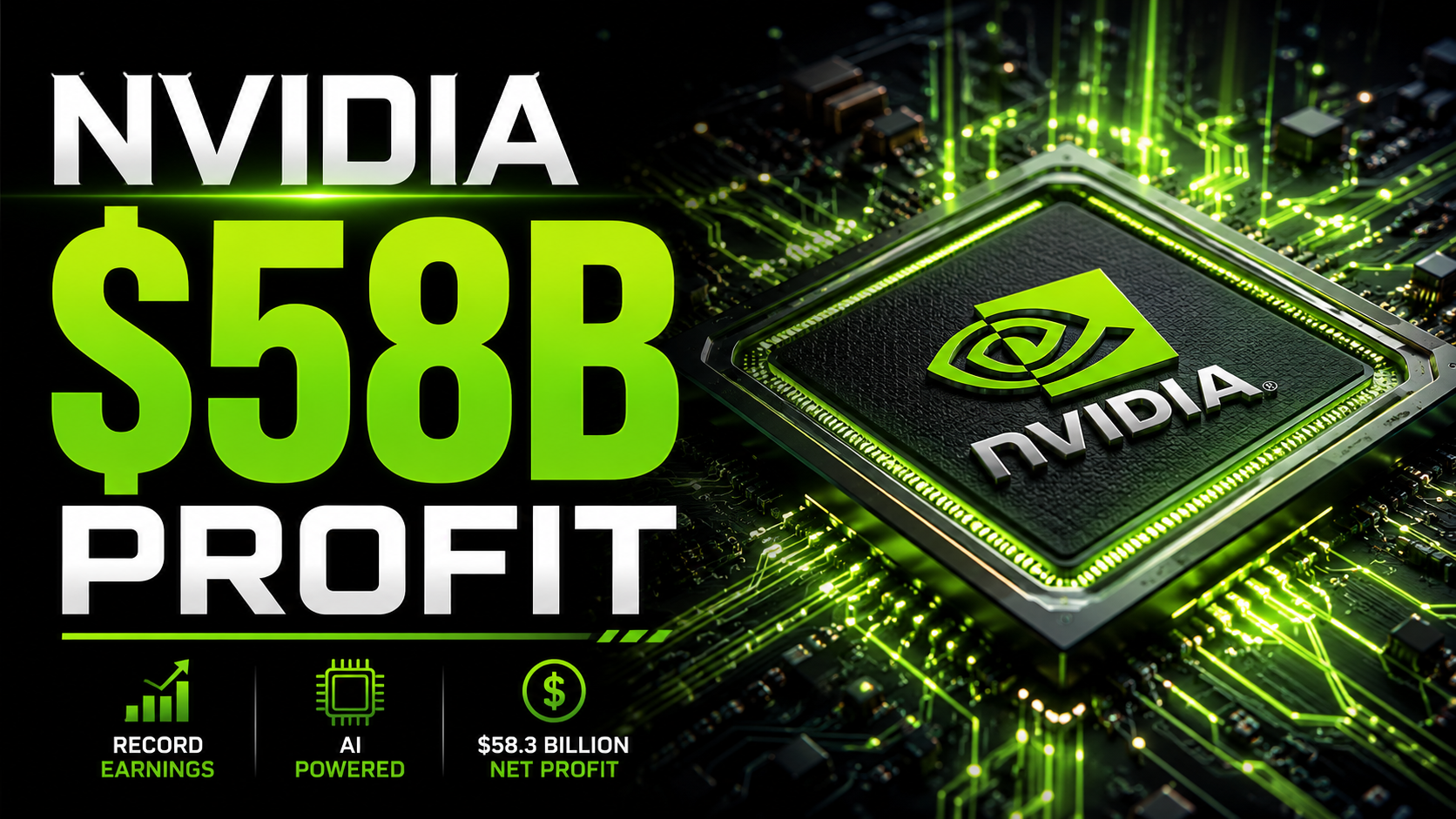
Nvidia just delivered the most profitable quarter in semiconductor history — and Wall Street barely flinched. When a company posts $58.3 billion in net income in a single quarter, you’d expect the markets to lose their minds. Instead, investors have already priced in dominance. That’s how far Nvidia’s AI chip empire has come.

The numbers from Nvidia’s Q1 FY2027 (February–April 2026) are staggering by any measure: revenue hit $81.6 billion, up 85% year-over-year. Net income surged 211% compared to the same period in 2025. The data center division alone — the engine powering the AI arms race — pulled in $75.2 billion, a 92% jump from last year.

And the company says this is just the beginning. Nvidia’s guidance for the current quarter? $91 billion in revenue. That would be another record.

The Numbers That Broke Records

Let’s break down what Nvidia just reported:

  • Revenue: $81.6 billion (up 85% YoY, up 20% from prior quarter)
  • Net income: $58.3 billion (up 211% YoY, up 37% from prior quarter)
  • Data center revenue: $75.2 billion (up 92% YoY)
  • Q2 2026 guidance: $91 billion revenue
  • EPS: Blew past analyst consensus of $1.75 per share

Analysts had expected roughly $78.91 billion in revenue. Nvidia beat that by nearly $3 billion. The data center segment now accounts for 92% of all Nvidia revenue — a total inversion from five years ago when gaming chips dominated the business.

Why Nvidia’s Moat Is Almost Impossible to Break

The real story isn’t the raw numbers — it’s the why. Every major hyperscaler (Microsoft, Google, Amazon, Meta) is in a frantic race to build AI infrastructure at a scale the world has never seen. That means hundreds of thousands of Nvidia H100 and H200 GPUs, plus the upcoming Blackwell architecture rollout.

Nvidia disclosed that H100 rental prices have risen approximately 20% in 2026 — and demand still outpaces supply. When you’re selling the only shovel in the gold rush at ever-higher prices and still can’t make enough of them, that’s not a business. That’s a printing press.

This dynamic is playing out across the entire AI stack. Big Tech is on track to spend a combined $725 billion on AI infrastructure in 2026, with the majority flowing through Nvidia’s CUDA ecosystem. Even companies exploring alternatives — like Cerebras with its wafer-scale AI chips — are a long way from denting Nvidia’s dominance.

Data Centers: The $75.2 Billion Engine

Nvidia’s data center segment is no longer a division — it is Nvidia. The $75.2 billion quarterly haul represents a business that rivals the annual revenues of most Fortune 500 companies. And it’s growing.

The key drivers of this growth include the massive H200 deployments by Microsoft Azure, Google Cloud, and Amazon Web Services, ongoing buildout of sovereign AI infrastructure in the Middle East and Asia, strong demand from model labs like Anthropic and OpenAI, and the emerging market for AI inference clusters — not just training.

The shift toward AI inference (running trained models at scale) is particularly important. Training a foundation model is a one-time expense; inference runs continuously, 24/7, at massive scale. That means recurring, durable demand for Nvidia silicon — not just a burst of capital expenditure.

CUDA: The Lock-In Nobody Talks About

Nvidia’s real competitive advantage isn’t the hardware — it’s CUDA, the software layer that makes Nvidia GPUs programmable for AI workloads. Over 15 years, Nvidia built an ecosystem of thousands of optimized libraries, frameworks, and tools around CUDA. PyTorch, TensorFlow, JAX — every major AI framework is optimized for CUDA first.

Switching away from Nvidia isn’t just about buying different chips. It means re-engineering entire AI pipelines, retraining teams, and accepting performance regressions during the transition. For a hyperscaler in a race to ship GPT-6 or Gemini 4, that’s not a risk they’re willing to take.

This is why AMD’s MI300X, Google’s TPUs, and Intel Gaudi have all made inroads — but none have meaningfully disrupted Nvidia’s core market share at the top of the inference and training stack.

The $91 Billion Question: What Comes Next?

Nvidia’s guidance of $91 billion for Q2 FY2027 (May–July 2026) implies continued acceleration. That number is extraordinary — it suggests Nvidia will generate more revenue in one quarter than most countries’ entire tech sectors produce in a year.

The Blackwell architecture is still ramping up supply. The GB200 “superchip” — featuring two B200 GPUs connected by NVLink — is being deployed in rack-scale configurations that promise 30x better performance per dollar for inference workloads compared to the H100 generation. As those systems come online at scale, Nvidia’s ASPs (average selling prices) are expected to rise even further.

There are headwinds. US export restrictions mean Nvidia can’t sell its most powerful chips to China without licenses. A downgraded “China-legal” chip, the H20, has been selling briskly — until reports emerged that geopolitical tensions could tighten those rules further. But the Chinese market’s share of Nvidia’s total revenue has shrunk significantly, making it a manageable risk.

Nvidia Stock: Is the Valuation Insane or Rational?

Nvidia currently trades at roughly 30x forward earnings — expensive by historical chip standards, but not irrational given the growth trajectory. When a company grows revenue 85% annually and is guiding for continued acceleration, traditional valuation frameworks start to break down.

The question investors are wrestling with: how long can the AI infrastructure buildout sustain this level of demand? There’s a credible bull case that AI capital expenditure remains elevated for the rest of this decade as the industry builds out inference clusters, reasoning models, and physical AI systems like humanoid robots. There’s also a bear case that hyperscalers overshoot, leading to a sharp correction in GPU demand once the current wave of infrastructure build is complete.

For now, the data says keep building. With $91 billion guided for next quarter, Nvidia’s story isn’t close to ending — and the AI applications being built on top of its silicon are only just beginning to demonstrate their economic potential.

What This Means for the AI Industry

Nvidia’s record quarter is more than a company milestone — it’s a signal about where the entire tech industry is heading. The AI arms race is real, it’s accelerating, and the companies that control the hardware layer are capturing enormous value.

The broader question is whether AI will ultimately deliver returns that justify this level of investment. Microsoft, Google, Amazon, and Meta are collectively spending hundreds of billions of dollars on infrastructure, betting that AI agents, automation, and new product capabilities will generate returns far exceeding those costs. Nvidia is the prime beneficiary of that bet — regardless of whether the bet ultimately pays off.

For now, Jensen Huang’s company sits at the center of the most consequential technology transition in decades. And with $58.3 billion in quarterly profit, it’s being compensated accordingly.

Sources: Al Jazeera — Nvidia posts record profit | Washington Post — Nvidia Q1 results | BeInCrypto — Nvidia earnings beat

Similar Posts

Leave a Reply

Your email address will not be published. Required fields are marked *