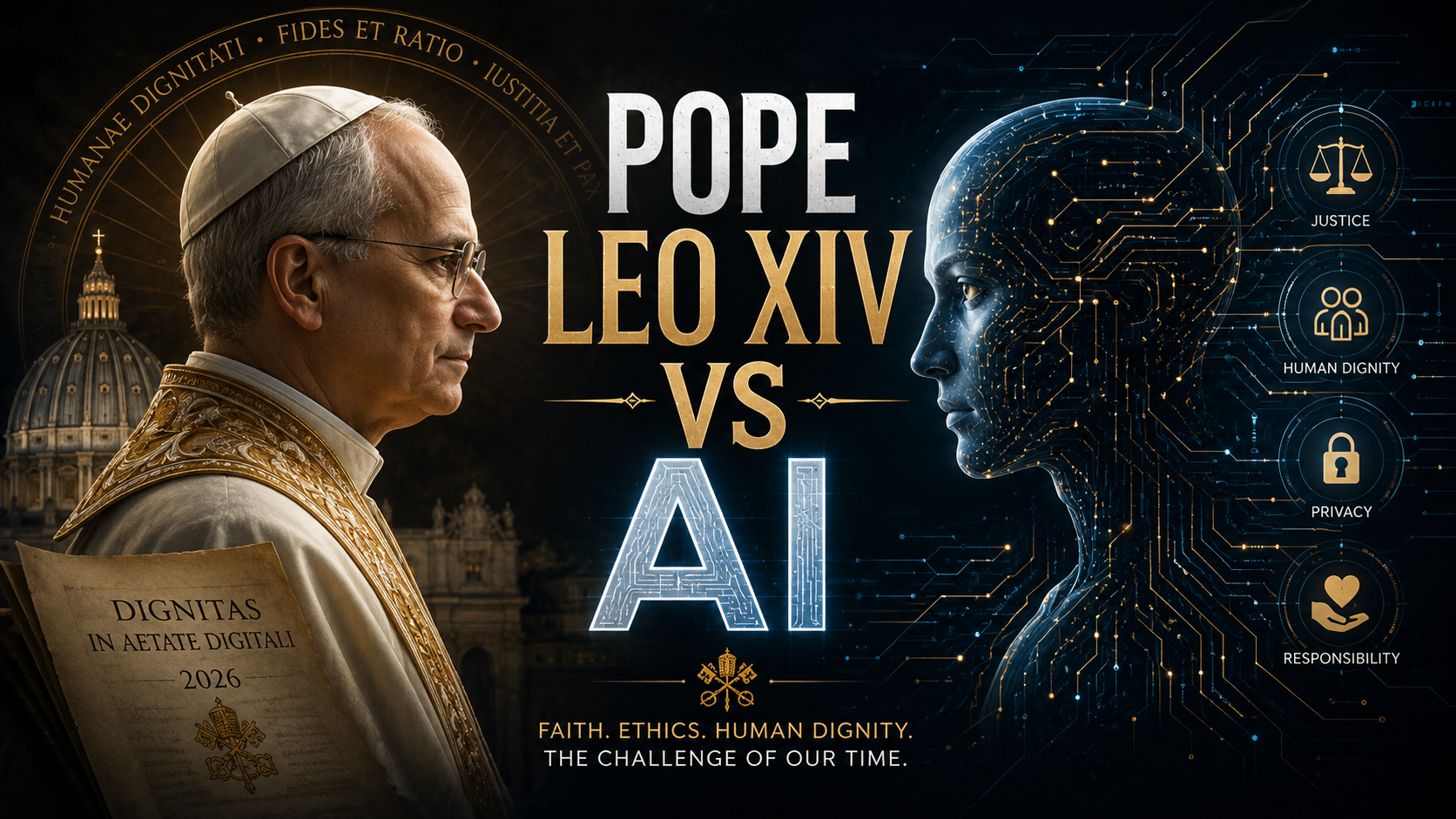
Pope Leo XIV’s AI Encyclical: Vatican Challenges Silicon Valley on Human Dignity in 2026
Table of Contents
Table of Contents
On May 25, 2026, the Roman Catholic Church will do something it has never done before: publish a papal encyclical specifically addressing artificial intelligence — and present it alongside a co-founder of one of the world’s most powerful AI companies. Pope Leo XIV’s first encyclical, Magnifica Humanitas (The Magnificence of Humanity), will be released at 11:30 AM at the Vatican’s Synod Hall, with Christopher Olah — co-founder of Anthropic and head of AI interpretability research — standing at the podium.
The intersection of the world’s oldest moral institution and Silicon Valley’s most ambitious technology is not symbolic. It is, arguably, the most significant ethical statement about AI that 2026 has produced.
What Is Magnifica Humanitas?
Magnifica Humanitas is Pope Leo XIV’s first encyclical letter — the highest form of papal teaching document, addressed to the entire Catholic Church and to all people of good will. Its subject: “the protection of the human person in the age of artificial intelligence.”
The encyclical bears the Pope’s signature dated May 15, 2026 — the 135th anniversary of Rerum Novarum, Pope Leo XIII’s landmark 1891 encyclical on workers’ rights in the industrial age. The choice of date is deliberate and powerful: the Church is drawing a direct parallel between the industrial revolution’s displacement of workers and AI’s displacement of humanity’s role in the modern world.
Where Rerum Novarum responded to factories replacing human labor with machinery, Magnifica Humanitas responds to AI replacing human cognition, creativity, and agency — a transformation arguably more profound than the industrial revolution.
Why Christopher Olah? The Anthropic-Vatican Connection
The presence of Christopher Olah at the Vatican’s launch event is striking. Olah is one of the pioneers of neural network interpretability — the scientific effort to understand why AI systems make the decisions they do, and to ensure they remain explainable to humans. He co-founded Anthropic, the AI safety company behind the Claude AI models, with a mission explicitly centered on building AI that is safe and beneficial for humanity.
Olah’s research focus — making AI’s internal reasoning legible to humans — aligns closely with the encyclical’s reported emphasis on human dignity and agency. The message the Vatican is sending is clear: the Church doesn’t view AI as inherently evil. It views unexamined, uncontrolled AI as a threat to human dignity — and it wants the people building AI to be held to a moral standard.
Anthropic has positioned itself as the safety-conscious alternative in an increasingly reckless AI race. The Vatican collaboration reinforces that identity at a global scale. This comes as Anthropic was notably excluded from Pentagon AI deals — perhaps its principled stance on safety is finding different, more philosophical allies.
What the Encyclical Is Expected to Say
While the full text hasn’t been released yet, Vatican officials and advance summaries indicate Magnifica Humanitas will address:
- Human dignity in the face of AI displacement — the right of humans to meaningful work, creativity, and purpose in an age of automation
- The ethics of AI development — calling on AI companies and governments to pursue safety, transparency, and accountability
- Algorithmic bias and inequality — how AI systems can entrench existing inequalities if not deliberately designed otherwise
- Surveillance and privacy — the threat posed by AI-powered mass surveillance to individual freedom and conscience
- The responsibility of developers — a direct moral call to AI researchers and engineers to consider the human consequences of their work
- AI in warfare — concerns about autonomous weapons and lethal AI systems operating without human oversight
The encyclical also connects to the Church’s broader social teaching tradition — the Laudato Si’ series on the environment, Caritas in Veritate on economic justice — placing AI ethics firmly within Catholic social doctrine.
Why Now? The Perfect Storm of AI Anxiety
The timing of Magnifica Humanitas is not accidental. Consider what’s happening in tech right now:
- Meta just fired 8,000 workers to fund AI infrastructure
- AI is now capable of generating zero-day exploit code, enabling AI-assisted cyberattacks at scale
- Autonomous AI agents are beginning to take action in the real world without human approval at each step
- Surveillance capabilities enabled by AI have expanded dramatically in authoritarian and democratic countries alike
- The AI chip market is being dominated by a handful of companies with virtually no public oversight
A Gallup poll from earlier this month found that 71% of Americans oppose AI data centers being built in their communities — a figure that reflects deep unease with how rapidly AI infrastructure is being deployed with minimal democratic input. The Church is responding to a genuine public anxiety that government has been slow to address.
The Full Vatican Lineup: A Global Conversation
The May 25 launch event at the Synod Hall will feature a remarkable cross-disciplinary panel alongside Pope Leo XIV and Christopher Olah:
- Cardinal Víctor Manuel Fernández — Prefect of the Dicastery for the Doctrine of the Faith, the Church’s doctrinal authority
- Cardinal Michael Czerny, S.J. — Prefect of the Dicastery for Promoting Integral Human Development, focused on economic and social justice
- Professor Anna Rowlands — Theologian and professor at Durham University, an expert in Catholic social thought
- Professor Leocadie Lushombo — Professor of political theology and Catholic social thought, bringing Global South perspectives
The combination of a doctrinal authority, a social justice advocate, a theologian, and an AI safety researcher in the same room signals that the Vatican is treating AI as a complete civilizational challenge — not just a technical problem.
Why This Matters Beyond Religion
Even if you’re not Catholic — even if you’re not religious at all — Magnifica Humanitas matters. Here’s why:
The Catholic Church has 1.4 billion members globally and significant moral and political influence in over 100 countries. Papal encyclicals have shaped labor law (Rerum Novarum directly influenced minimum wage legislation), environmental policy (Laudato Si’ influenced the Paris Agreement negotiations), and more. An encyclical specifically demanding ethical AI governance could shape regulatory debates in Europe, Latin America, and Africa — regions where tech companies currently operate with minimal oversight.
Moreover, the Vatican’s choice to partner with Anthropic — rather than criticize OpenAI’s recent moves toward commercialization or Google’s dominance — signals a sophisticated understanding of the AI landscape. The Church isn’t technophobic. It’s drawing a moral line around the pace and direction of AI development.
Early Reactions: From Tech to Theology
The announcement has generated unusual reactions across traditionally separate worlds. AI safety researchers have welcomed the encyclical as potential political cover for safety-focused AI governance that has struggled to gain traction in the US. The EU’s AI Act — which has faced pushback from Big Tech — may find new momentum if the Church explicitly endorses its core principles.
Some Silicon Valley insiders view the encyclical with skepticism, arguing that theological frameworks aren’t equipped to address the technical realities of AI development. Others see it as a genuinely necessary intervention in a debate that has been too narrowly confined to engineers, investors, and regulators.
As America Magazine noted: “Pope Leo’s encyclical comes just in time: AI is raising questions only religion can answer.” Whether you agree with that framing or not, the questions being raised — about meaning, dignity, purpose, and what it means to be human — are exactly the ones that pure technical discourse has consistently failed to address.
Bottom Line: The Moral Debate Around AI Just Got Much Bigger
On May 25, the world’s largest religious institution will publish the most significant moral statement on artificial intelligence ever produced by a non-governmental body. It will be presented by both the Pope and a co-founder of the company that made the AI powering this very article.
Whether Magnifica Humanitas changes anything depends on whether governments, companies, and developers are willing to listen. But the fact that 1.4 billion people’s spiritual leader is speaking directly to the AI engineers of Silicon Valley is, at minimum, an unmistakable sign of where the moral weight of 2026’s defining technology debate now sits.