Anthropic Just Bought the Tool That OpenAI and Google Depend On — Then Killed It
Table of Contents
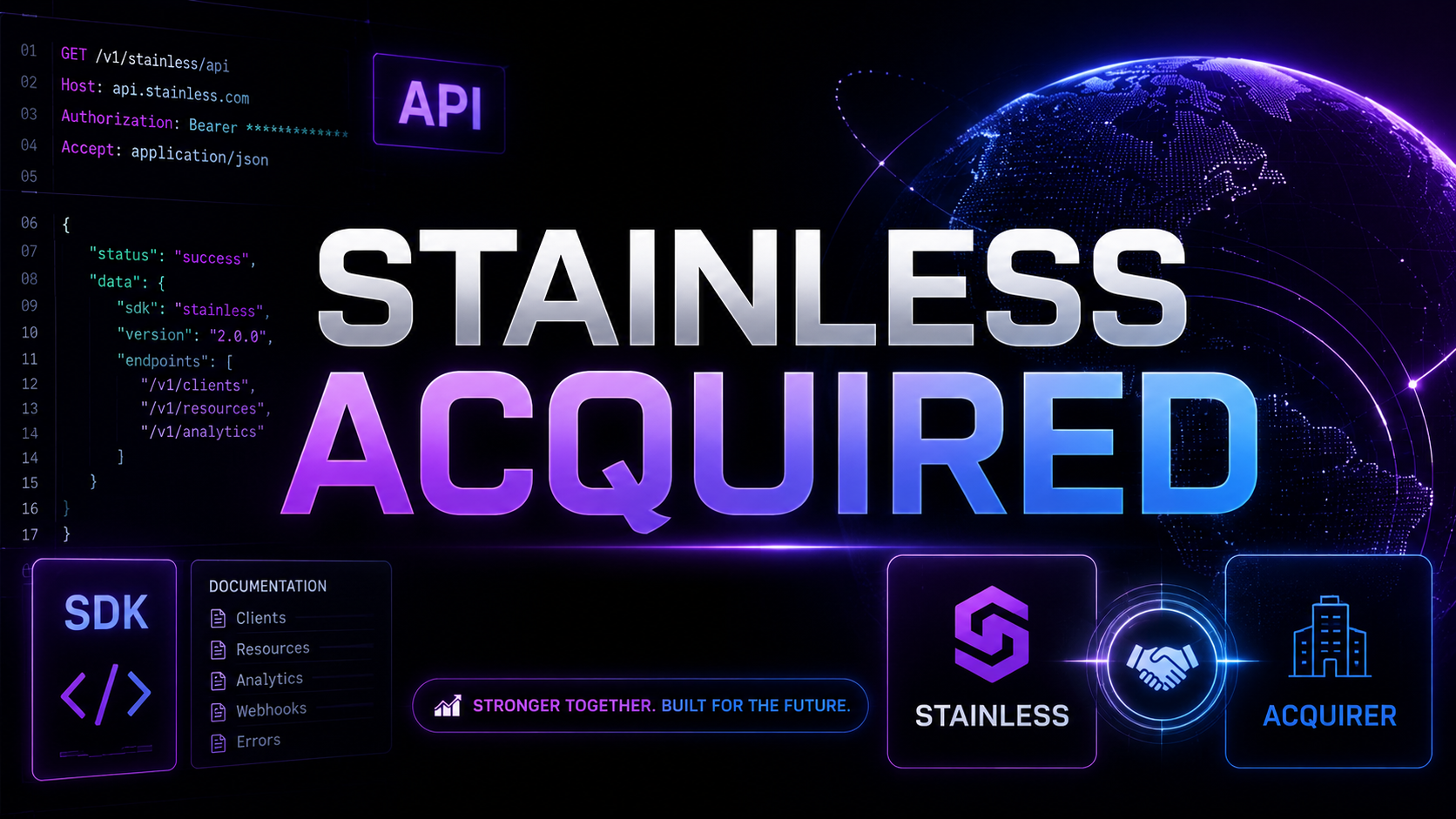
On May 18, 2026, Anthropic made a move that most people outside the developer world completely missed. The company acquired Stainless, a small New York-based startup that builds software development kits (SDKs), for more than $300 million.
That sounds like a boring developer tools acquisition. It’s not. Here’s why: Stainless is the company that builds the SDKs for OpenAI, Google, Cloudflare, and dozens of other major tech companies. And after buying it, Anthropic announced it would shut down all hosted Stainless products.
In one move, Anthropic acquired a critical piece of its competitors’ infrastructure — and pulled the plug.
What Is Stainless?
Stainless, founded in 2022 by former Stripe engineer Alex Rattray, solved a tedious but critical problem in software development. When a company builds an API (like OpenAI’s API or Google’s API), developers need SDKs — libraries in Python, TypeScript, Go, Java, Kotlin, and other languages — to interact with that API.
Building and maintaining SDKs across multiple languages is expensive and time-consuming. Stainless automated this process: you give it your API specification, and it generates production-ready SDKs across all major programming languages. No manual coding. No version mismatches. No maintenance headaches.
The company was backed by Sequoia Capital and Andreessen Horowitz — two of the most prestigious VC firms in the world. Its client list read like a who’s who of tech: OpenAI, Google, Cloudflare, Anthropic itself, and many others.
The $300M+ Deal
Anthropic didn’t disclose the exact price, but The Information reported the deal was worth more than $300 million. For a developer tools startup with a relatively small team, that’s an extraordinary premium.
But Anthropic wasn’t paying for the revenue. It was paying for the strategic position. Stainless is embedded in the development workflow of nearly every major AI company. Acquiring it gives Anthropic control over a piece of infrastructure that its competitors depend on.
Why This Matters More Than You Think
To understand why this acquisition is significant, you need to understand how the AI API ecosystem works. When developers build applications using AI models like Claude or GPT, they don’t interact with the model directly. They use SDKs — pre-built code libraries that handle authentication, request formatting, error handling, and response parsing.
These SDKs are the interface layer between developers and AI models. If your SDK is better — faster, more reliable, better documented — developers are more likely to choose your model. SDKs might seem like a small detail, but they have an outsized impact on developer adoption.
By acquiring Stainless, Anthropic now has the team that knows how to build world-class SDKs faster than anyone else. That’s a permanent advantage in developer experience.
The Shutdown That Shook Developer Twitter
The controversial part of this acquisition wasn’t the purchase — it was what came next. Anthropic announced it would wind down all hosted Stainless products, including the SDK generator that companies like OpenAI and Google relied on.
An Anthropic spokesperson said existing Stainless customers “still own the SDKs they’ve generated to date and have full rights to modify and extend them.” But the service itself? Gone. No more automated SDK generation for competitors.
This forced companies using Stainless to either build their own SDK generation tools, find an alternative provider, or manually maintain their SDKs across multiple languages. None of these options are quick or cheap.
The Strategic Play
Anthropic’s acquisition of Stainless serves multiple strategic purposes. First, it improves Anthropic’s own developer tools. Claude’s SDKs will now be maintained by the best SDK team in the industry.
Second, it disrupts competitors’ developer workflows. OpenAI and Google now need to find alternative ways to maintain their SDKs. That takes time, money, and engineering talent that could be spent on other things.
Third, it signals that developer experience is a competitive weapon in the AI wars. The company with the best SDKs, documentation, and developer tools wins the developers. And the company that wins the developers wins the market.
Who Gets Hurt
The most directly affected companies include OpenAI, which used Stainless for its official Python and Node.js SDKs, Google, which used it for some of its API client libraries, and Cloudflare, which relied on Stainless for its developer SDK generation.
These companies aren’t going to collapse because of this — they have the resources to build their own solutions. But it’s a meaningful operational disruption at a time when every week matters in the AI race.
Smaller companies that relied on Stainless are in a worse position. They may not have the engineering bandwidth to maintain SDKs across five or six languages without automated tooling.
The Bigger Picture: Infrastructure as Weapon
The Stainless acquisition is part of a broader trend in the AI industry: companies are weaponizing infrastructure. Instead of just competing on model quality, AI labs are now competing on every layer of the stack — from chips to data centers to developer tools.
Anthropic’s recent moves tell the story. The company is building frontier models, expanding globally, and now acquiring critical developer infrastructure. It’s not just trying to build the best AI — it’s trying to build the best platform.
This mirrors what Google did with Android (control the OS), what Apple did with the App Store (control distribution), and what Amazon did with AWS (control the infrastructure). The company that controls the most layers of the stack has the most leverage.
The Bottom Line
Anthropic paying $300 million for an SDK startup sounds boring. It’s actually one of the most strategically ruthless moves in the AI wars so far.
Buy the tool your competitors depend on. Shut it down. Use the team to make your own products better while forcing everyone else to scramble.
It’s not illegal. It’s not even unethical. But it’s a clear signal that the AI competition has moved beyond “who has the best model” into “who controls the most infrastructure.”
And right now, Anthropic is playing that game harder than anyone.