Meta’s Llama 5 ‘Avocado’ Missed 3 Deadlines: Now It’s Going Closed Source
Table of Contents
Meta Llama 5 Avocado has missed three release deadlines, burned through $135 billion in AI investment, and now — in the most un-Meta move imaginable — it’s going closed source. The model that was supposed to cement Meta’s position as the champion of open-source AI is being locked behind a proprietary wall. If you built your company’s AI strategy around the assumption that Meta would keep releasing frontier models for free, it’s time to panic.
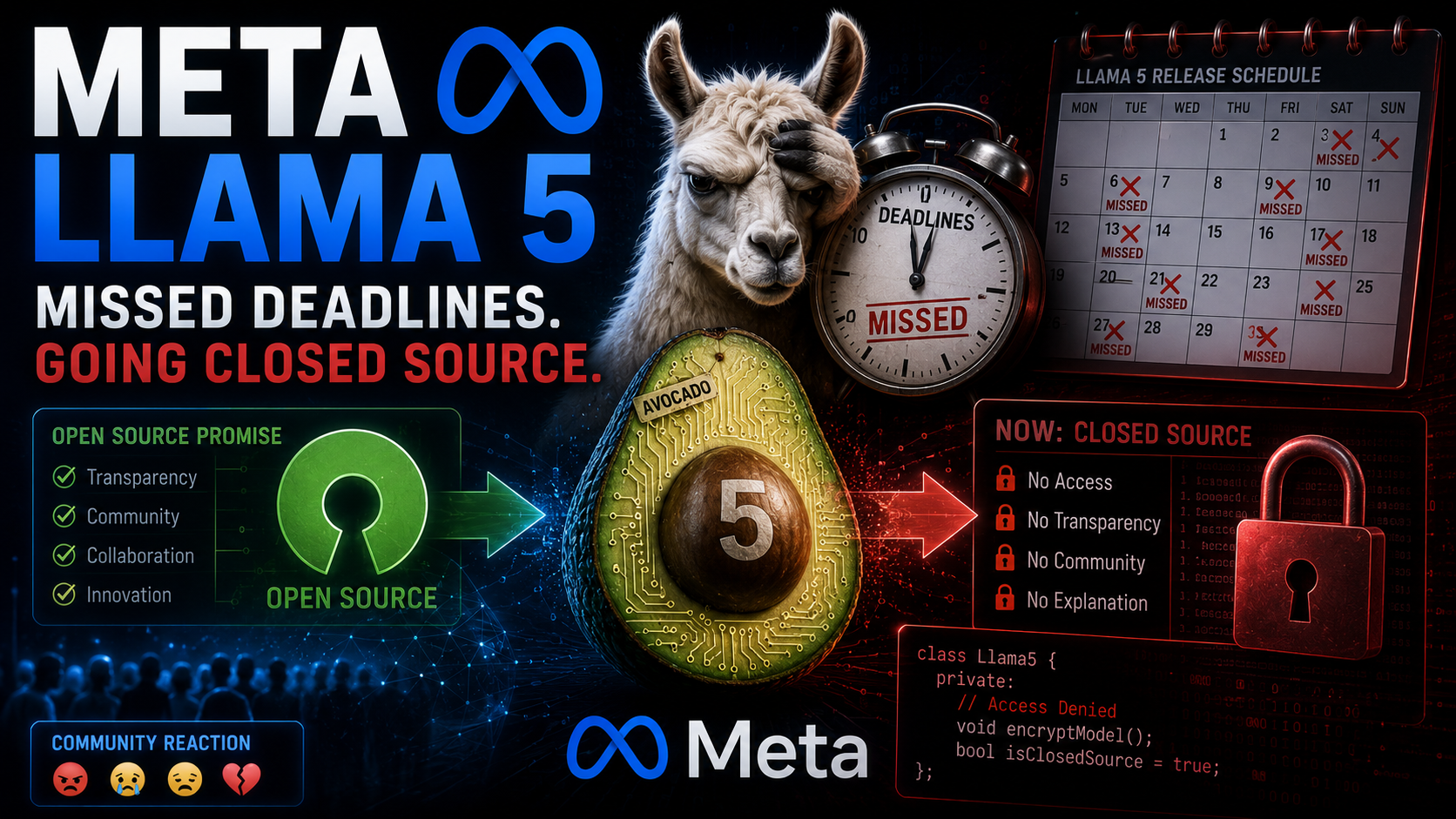
Codenamed “Avocado” and developed by Meta’s newly formed Superintelligence Labs division, Llama 5 was originally scheduled for release at the end of 2025. Then it was pushed to March 2026. Then May. Now June 2026, and even that date looks uncertain. Each delay was accompanied by vague statements about “additional safety evaluation” and “performance optimization.” But the real story — the one Meta doesn’t want to tell — is that Avocado isn’t performing as well as they hoped, and the economics of giving away frontier AI models are finally catching up to Zuckerberg’s strategy.
Meta Llama 5 Avocado: The Open Source Betrayal
Let’s call this what it is: a betrayal. Meta built its entire AI reputation on open source. Llama 1 (2023) was a revelation — a powerful language model that researchers and developers could actually download, fine-tune, and deploy. Llama 2 expanded the ecosystem. Llama 3 and 3.1 became the backbone of countless startups, academic projects, and enterprise AI deployments. Meta was the “good guy” of AI — the company that believed in democratizing access to frontier models.
Now, with Meta Llama 5 Avocado, that entire narrative collapses. Internal sources confirm that Avocado will NOT be released under an open-source (or even “open weight”) license. Instead, it will be available only through Meta’s own AI products — WhatsApp, Instagram, Facebook Messenger, and the Meta AI assistant. Enterprise access will reportedly be offered through paid API tiers, directly competing with OpenAI, Anthropic, and Google rather than enabling the open-source community.
The justification Meta provides is predictable: safety. They claim that frontier-capability models present risks when openly distributed, and that responsible deployment requires controlled access. The same argument OpenAI used when it stopped publishing weights. The same argument Google uses for Gemini. The difference is that Meta positioned itself as the alternative to that philosophy. They were supposed to be different.
This shift connects to a broader pattern we’ve been tracking. When we covered the Claude Mythos launch, we noted how AI companies are increasingly using marketing spectacle to distract from competitive realities. Meta’s “open source champion” branding was always partly marketing — and now the mask is off.
Meta Llama 5 Avocado Missed Deadlines: A Timeline
The Meta Llama 5 Avocado development timeline reads like a case study in scope creep and underdelivering:
- Mid-2025: Meta announces Superintelligence Labs, a new division dedicated to building “the world’s most capable AI.” Llama 5 development begins, codenamed Avocado.
- Q4 2025 (Original deadline): Initial target for Llama 5 release. Missed. Meta cites “extended pre-training” as the reason.
- January 2026: Pre-training officially completes. Post-training, alignment, and safety evaluation begin.
- March 2026 (Second deadline): Missed. Internal reports suggest benchmark performance wasn’t meeting targets. Additional training runs initiated.
- May 2026 (Third deadline): Missed again. Meta quietly shifts messaging from “open release” to “product integration” — the first signal that Avocado won’t be open-sourced.
- June 2026 (Current target): Limited announcement expected, likely as a product feature within Meta AI rather than a model release.
Three missed deadlines in six months for a company spending $135 billion on AI infrastructure. That’s not a minor delay — it suggests fundamental challenges in scaling model performance beyond what Llama 4 achieved.
Why Meta Llama 5 Avocado Is Going Closed Source
There are two reasons Meta is locking Avocado behind closed doors, and only one of them is about safety.
Reason 1: Economics. Training a frontier model costs hundreds of millions of dollars. Llama 3’s training run reportedly cost $200-300 million in compute alone. Llama 5, with its larger scale, likely cost $500 million or more. Meta’s total AI investment has reached $135 billion across infrastructure, talent, and research. At some point, shareholders start asking: what’s the return on that investment?
When Meta gave away Llama 2 and 3, the strategy was to commoditize the model layer so companies would build on Meta’s ecosystem (PyTorch, ONNX, Meta’s cloud partnerships). But that strategy only works if your model is clearly the best open option. With Mistral, Cohere, and others producing competitive open models, Meta’s free frontier models were creating competition for themselves without capturing the economic value.
Reason 2: Competitive pressure. Avocado’s benchmark performance reportedly places it as second-tier compared to the latest from OpenAI (GPT-5.5), Anthropic (Claude Opus 4.7), and Google (Gemini 3.0). Releasing a model that doesn’t clearly lead on benchmarks — while competitors charge premium prices for their superior models — would undermine Meta’s narrative of AI leadership.
By keeping Avocado closed, Meta can optimize it for specific product experiences (consumer chat, image generation, real-time translation) where raw benchmark performance matters less than user experience. It’s a pivot from “best model” to “best product” — which is smart business but terrible for the open-source community that depended on Meta’s generosity.
Meta Llama 5 Avocado Benchmarks vs GPT-5.5, Claude Opus
According to leaked internal evaluations and industry sources, Avocado’s performance picture is mixed:
- Coding benchmarks: Competitive with GPT-5.5, behind Claude Opus 4.7 on complex multi-file tasks
- Reasoning: Improved over Llama 4 but not matching Gemini 3.0’s chain-of-thought performance
- Multilingual: Strong — potentially best-in-class for non-English languages, reflecting Meta’s global product needs
- Multimodal: Image understanding and generation capabilities integrated, competitive with GPT-5.5
- Context window: Reported 256K tokens, behind some competitors but sufficient for most enterprise use cases
- Enterprise tasks: Document analysis, summarization, and structured data extraction ranked second or third tier vs. the competition
The picture is clear: Meta Llama 5 Avocado is a capable model but not the undisputed leader in any single category. In the AI race, being “pretty good at everything” isn’t enough to justify $135 billion in investment or to win enterprise contracts away from OpenAI and Anthropic. The Google Gemini 3.1 Pro launch showed that even Google, with its vast resources, had to deliver clear performance leadership to stay relevant. Meta apparently couldn’t.
$135 Billion AI Investment and What Meta Got For It
Meta’s $135 billion cumulative AI investment makes it one of the largest AI spenders on the planet, rivaling Microsoft’s OpenAI partnership and Google’s internal AI budget. That money has gone toward:
- GPU clusters: Massive H100 and H200 deployments, plus custom MTIA (Meta Training and Inference Accelerator) chips
- Data centers: New facilities specifically designed for AI training workloads
- Talent: Aggressive hiring (and retention bonuses) for AI researchers, many poached from Google, OpenAI, and academia
- Meta Superintelligence Labs: A new division carved out specifically for frontier model development
- Research: Continued investment in open research publications, even as the model itself goes closed
What has Meta gotten for $135 billion? A model that can’t definitively beat GPT-5.5 on enterprise benchmarks. That’s the blunt reality. Meta’s AI products — the Meta AI assistant, AI-generated content in Instagram, WhatsApp chatbots — are useful consumer features, but they don’t generate the enterprise revenue that OpenAI and Microsoft are capturing with Copilot, or that Google is capturing with Gemini for Workspace.
Wall Street is starting to notice. Meta’s stock has faced pressure as analysts question the AI spending trajectory. As we covered in our piece on Big Tech layoffs amid record profits, companies are under immense pressure to show AI returns. Meta’s decision to close-source Avocado may be partly driven by shareholder pressure to monetize AI investments rather than give them away.
Project Mango: The Smaller Meta Llama 5 Variant
There’s a glimmer of hope for the open-source community. Meta is reportedly also developing “Mango” — a smaller, more efficient variant of Llama 5 aimed at on-device and edge deployment. Mango is rumored to be a 7B-30B parameter model optimized for mobile devices, IoT, and cost-effective inference.
The speculation is that Mango might still be released with open weights, continuing the Llama tradition at the smaller scale while keeping Avocado (the flagship) proprietary. This two-tier approach would let Meta claim it’s “still open source” while reserving the most capable model for monetization. It’s clever corporate positioning — give away the Honda while selling the Ferrari — but it fundamentally changes the Llama value proposition.
If Mango does get an open release, it could be significant for on-device AI. Running capable models locally is increasingly important — as we explored in our AI agents tutorial, edge deployment is where practical AI applications live. A high-quality, small Llama 5 model running on phones and laptops could still be game-changing, even if Avocado stays locked away.
What Meta Llama 5 Avocado Means for Open Source AI
The open-source AI community just lost its biggest patron. Meta’s decision to close-source Avocado signals that even the most vocal advocates of open AI eventually succumb to economic gravity. When training a frontier model costs hundreds of millions of dollars, giving it away for free is a business decision, not a moral stance — and business decisions can be reversed.
The good news is that the open-source AI ecosystem has diversified significantly since Llama 2. Mistral, Cohere’s Command series, Allen AI’s OLMo, Databricks’ DBRX, and numerous other projects continue to advance open models. The community isn’t dependent on Meta alone anymore. But Meta’s models were consistently the most capable open options, and losing that benchmark-leading open model will slow down research, reduce competitive pressure on closed providers, and limit access for smaller organizations that can’t afford API pricing.
There’s a deeper philosophical question here: was open-source AI ever sustainable at the frontier? Training runs that cost $500 million or more are beyond the reach of non-profit organizations, academic institutions, and small companies. If only Big Tech companies can afford frontier training, and those companies eventually decide the economics don’t justify open release, the future of AI becomes a closed oligopoly. That’s precisely the outcome open-source advocates warned about — and Meta just moved one step closer to making it reality.
Meta Llama 5 Avocado: The Real Question
The real question about Meta Llama 5 Avocado isn’t when it launches or how it performs. It’s whether Meta’s retreat from open source is permanent or temporary. If Avocado’s closed release is just a response to current competitive pressure — a strategic pause while Meta catches up — then Llama 6 or 7 might return to open weights. But if it reflects a fundamental shift in Meta’s AI business model, the open-source community needs to find alternative champions.
Three missed deadlines, $135 billion spent, and a model that can’t definitively beat the competition. That’s the Meta Llama 5 Avocado story as it stands in June 2026. Meta built an empire on the promise of open AI, and now they’re taking their ball and going home. The open-source community will survive — it always does — but the frontier just got a little more closed, a little more expensive, and a lot less accessible.
Follow SudoFlare for continuing coverage of the AI model wars, including benchmark analysis when Avocado finally ships. We’ll also be tracking whether the Mango variant gets an open release and what that means for the broader ecosystem. If you’re interested in how these AI models are being deployed in real-world systems, check out the Pentagon’s AI infrastructure strategy for a look at how governments are navigating the open vs. closed debate.