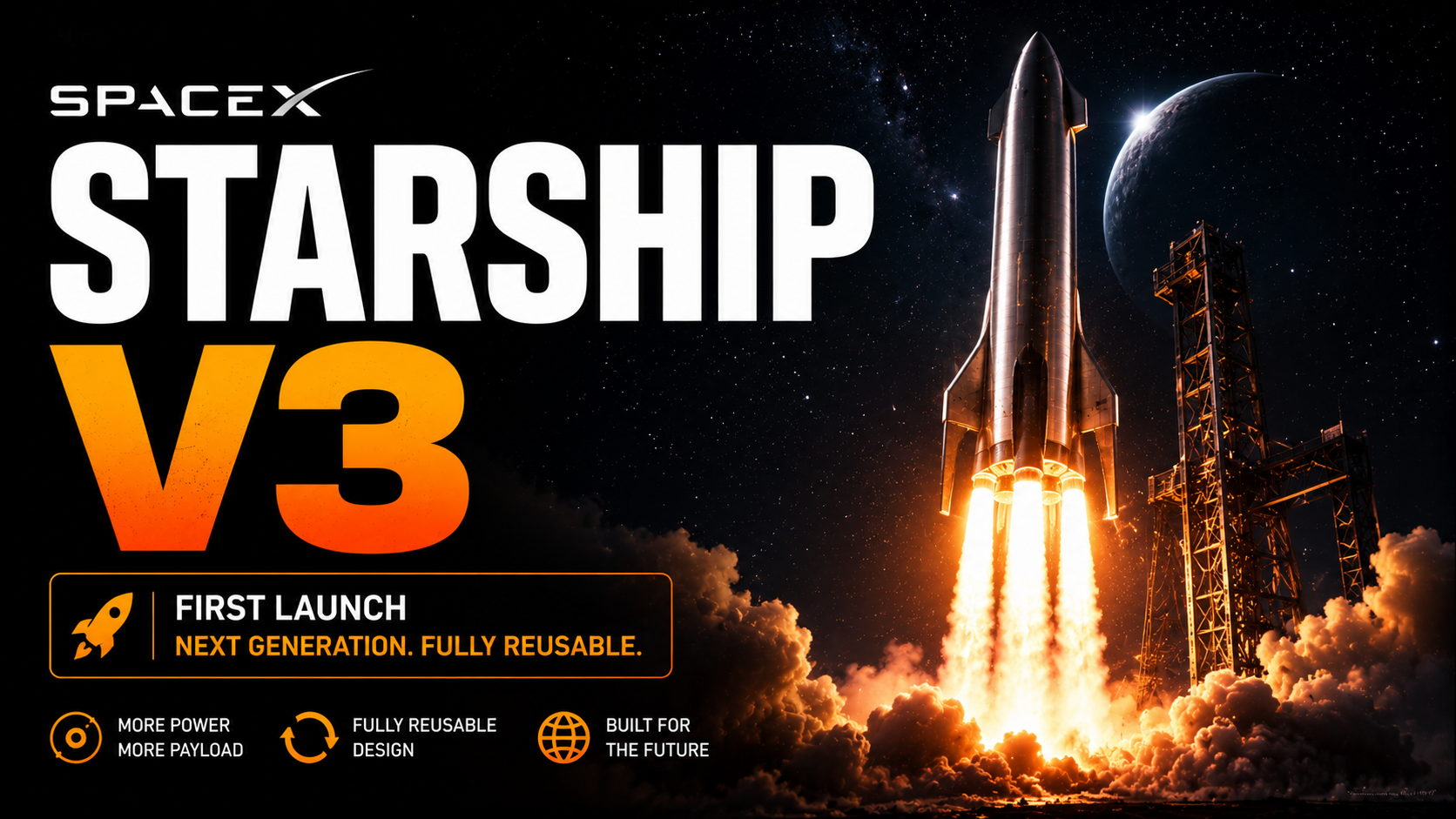
SpaceX Starship V3 Just Flew for the First Time — The Booster Crashed, but the Ship Nailed Its Landing
Table of Contents
Table of Contents
Starship V3 Flight 12: The Tallest Rocket in History Finally Launches
After a last-minute scrub on Thursday, SpaceX successfully launched the first-ever Starship V3 rocket on its 12th test flight from Starbase, Texas on May 22, 2026. The launch from the brand-new Pad 2 marked the debut of SpaceX’s most powerful and ambitious vehicle yet — a towering megarocket designed to deliver 100 metric tons to Earth orbit in a fully reusable configuration.
The results were quintessentially SpaceX: a spectacular mixture of triumph and spectacular failure that still managed to advance the program by leaps and bounds. The Super Heavy booster spun out of control and crashed into the Gulf of Mexico during its boostback burn. But the Starship upper stage, despite losing one of its Raptor engines, completed a controlled reentry and splashdown in the Indian Ocean — deploying 22 Starlink simulators and two real observation satellites along the way.
For SpaceX, this is exactly the kind of data-rich flight that justifies the “test early, test often” philosophy. For the rest of the space industry — and for the investors eyeing SpaceX’s imminent IPO — it was a reminder that making the most ambitious engineering project in history work is going to be messy, expensive, and absolutely thrilling.
What Makes Starship V3 Different: Raptor 3 Engines and Radical Design Changes
Starship V3 is not a minor revision — it is a fundamental redesign of the vehicle. The most significant change is the new Raptor 3 engine, which delivers higher thrust while being lighter and mechanically simpler than its predecessor. The simplified design means fewer potential failure points and faster manufacturing, which is critical for SpaceX’s goal of mass-producing Starship vehicles like automobiles.
The Super Heavy booster received a radical redesign of its own. V3 reduces the number of grid fins from four large ones to three even larger and stronger fins, with an integrated hot-staging design that eliminates the expendable interstage adapter. In previous flights, the interstage was a disposable section that was jettisoned during stage separation. By integrating hot-staging directly into the booster design, SpaceX reduces mass and complexity while simplifying the recovery process.
The vehicle is also taller and more capable than any rocket ever built. Standing at over 400 feet tall when fully stacked, Starship V3 dwarfs the Saturn V moon rocket and makes every other launch vehicle on the planet look like a model rocket by comparison. The payload capacity of 100 metric tons to orbit in reusable mode (and significantly more in expendable mode) opens up mission profiles that were previously impossible — from deploying massive satellite constellations to sending heavy equipment to the Moon and Mars.
The Super Heavy Booster Spun Out of Control and Crashed
The flight’s most dramatic moment came during the booster’s attempted boostback burn. After hot-staging — where the Starship upper stage’s six Raptor vacuum engines ignited while still attached to the booster — the Super Heavy initiated its flip and boostback maneuver. But something went wrong.
According to Space.com’s live coverage, several booster engines failed to ignite during the boostback burn, causing the vehicle to spin uncontrollably. Without sufficient thrust to arrest its trajectory and return to the launch site, the booster tumbled into the Gulf of Mexico in an uncontrolled impact.
Importantly, the booster was not planned to be recovered on this flight. SpaceX had not intended to attempt a tower catch — the signature maneuver where the Super Heavy booster returns to the launch site and is caught by the tower’s mechanical arms. This was a data-gathering flight, and the booster was always going to end up in the ocean. The question was whether it would get there gracefully or not. The answer: not gracefully, but with plenty of useful telemetry data about the new engine and grid fin configuration.
The Starship Ship Lost an Engine — Then Nailed Everything Else
While the booster’s flight ended in the Gulf of Mexico, the upper stage — the “Ship” — told a very different story. Despite losing one of its Raptor engines during the ascent phase, Starship V3 completed its entire mission profile with remarkable precision.
The Ship followed a suborbital trajectory that carried it over the Atlantic and toward a targeted splashdown zone in the Indian Ocean. Along the way, it accomplished several critical objectives: successful deployment of 22 Starlink simulator satellites (mass simulators that test the deployment mechanism), deployment of two real observation satellites equipped with cameras to monitor the heat shield during reentry, and a single Raptor engine relight in space — a crucial capability for orbital missions.
The controlled reentry and splashdown were particularly impressive given the engine-out condition. The Ship’s ability to compensate for a missing engine and still hit its landing target demonstrates the redundancy and resilience built into the V3 design. For a vehicle that will eventually carry humans, engine-out capability is not just a nice-to-have — it is a fundamental safety requirement.
22 Starlink Simulators Deployed — Plus 2 Real Satellites
One of the most significant milestones of Flight 12 was the deployment of 22 Starlink simulator satellites and two operational observation satellites. The simulators are mass models that replicate the size and weight of actual Starlink V3 satellites, testing the payload deployment mechanism without risking real hardware.
The two real satellites were equipped with cameras positioned to observe Starship’s heat shield during the reentry phase — capturing what CNN described as stunning footage of the thermal protection system under extreme conditions. This external observation capability is invaluable for understanding how the heat shield performs and identifying areas that need improvement.
The successful deployment test is directly relevant to SpaceX’s commercial plans. The company intends to use Starship to deploy Starlink V3 satellites at a rate and scale that would be impossible with Falcon 9. Each Starship launch could deploy dozens of next-generation satellites, dramatically accelerating the buildout of the Starlink constellation and reducing the cost per satellite deployed.
SpaceX Deliberately Removed a Heat Shield Tile — And the Results Were Fascinating
In one of the more audacious tests conducted during Flight 12, SpaceX intentionally removed one heat shield tile from the Starship before flight to observe the effect on adjacent tiles during reentry. This kind of deliberate damage testing is critical for understanding the failure modes of the thermal protection system and designing appropriate margins of safety.
The heat shield has been one of the most challenging aspects of Starship development. Unlike the Space Shuttle’s ceramic tiles, Starship uses a next-generation tile design that is more robust and easier to inspect. But the extreme temperatures experienced during reentry — thousands of degrees Fahrenheit — leave no room for error. Understanding how a missing tile affects heat flow to surrounding tiles is essential for determining whether Starship can safely fly with minor tile damage, or whether any tile loss requires replacement before the next flight.
This Launch Matters Even More With the IPO Looming
The timing of Flight 12 is not coincidental. SpaceX filed its S-1 IPO prospectus with the SEC just two days before the launch, and the company is targeting what could be the largest IPO in history. Every Starship test flight between now and the listing date is a live demonstration for potential investors of the vehicle’s progress toward operational status.
The mixed results of Flight 12 — booster failure but Ship success — are typical for an aggressive development program. For investors evaluating SpaceX, the key question is not whether any single test flight is perfect. The question is whether the rate of progress is fast enough to justify the company’s stratospheric valuation. Based on the data from Flight 12, the answer appears to be yes: the Ship’s performance demonstrates that Starship V3 is converging on a design that can reliably reach orbit and return.
What Comes Next: More Flights, Booster Catches, and Orbital Missions
SpaceX’s development cadence means the next Starship test flight is likely only weeks away. Elon Musk has repeatedly stated the goal of reaching a rapid launch cadence for Starship, similar to what Falcon 9 achieves today with weekly or near-weekly flights. The data from Flight 12 will be analyzed to understand the booster engine failures and implement fixes for the next attempt.
The ultimate goal for Starship V3 is ambitious: fully reusable orbital flights with tower catches of both the booster and the ship. SpaceX has already demonstrated booster catches with V2, and extending that capability to the larger V3 is the next major milestone. Beyond that, NASA’s Artemis lunar program depends on a cargo variant of Starship serving as the lunar lander, making these test flights directly relevant to humanity’s return to the Moon.
Flight 12 was not perfect — but in the world of rocket engineering, perfect is the enemy of progress. SpaceX learned more about Starship V3 in one 90-minute flight than months of ground testing could provide. And with the IPO clock ticking, every successful data point brings the company one step closer to proving that the most ambitious rocket in history is also a sound investment.