What Is C Programming Language: History, Uses & Why It Still Matters in 2026
What Is C Programming Language
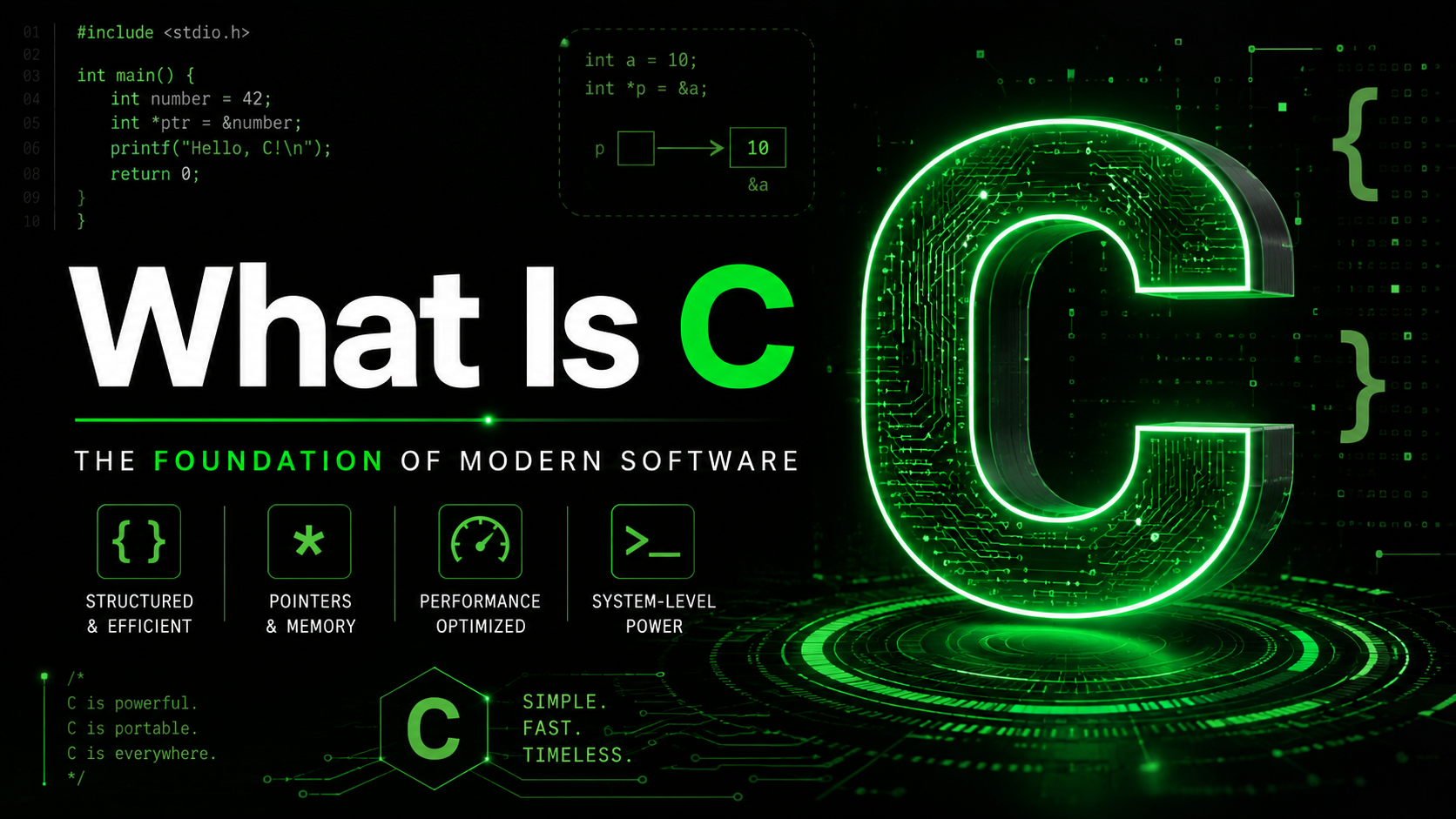
C is a general-purpose, procedural programming language created by Dennis Ritchie at Bell Labs in 1972. It was designed to write the Unix operating system, and that single decision shaped the entire software industry. More than five decades later, C remains one of the most widely used programming languages on the planet.
Unlike modern languages that pile on abstractions, C gives you direct access to memory, hardware registers, and system calls. You write exactly what happens. Nothing is hidden. That transparency is why operating systems, databases, compilers, and embedded firmware are still written in C — when performance and control matter more than convenience, C is the tool engineers reach for.
A Brief History of C Programming
The story of C begins with a problem. Ken Thompson and Dennis Ritchie wanted to rewrite Unix in a language more portable than assembly. Thompson first created B (a stripped-down version of BCPL), but B lacked data types and was too limited. Ritchie evolved B into C between 1971 and 1973, adding types like int, char, float, structs, and a proper type system.
By 1973, the Unix kernel was rewritten in C. That was revolutionary — an operating system written in a high-level language rather than hand-tuned assembly. It made Unix portable across different hardware, which accelerated its adoption across universities and corporations throughout the late 1970s.
In 1978, Brian Kernighan and Dennis Ritchie published The C Programming Language, commonly known as K&R C. This book became the de facto standard for years. The first official standard, ANSI C (C89), arrived in 1989. Since then, the language has evolved through C99, C11, C17, and the upcoming C23 — each adding features while preserving backward compatibility.
Key Milestones in C History
The progression from B to modern C standards shows a language that evolves carefully. C89 formalized the language. C99 added inline functions, variable-length arrays, // comments, and _Bool. C11 introduced threading primitives (_Thread_local, _Atomic), anonymous structs and unions, and _Static_assert. C17 was a bug-fix release. C23, finalized recently, brings nullptr, typeof, binary literals, and improved constexpr support.
Throughout these revisions, the core philosophy has remained unchanged: give the programmer control, keep the language small, and generate efficient machine code.
Where Is C Used Today
If you use technology, you use C — even if you never write a line of it. C powers the invisible layer beneath every modern computing experience. Here is where C dominates in 2026.
Operating Systems
The Linux kernel, which runs on everything from Android phones to AWS servers to the International Space Station, is written almost entirely in C. Windows and macOS both have massive C codebases in their kernels. FreeBSD, OpenBSD, and every other Unix-like system traces its lineage back to C. The RTOS (Real-Time Operating System) running your car’s engine control unit is also written in C.
Embedded Systems and IoT
Microcontrollers with 2 KB of RAM cannot run Python or Java. They run C. Medical devices, automotive ECUs, industrial controllers, drones, smart thermostats, satellite firmware — all C. The hardware and IoT industry lives on C because nothing else gives you such precise control over limited resources.
Databases and Infrastructure
SQLite, PostgreSQL, MySQL, and Redis are written in C. When you query a database, your SQL is parsed and executed by C code. Web servers like Nginx and Apache are C. The entire internet infrastructure — DNS resolvers, routing daemons, packet filters — runs on C programs that have been battle-tested for decades.
Compilers and Language Runtimes
Python’s default interpreter (CPython) is written in C. So is the Ruby interpreter (CRuby/MRI), the PHP engine (Zend), and the Lua runtime. GCC (GNU Compiler Collection) compiles C, C++, Fortran, and more — and GCC itself is written in C. When you learn C, you learn the language that makes other languages possible.
Game Engines and Graphics
Low-level game engine components, graphics drivers, and OpenGL/Vulkan implementations are written in C. Game consoles use C for firmware and driver layers. When frame timing matters down to the microsecond, C is the choice.
Security and Cryptography
OpenSSL, the library that encrypts most HTTPS traffic, is written in C. So are GnuPG, WireGuard, and most cybersecurity tools. Firewalls, intrusion detection systems, and packet analyzers like Wireshark all rely on C for performance-critical packet processing.
Why C Still Matters in 2026
Every few years, someone declares C dead. And every year, C remains in the top three on the TIOBE index, the IEEE Spectrum rankings, and the PYPL popularity index. Here is why.
Performance
C compiles directly to machine code. There is no virtual machine, no garbage collector, no runtime overhead. A well-written C program runs as fast as the hardware allows. When companies need to squeeze every nanosecond — in high-frequency trading, real-time audio processing, or physics simulations — they write it in C.
Portability
C code can be compiled for virtually any processor architecture: x86, ARM, RISC-V, MIPS, AVR, MSP430. Write your code once, cross-compile for a different target. This portability is why C has survived across five decades of hardware evolution.
Simplicity
The entire C language specification fits in about 550 pages. Compare that to C++ (over 1,800 pages) or Java (over 800 pages). C has roughly 32 keywords. There are no classes, no templates, no generics, no pattern matching, no async/await. This simplicity makes C easier to reason about and easier to optimize.
Ecosystem and Legacy
Billions of lines of C code run in production right now. Every Linux distribution, every Android phone, every router, every embedded device. These systems need maintenance, optimization, and security patches. The demand for C programmers is not going away because the code is not going away.
Foundation for Other Languages
Learning C teaches you how computers actually work. Memory allocation, pointer arithmetic, stack frames, system calls — these concepts carry over to every language you learn after C. Developers who understand C write better Python, better Java, better Rust, because they understand what happens under the hood.
C vs Other Languages
Where does C fit compared to alternatives you might be considering?
C vs C++
C++ started as “C with Classes” and has grown into a massive language with templates, RAII, smart pointers, lambdas, and concepts. C++ is ideal when you need object-oriented design with performance. C is better when you want simplicity, transparency, and a smaller attack surface. The Linux kernel, for instance, deliberately stays in C — Linus Torvalds has been vocal about avoiding C++ complexity in kernel code.
C vs Rust
Rust offers memory safety guarantees at compile time through its ownership system. It is an excellent language for new systems programming projects. But C has a 50-year ecosystem, runs on every platform, and most existing infrastructure is in C. Learning C first makes Rust easier to understand because Rust’s safety features are solutions to problems you will encounter firsthand in C.
C vs Python
Python is a high-level scripting language built on top of C. Python is 10-100x slower than C for compute-heavy tasks. When Python’s performance is not enough, developers write C extensions or use Cython. Knowing C lets you understand why Python behaves the way it does and how to optimize it.
How to Start Learning C Programming
This roadmap will take you from writing your first printf("Hello") all the way to building real systems — linked lists, socket servers, multithreaded programs, and debugging with Valgrind. Every lesson is structured to build on the previous one.
Here is the path ahead in this C programming course:
You will start by setting up GCC and writing your first program. Then you will learn variables, data types, operators, and I/O. From there, control flow (if/else, loops, switch) and functions. The middle section covers the heart of C: arrays, strings, pointers, and dynamic memory management. Advanced topics include structs, file I/O, data structures (linked lists, hash tables, trees), bitwise operations, and build systems. The final section covers systems programming: threads, sockets, debugging, and security.
Each lesson includes working code examples, common pitfalls, and explanations of what happens in memory. No copying from textbooks — everything is explained in plain language, as a teacher would explain it on a whiteboard.
What You Need Before Starting
You need a computer (Linux, macOS, or Windows with WSL) and a text editor. That is it. No frameworks, no package managers, no configuration files. C is one of the simplest languages to set up — install a compiler, write a file, compile, run.
If you have programming experience in any language, great — you will move faster. If C is your first language, that is fine too. This course assumes zero prior knowledge and builds every concept from scratch.
Start with the next lesson: Setup & First Program, where you will install GCC, write your first C program, and understand the compile-link-run cycle that every C program goes through.
Frequently Asked Questions
Is C hard to learn?
C’s syntax is straightforward — simpler than most modern languages. The challenge comes from manual memory management and pointers, which require understanding how computers store data. This course addresses those concepts step by step with visual explanations.
How long does it take to learn C?
With consistent daily practice, you can write useful programs within 4-6 weeks. Mastering pointers, memory management, and data structures takes 3-6 months. Systems programming proficiency takes a year or more of building real projects.
Should I learn C or C++ first?
Learn C first. C++ adds layers on top of C, and understanding the base layer makes C++ much easier. Many universities teach C before C++ for this reason.
Is C relevant for jobs in 2026?
Absolutely. Embedded systems, kernel development, firmware engineering, cybersecurity research, database internals, and AI inference optimization all require C. Companies like Google, Apple, Microsoft, NVIDIA, Qualcomm, and every automotive manufacturer actively hire C developers.