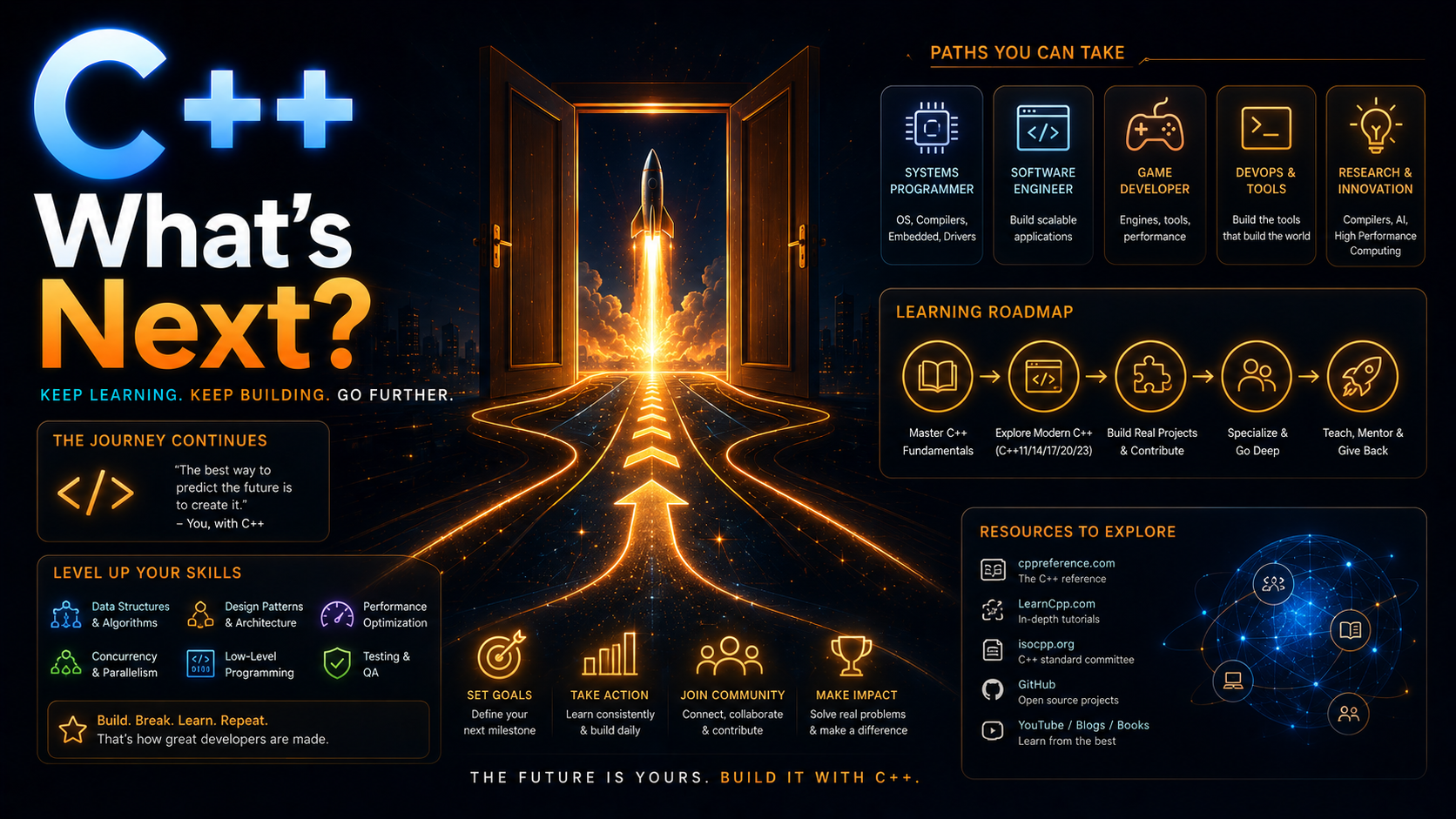
C++ Where to Go from Here: Projects, Books & Career Path Guide 2026
Table of Contents
What You’ve Accomplished
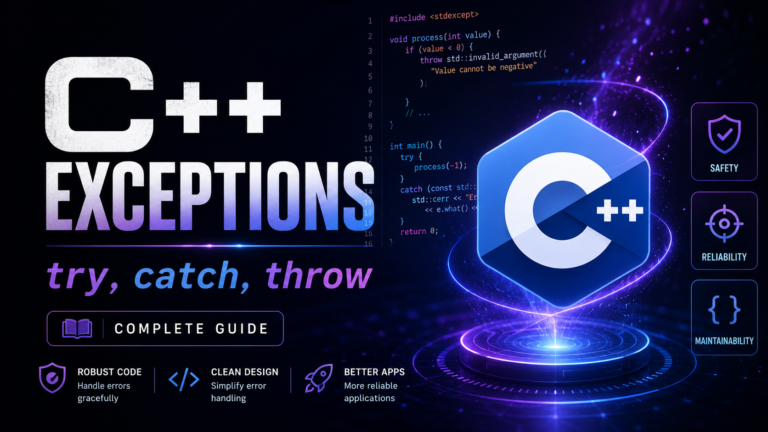
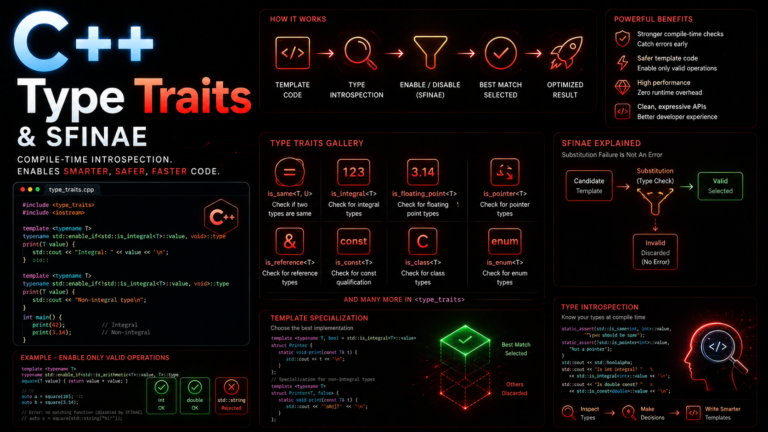
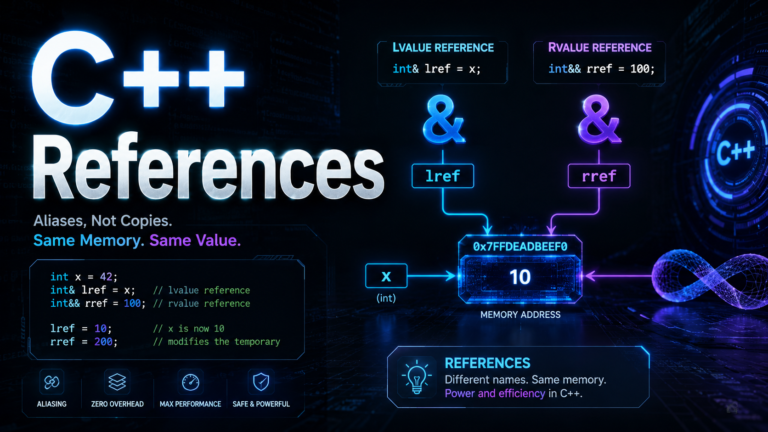
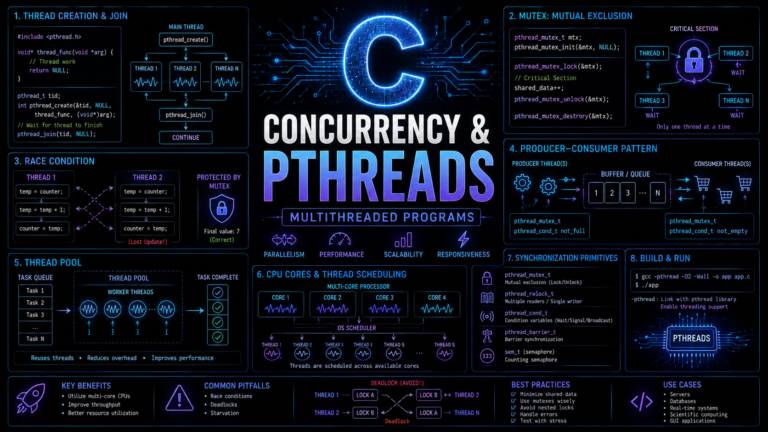
You’ve completed a comprehensive C++ curriculum covering the language from fundamentals to advanced topics. You know variables and types, control flow, functions, OOP (classes, inheritance, polymorphism), templates and generic programming, the STL (containers, algorithms, iterators), modern C++ features (auto, lambdas, move semantics, constexpr, ranges, concepts), memory management (pointers, smart pointers, RAII), concurrency (threads, mutexes, async), build systems (CMake), debugging (GDB, Valgrind, sanitizers), and testing (Google Test, Catch2).
That’s a solid foundation. But knowing syntax and patterns isn’t the same as being able to build things. The gap between “I understand C++” and “I can build production software in C++” is closed by practice. This lesson points you to the projects, resources, and paths that will get you there.
Beginner Projects
Start with projects that exercise your core language skills. A command-line calculator with proper expression parsing teaches you string handling, error management, and basic data structures. A todo list application with file persistence exercises file I/O, structs, and vectors. A text-based adventure game practices OOP — rooms as objects, items as classes, inheritance for different entity types.
Other beginner projects worth building: a Hangman game, a student grade tracker with CSV export, a simple encryption/decryption tool (Caesar cipher, then XOR), a unit converter, or a contact book with search functionality. Each should use CMake for building and include at least a few unit tests.
Intermediate Projects
Intermediate projects involve multiple files, external libraries, and non-trivial design decisions. A JSON parser teaches recursive descent parsing, variant types, and error handling. A HTTP client using sockets teaches networking and protocol handling. A key-value database with persistence teaches file formats, hashing, and concurrency.
More intermediate ideas: a Markdown to HTML converter, a simple shell (command parsing, process creation), a memory allocator (custom new/delete), a thread pool library, a logging framework, a regex engine, or a static site generator. These projects force you to make architectural decisions and deal with edge cases that tutorial code never encounters.
Advanced Projects
Advanced projects push you into real-world complexity. A compiler for a simple language (lexer, parser, AST, code generation) is the ultimate test of your C++ skills — templates, polymorphism, memory management, and algorithms all come together. A game engine component (renderer, physics, entity-component system) teaches real-time performance constraints. A database engine with B-tree indexing and SQL parsing exercises systems programming at its finest.
Other advanced projects: a web server (HTTP/1.1, concurrent connections), a BitTorrent client, a ray tracer, a virtual machine or bytecode interpreter, a packet sniffer, or a distributed key-value store. Pick one that excites you — motivation matters more than technical relevance.
Specialization Paths
C++ is used across many domains. Each has its own ecosystem, libraries, and job market.
Game Development: Learn a game engine (Unreal Engine uses C++, or build your own). Study graphics programming with OpenGL or Vulkan. Understand ECS (Entity-Component-System) architecture, physics engines, and real-time audio. Libraries: SDL2, SFML, Vulkan, OpenGL, Box2D, Dear ImGui.
Systems Programming: Operating system internals, device drivers, embedded systems. Study POSIX APIs, memory-mapped I/O, and kernel interfaces. Build on your knowledge of threads and RAII. This path leads to companies like Google, Microsoft, Apple, and Linux kernel development.
Financial Technology: High-frequency trading systems, risk engines, pricing models. Extreme focus on latency — nanoseconds matter. Learn lock-free data structures, cache optimization, and FPGA integration. Libraries: QuantLib, Boost. Very high-paying career path.
Embedded and IoT: Microcontrollers, real-time operating systems (RTOS), hardware interfaces. C++ is increasingly used in embedded (replacing C) thanks to zero-cost abstractions. Learn about memory constraints, interrupt handling, and bare-metal programming. Platforms: ARM, ESP32, STM32.
Scientific Computing / AI: Numerical computation, machine learning frameworks. C++ powers TensorFlow, PyTorch, ONNX Runtime. Learn linear algebra libraries (Eigen), GPU computing (CUDA), and parallel algorithms. Libraries: Eigen, BLAS, CUDA, OpenMP.
Must-Read Books
For deepening your C++ knowledge, these books are considered essential by the community. A Tour of C++ by Bjarne Stroustrup gives you the creator’s perspective on modern C++ in 200 pages — read this first. Effective Modern C++ by Scott Meyers teaches 42 specific ways to improve your C++11/14 code — the most practical C++ book ever written. C++ Concurrency in Action by Anthony Williams covers multithreading in depth far beyond what this course could.
For going deeper: The C++ Programming Language (4th Edition) by Stroustrup is the definitive reference at 1,300 pages. Design Patterns by the Gang of Four teaches OOP patterns applicable to C++. Clean Code by Robert Martin (language-agnostic) teaches you to write maintainable code. For competitive programming: Competitive Programming by Steven Halim uses C++ throughout.
Online Resources
For reference: cppreference.com is the authoritative C++ reference — bookmark it. For learning: CppCon talks on YouTube are world-class (start with Herb Sutter and Jason Turner’s talks). For practice: LeetCode, Codeforces, and HackerRank have thousands of C++ problems ranked by difficulty.
For staying current: isocpp.org has news and proposals. The C++ Core Guidelines at isocpp.github.io/CppCoreGuidelines are essential reading. Reddit’s r/cpp community discusses new features and libraries. Jason Turner’s C++ Weekly YouTube series covers one C++ topic per episode in 10-minute videos.
Contributing to Open Source
Contributing to open source is the fastest way to level up. You’ll read professional code, get code reviews from experienced developers, and learn how real projects are structured. Start with projects tagged “good first issue” on GitHub.
Beginner-friendly C++ projects to contribute to: fmtlib/fmt (string formatting), nlohmann/json (JSON library), Catch2 (testing framework), and LLVM (compiler infrastructure — large but well-organized). Start by fixing documentation, writing tests, or fixing small bugs. Every major C++ project needs help, and maintainers are generally welcoming to new contributors.
C++ Career Landscape
C++ developers are among the highest-paid in software engineering, especially in finance, gaming, and systems. According to industry surveys, C++ consistently ranks in the top 5 highest-paying languages. The demand is strong because few new developers learn C++ (most start with Python or JavaScript), but C++ is irreplaceable in performance-critical domains.
Common C++ job titles: Systems Engineer, Game Engine Programmer, Embedded Software Engineer, Quantitative Developer, Graphics Programmer, Firmware Engineer, Performance Engineer, and Compiler Engineer. Companies that hire heavily in C++: Google, Microsoft, Apple, Meta, Bloomberg, Jane Street, Citadel, Epic Games, NVIDIA, AMD, Intel, and virtually every autonomous vehicle company.
Interview Preparation
C++ technical interviews typically cover data structures and algorithms (implement on a whiteboard or screen share), language-specific questions (virtual functions, vtable, RAII, smart pointers, move semantics, template metaprogramming), system design (design a cache, a thread pool, a logging framework), and debugging (find the bug in this code). Practice on LeetCode (solve in C++, not Python) and review the topics from this course.
Key topics interviewers focus on: understand the difference between stack and heap allocation, explain RAII and why it matters, know when to use unique_ptr vs shared_ptr, understand move semantics and perfect forwarding, explain how virtual functions work (vtable), know the complexity of STL container operations, and understand thread safety and common concurrency patterns.
Staying Current
C++ evolves on a three-year cycle. C++23 is the latest completed standard (with ranges improvements, std::print, and std::expected). C++26 is in progress with reflection, contracts, and pattern matching on the table. You don’t need to learn every new feature immediately, but keeping up with the major additions keeps your code modern and your skills marketable.
Follow CppCon (annual conference), C++Now (advanced topics), and Meeting C++ (European conference). Watch the keynotes at minimum. Read Herb Sutter’s blog (Sutter’s Mill) and Bartlomiej Filipek’s blog (C++ Stories) for accessible explanations of new features.
Final Advice
The single most important thing you can do now is build something. Pick a project from the lists above — one that interests you personally — and build it from scratch. Use CMake. Write tests. Use sanitizers. Follow the best practices. Push through when it gets hard. The struggle is where the learning happens.
You have all the tools. Every concept in this 65-lesson course — from “Hello, World” to ranges pipelines and async futures — is a building block for real software. The C++ community is active, helpful, and always looking for new developers who’ve put in the effort to learn the language properly. You’ve done that. Now go build something great.