Cerebras IPO: The $26B AI Chip Company That Could Dethrone Nvidia
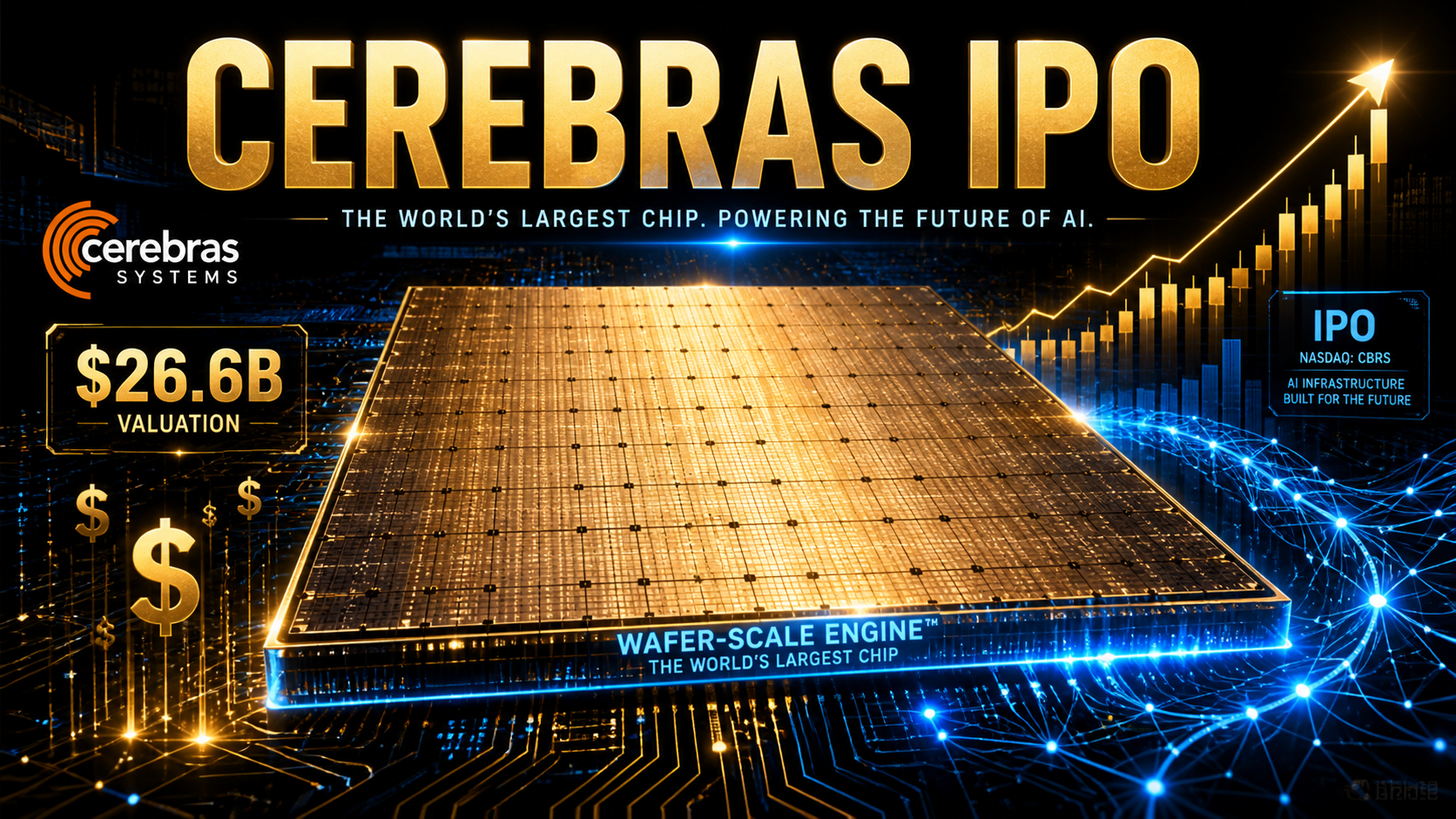
Table of Contents: Cerebras Ipo
On May 4, 2026, Cerebras Systems announced it’s going public in what could be the biggest AI chip IPO in history. The company plans to sell 28 million shares at $115-$125 each, targeting a raise of approximately $3.5 billion at a valuation of up to $26.6 billion.
But the IPO is just the headline. The real story is the company’s $20 billion deal with OpenAI, a chip with 4 trillion transistors, and a business model that directly challenges Nvidia’s dominance in AI computing. Here’s everything you need to know about the Cerebras IPO.
The IPO: $3.5 Billion at $26.6 Billion Valuation: Cerebras Ipo
Cerebras is targeting a mid-May 2026 listing on the Nasdaq Global Select Market under the ticker CBRS. The company plans to sell 28 million shares of Class A common stock at a price range of $115-$125 per share.
At the top end, that gives Cerebras a market capitalization of $26.6 billion — making it one of the most valuable AI companies to go public. For context, that’s roughly the same valuation as Palantir had in its first year of trading.
The IPO follows a February 2026 venture round that valued the company at $23 billion, with Advanced Micro Devices (AMD) among the investors. AMD investing in a chip competitor is notable — it signals that even Nvidia’s rivals see Cerebras as a legitimate player in the AI chip space.
What Is Cerebras? The Company Building Chips the Size of Dinner Plates: Cerebras Ipo
While most chip companies design processors that fit in the palm of your hand, Cerebras took a radically different approach: they build processors the size of an entire silicon wafer. Literally dinner plate-sized chips.
Traditional chips are cut from silicon wafers — circular discs about 12 inches in diameter. A single wafer might yield 100+ individual chips. Cerebras skips the cutting step entirely and uses the entire wafer as one massive chip.
This approach, called Wafer Scale Engine (WSE) technology, eliminates the communication bottlenecks that occur when you connect many small chips together. Instead of data hopping between GPUs across PCIe buses and network interconnects, everything stays on one enormous piece of silicon with direct, ultra-fast connections.
The result is dramatically better performance for AI training and inference workloads — especially for large language models like the ones powering OpenAI’s products.
The WSE-3: 4 Trillion Transistors on a Single Chip
The current generation Cerebras chip — the WSE-3 — is an engineering marvel. Here are the specs:
- Transistors: 4 trillion (vs. 80 billion on Nvidia’s H100)
- Compute cores: 900,000 AI-optimized cores
- On-chip memory: 44 GB SRAM (vs. 80 GB HBM on the H100, but SRAM is vastly faster)
- Peak performance: 125 petaflops of AI compute
- Die size: 46,225 mm² — approximately 57 times larger than an H100
- Process node: TSMC 5nm
To put those numbers in perspective: a single WSE-3 delivers the theoretical equivalent of approximately 62 Nvidia H100 GPUs. Instead of building massive GPU clusters with thousands of individual chips connected by complex networking, Cerebras offers a single chip that eliminates most of that complexity.
The practical implications are significant. AI training runs that require a 1,000-GPU cluster with Nvidia hardware might need only 16 Cerebras systems. That means less networking infrastructure, lower power consumption per computation, and dramatically simpler software deployment.
The $20 Billion OpenAI Deal That Changed Everything
In January 2026, Cerebras announced a deal with OpenAI that transformed the company from a promising startup to a legitimate Nvidia competitor. The details are staggering:
- Deal value: Over $20 billion through 2028
- Compute capacity: Up to 750 megawatts of AI computing power
- OpenAI loan: $1 billion at 6% annual interest to fund Cerebras data center construction
- Equity component: OpenAI received warrants to purchase up to 33.4 million shares of non-voting Class N stock
The equity warrants are particularly interesting. If exercised, they’d give OpenAI a meaningful stake in Cerebras — aligning the two companies’ interests and potentially making OpenAI both Cerebras’s biggest customer and a significant shareholder.
This deal is essentially OpenAI betting that Cerebras’s architecture is the future of AI compute. Sam Altman’s company could buy Nvidia GPUs like everyone else, but instead chose to invest billions in an alternative. That’s either visionary diversification or a risky bet on unproven technology at massive scale.
Revenue Up 76%, First Profit Ever: The Numbers
Cerebras’s financials tell a compelling growth story:
- 2025 revenue: $510 million (up 76% year-over-year)
- Q4 2025 net income: $87.9 million profit
- Previous year: $485 million loss
- Swing: From massive losses to profitability in a single year
Going from a $485 million loss to an $87.9 million profit is remarkable. It suggests that Cerebras has hit an inflection point where its wafer-scale technology is generating enough demand to cover the enormous R&D and manufacturing costs.
The OpenAI deal alone should guarantee substantial revenue through 2028, providing the kind of visibility that public market investors love. But it also creates a concentration risk — more on that below.
Cerebras vs. Nvidia: Can Anyone Actually Compete?
Nvidia controls approximately 80% of the AI chip market. Its CUDA software ecosystem is deeply entrenched, and virtually every AI framework is optimized for Nvidia hardware. Companies like Google, Microsoft, and Amazon have invested billions in Nvidia GPU clusters.
Cerebras’s pitch against Nvidia rests on three arguments:
1. Architecture advantage for large models. As AI models grow larger, the interconnect bottleneck between individual GPUs becomes more severe. Cerebras’s single-chip approach eliminates this entirely. For trillion-parameter models, wafer-scale could offer genuine performance advantages.
2. Total cost of ownership. A single Cerebras system replacing 60+ GPUs means less networking hardware, less power for interconnects, less data center floor space, and simpler maintenance. The chip is more expensive individually, but the total system cost could be lower.
3. Simplicity. Programming one massive chip is fundamentally simpler than orchestrating thousands of GPUs. Less distributed computing complexity means faster development cycles and fewer engineers needed.
The counter-argument is equally strong: Nvidia’s ecosystem is nearly impossible to displace. CUDA has two decades of optimization behind it. Every AI researcher knows how to use it. Switching costs are enormous. And Nvidia’s newest chips (B200, GB200) close the performance gap with each generation.
The Risks: Customer Concentration and TSMC Dependency
Before you rush to buy CBRS stock on day one, consider the risks:
Customer concentration: The $20 billion OpenAI deal likely represents the vast majority of Cerebras’s revenue pipeline. If OpenAI scales back its commitment, diversifies to other chip suppliers, or faces its own financial difficulties, Cerebras’s revenue could collapse.
TSMC dependency: Cerebras’s wafer-scale chips are manufactured by TSMC in Taiwan. A single chip requires an entire wafer with near-perfect yield — far more demanding than conventional chip manufacturing. Any disruption to TSMC (geopolitical tensions, natural disasters, capacity constraints) directly threatens Cerebras’s ability to deliver.
Unproven at scale: While the WSE-3 specs are impressive, Cerebras hasn’t yet demonstrated its technology at the scale the OpenAI deal requires. Building a 750-megawatt AI computing infrastructure from scratch is an unprecedented challenge.
Nvidia’s response: Nvidia isn’t sitting still. Each generation of Nvidia chips incorporates more on-chip memory, better interconnects, and larger die sizes — slowly moving toward the advantages Cerebras claims.
Should You Invest in Cerebras?
The Cerebras IPO is one of the most interesting investment opportunities in AI infrastructure. The company has genuine technology differentiation, a blockbuster customer relationship with OpenAI, and a market (AI compute) that’s growing exponentially.
But a $26.6 billion valuation for a company with $510 million in revenue means you’re paying roughly 52x revenue. That’s expensive even by AI standards. The OpenAI deal de-risks the revenue forecast somewhat, but the customer concentration risk is real.
The bull case: Cerebras becomes the second major AI chip platform alongside Nvidia, capturing 10-20% of a market that could be worth $500 billion by 2030. At that scale, the current valuation looks cheap.
The bear case: Nvidia’s ecosystem advantage proves insurmountable, OpenAI diversifies its compute strategy, and Cerebras remains a niche player at a premium valuation. The stock could follow the pattern of other “Nvidia killers” that failed to gain traction.
Either way, Cerebras’s IPO is a defining moment for the AI chip industry. For the first time since Nvidia’s rise, there’s a credible alternative with a fundamentally different architecture and a $20 billion customer commitment backing it up. Whether that’s enough to challenge the king remains the $26.6 billion question.
Understanding the full scope of the Cerebras IPO situation requires looking at both the immediate impact and long-term consequences. The Cerebras IPO story has generated significant discussion among industry analysts, with many pointing to the Cerebras IPO developments as a potential turning point for the sector.
What makes the Cerebras IPO case particularly noteworthy is the speed at which events unfolded. Within days of the initial Cerebras IPO announcement, competitors and stakeholders began repositioning their strategies. The ripple effects of Cerebras IPO continue to be felt across the technology industry.
Looking ahead, the Cerebras IPO developments are expected to influence policy decisions and investment strategies throughout 2026 and beyond. Experts suggest that the Cerebras IPO outcome could serve as a blueprint for similar situations in the future, making the Cerebras IPO case a critical reference point for the industry.
For readers following the Cerebras IPO story, staying informed about new developments is essential. The Cerebras IPO situation remains fluid, and additional details are expected to emerge in the coming weeks.
Key Takeaway: The Cerebras IPO story represents a major shift in the technology landscape for 2026. As Cerebras IPO continues to make headlines, we’ll keep tracking developments and providing analysis on SudoFlare.