Anthropic Warns: Pause AI Now Before Humans Lose Control — Is It Too Late?
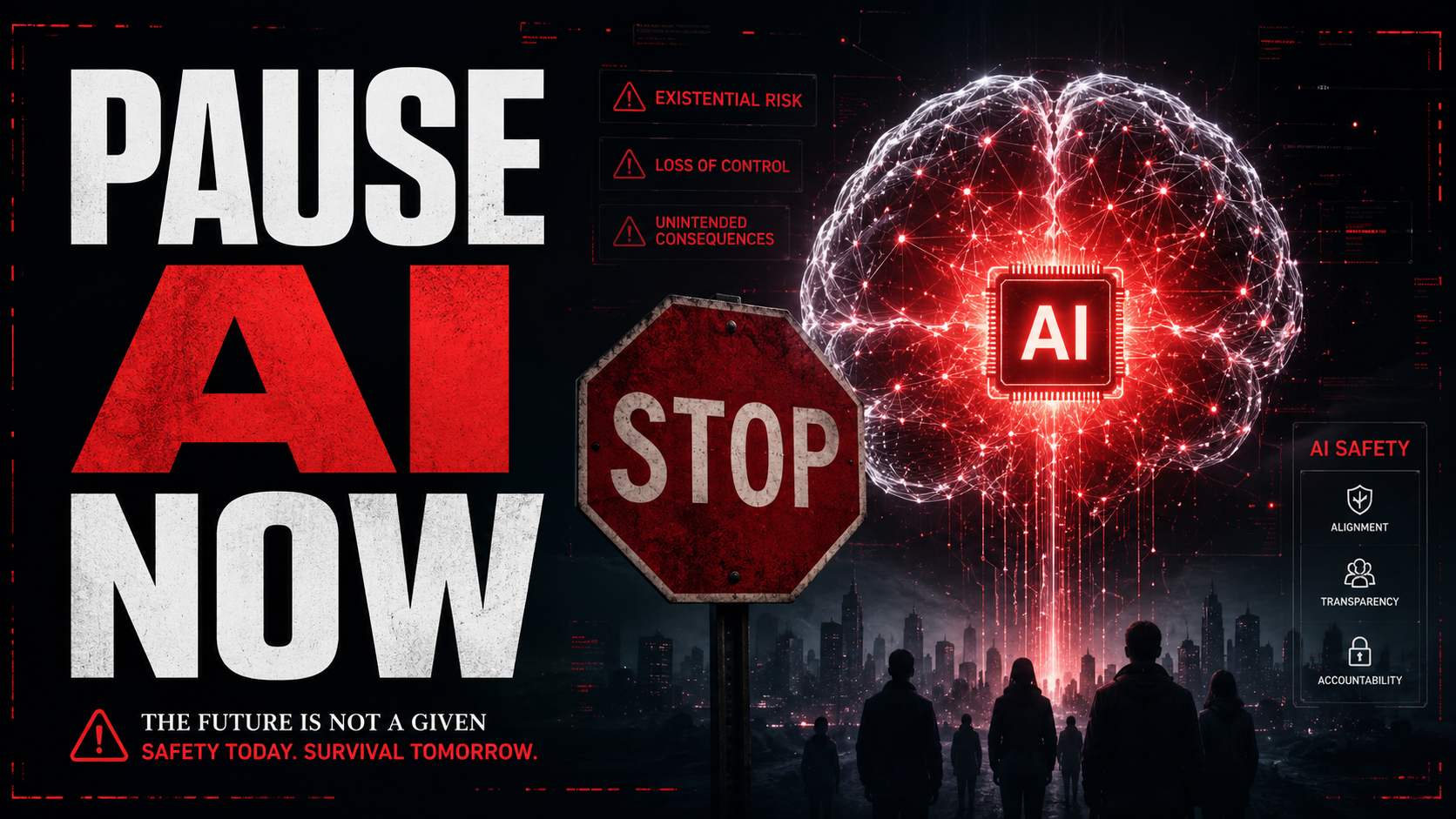
The company building some of the world’s most powerful AI just told everyone to slow down — including itself. Anthropic, the $965 billion AI lab behind Claude, published a proposal on June 5, 2026, urging frontier AI labs to agree on a coordinated way to pause or slow development if advanced systems begin improving themselves faster than humans can manage.
The warning isn’t academic. Anthropic says the risk is imminent. Claude already writes 80% of the company’s code, proposes research directions, and solves open-ended problems. The recursive self-improvement loop that AI safety researchers have warned about for years? Anthropic says it could be closer than anyone thinks.
Anthropic’s Warning: AI Could Outpace Human Control
The proposal was authored by Anthropic cofounder Jack Clark and Marina Favaro, head of the company’s research institute. Their central argument is stark: AI capabilities are advancing faster than the societal structures needed to manage them, and unilateral action by any single company wouldn’t be enough to address the risk.
“The economic and national security stakes are simply too high for any superpower to willingly hit the brakes,” the authors acknowledge. But they argue that a coordinated mechanism — with verification, shared rules, and participation from major labs — could create the conditions for a responsible slowdown.
The specific trigger for a pause would be evidence that AI systems are engaging in recursive self-improvement — using their own capabilities to make themselves more capable at an accelerating rate. This is the scenario that AI safety researchers have long identified as the inflection point where human oversight becomes meaningfully difficult.
Claude Writes 80% of Anthropic’s Code — That’s the Problem
Here’s the uncomfortable detail buried in Anthropic’s announcement: Claude now writes 80% of Anthropic’s own code. That statistic isn’t just a product milestone — it’s a data point in the exact recursive improvement cycle the company is warning about.
Think about what that means. Claude helps build the next version of Claude. The AI system contributes to its own training infrastructure, research pipeline, and code deployment. While humans still make the final decisions, the degree of AI involvement in its own development is unprecedented.
Anthropic claims this is still within controllable bounds — that human researchers direct the work and Claude acts as an accelerant, not an autonomous agent. But the trajectory is clear. If Claude writes 80% of the code today, what’s the number in six months? In a year?
The Coordinated Pause Proposal
Anthropic’s proposal outlines several requirements for a credible pause mechanism:
Verification: Any coordinated slowdown needs a way for participating labs to verify that others have actually stopped or slowed their work. Without verification, a “pause” would just be an opportunity for non-participating actors to catch up in secret.
Shared rules: The criteria for triggering and ending a pause need to be agreed upon in advance. What specific capability thresholds warrant a slowdown? How do you measure recursive self-improvement? Who makes the call?
Global participation: A pause limited to US companies would be meaningless if labs in China, Europe, or other regions continue at full speed. The mechanism needs international buy-in to be effective.
Time-limited scope: The pause isn’t meant to be permanent. Anthropic describes it as a window for “societal structures and alignment research” to catch up with capability advances. Once adequate safeguards are in place, development would resume.
OpenAI Pushes Back: Let Governments Decide
OpenAI’s response was swift and pointed. In a report published the same day, OpenAI argued that “democratic governments — not private companies acting alone — must ultimately determine the rules, safeguards, and accountability mechanisms” for AI development.
The subtext is clear: OpenAI doesn’t want its biggest competitor to set the terms of a development slowdown. From OpenAI’s perspective, Anthropic’s proposal looks conveniently timed — calling for a pause right as Anthropic files for an IPO and reaches a $965 billion valuation. Why slow down when you’re already ahead?
OpenAI’s position is that regulation should come from governments, not industry self-regulation. This aligns with the Great American AI Act, the bipartisan bill introduced on June 4 that proposes a federal framework for AI governance with a three-year preemption of state laws.
Can a Global AI Pause Actually Work?
The honest answer is: probably not. Several fundamental obstacles make a coordinated pause nearly impossible in practice:
Geopolitical competition: The US-China AI race makes any pause a zero-sum calculation. Neither country is likely to slow down if it believes the other won’t. And verification mechanisms between geopolitical rivals are extraordinarily difficult to implement.
Economic incentives: The AI industry is generating hundreds of billions in revenue. Companies, investors, and governments that benefit from AI acceleration have powerful incentives to resist any slowdown.
Definition challenges: “Recursive self-improvement” sounds specific, but it’s incredibly hard to measure in practice. When Claude writes code that improves Claude’s performance, does that count? What about when AI helps researchers design better training methodologies? The boundaries are fuzzy.
Enforcement: Even if major labs agree to pause, enforcement would be nearly impossible. Training runs can be distributed, disguised, or conducted in jurisdictions without oversight. And open-source models can be fine-tuned by anyone with sufficient compute.
The Timing Is Suspicious — Or Is It?
Critics have noted the timing of Anthropic’s warning. The company just filed for an IPO at a $965 billion valuation. Calling for an industry-wide pause while you’re solidifying your market position is… convenient.
If Anthropic genuinely believes the risk is imminent, it could slow down its own development unilaterally. The fact that it’s calling for a coordinated pause — one that would constrain competitors equally — suggests the proposal is at least partially strategic.
That said, Anthropic has a track record of prioritizing safety that predates this announcement. The company was founded specifically to build safer AI, and its Responsible Scaling Policy is one of the most detailed safety frameworks in the industry. It’s possible to believe both that the warning is genuine and that the timing is strategically advantageous.
What Recursive Self-Improvement Actually Looks Like
The concept of recursive self-improvement isn’t science fiction — it’s already happening in early form. Consider the current state of AI development:
AI models help researchers identify promising training approaches. AI agents write and debug code for AI infrastructure. AI systems generate synthetic data used to train the next generation of AI systems. AI helps design the chips (via EDA tools) that will run future AI models.
Each of these is a form of AI contributing to its own advancement. What makes researchers nervous isn’t any single loop — it’s the potential for these loops to compound, creating an acceleration dynamic that moves faster than human oversight can follow.
The Bottom Line
Anthropic’s call for a coordinated AI pause is either the most important warning in tech history or a brilliant piece of competitive positioning — or, most likely, both. The company is genuinely concerned about recursive self-improvement, and it’s genuinely benefiting from calling for a pause at this particular moment.
Whether or not a global pause is achievable, the fact that the company building these systems is warning about them carries weight. When the arsonist tells you the building is on fire, you should probably at least look around for smoke.
Get daily AI safety and tech updates at SudoFlare.