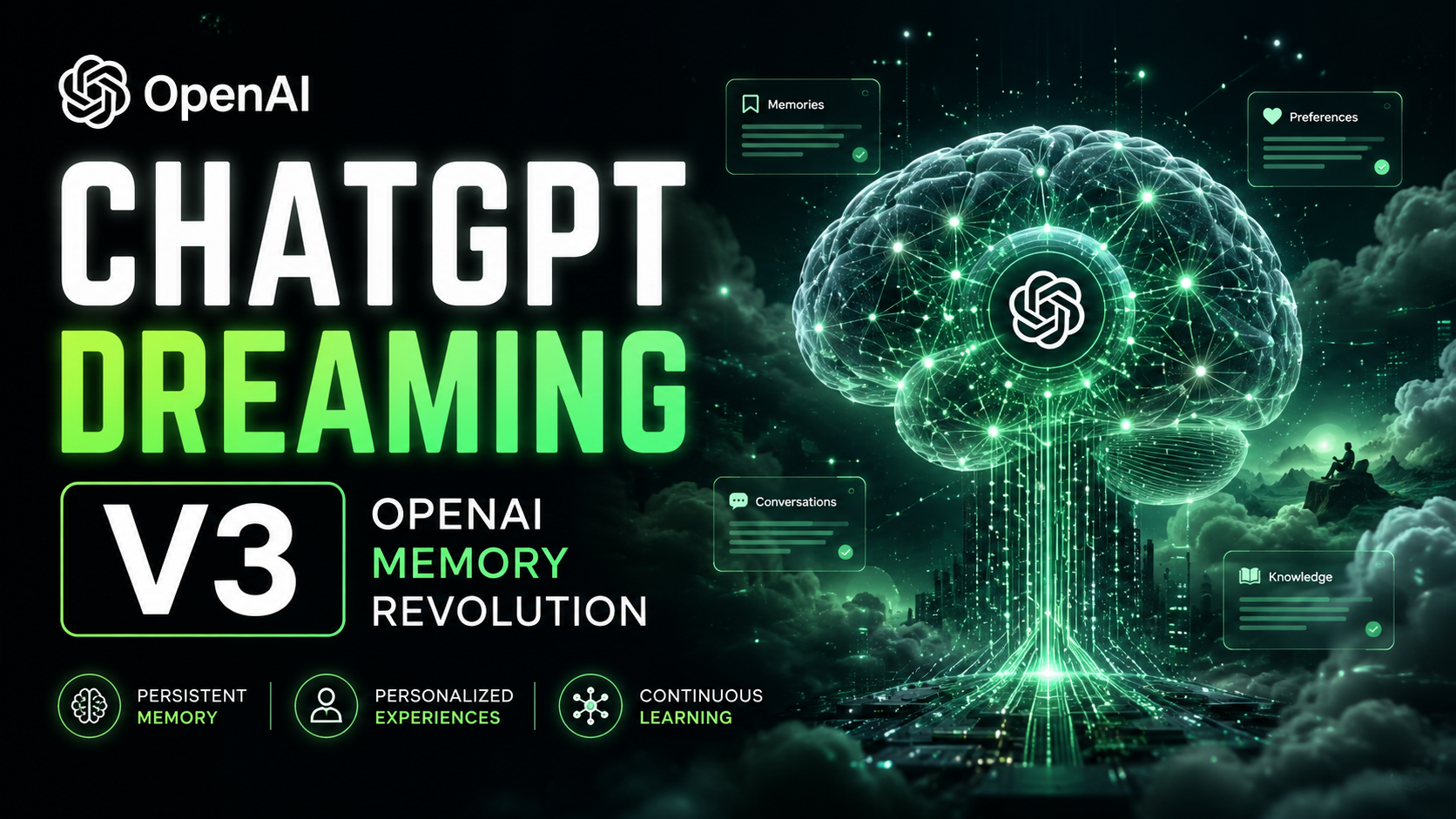
ChatGPT Dreaming V3: OpenAI’s Memory Revolution Changes Everything — Here’s How
OpenAI just dropped the most significant ChatGPT update since the original launch — and it’s not a new model. It’s memory. The new Dreaming V3 architecture, which started rolling out on June 4, 2026, fundamentally changes how ChatGPT remembers who you are, what you’ve talked about, and what you care about.
No more telling ChatGPT to “remember this.” No more repeating your preferences every session. Dreaming V3 makes ChatGPT memory automatic, self-updating, and — for the first time — available to free users. But this power comes with privacy tradeoffs that are already raising eyebrows.
What Is ChatGPT Dreaming V3?
Dreaming V3 is a background process that replaces ChatGPT’s old saved-memories system. Instead of requiring users to explicitly tell ChatGPT what to remember, the new architecture automatically captures context from natural conversations and synthesizes it into a persistent memory layer.
Think of it like this: the old memory system was a notebook you had to manually write in. Dreaming V3 is an assistant that listens to everything you say and builds a detailed profile of your preferences, habits, projects, and life events — without you ever asking it to.
The name “Dreaming” comes from the background process that runs between sessions. Like the human brain consolidating memories during sleep, ChatGPT now processes and reorganizes your conversational history during downtime, strengthening important memories and letting irrelevant ones fade.
How Dreaming V3 Memory Actually Works
The architecture operates on three layers that work together to create what OpenAI describes as “adaptive, living memory”:
Capture Layer: During conversations, Dreaming V3 identifies facts, preferences, and context worth remembering. This happens passively — you don’t need to say “remember that I prefer Python over JavaScript” because the system infers it from how you talk about coding.
Synthesis Layer: Between sessions, the Dreaming process consolidates captured information, resolves contradictions, and updates outdated facts. If you mentioned planning a trip to Singapore three months ago and then discussed your photos from Singapore last week, the system automatically updates your memory to reflect that the trip is now in the past.
Retrieval Layer: When you start a new conversation, the system pulls relevant memories based on context. Ask about restaurant recommendations and it’ll remember you’re vegetarian. Ask about code and it’ll remember your preferred tech stack.
The Three Pillars: Freshness, Continuity, Relevance
OpenAI’s documentation emphasizes three dimensions that Dreaming V3 optimizes for:
Freshness ensures memories stay current. A memory about a future event automatically transitions to a past event once the date passes. Your job title updates when you mention a promotion. Your address changes when you talk about moving. The system doesn’t just store facts — it maintains a timeline-aware model of your life.
Continuity creates coherent threads across conversations. If you’ve been discussing a work project over multiple sessions, Dreaming V3 maintains the narrative arc — tracking milestones, blockers, and decisions without you rehashing the backstory every time.
Relevance determines which memories surface and which stay dormant. Not every memory is relevant to every conversation. The system uses contextual signals to decide what to bring forward, avoiding the problem of overwhelming conversations with irrelevant personal details.
5x Compute Reduction: How OpenAI Made It Free
Perhaps the most impressive technical achievement isn’t the memory system itself — it’s the 5x reduction in compute required to serve it. This efficiency gain is what allowed OpenAI to extend Dreaming V3 to Free-tier users for the first time.
Previous versions of ChatGPT memory were compute-intensive enough that they were restricted to paying subscribers. The Dreaming V3 architecture uses more efficient embedding representations, smarter retrieval algorithms, and aggressive compression of memory storage to bring costs down dramatically.
For OpenAI, this is a strategic move. By giving free users access to persistent memory, the company creates stickiness that makes switching to competitors like Claude or Gemini significantly harder. Once ChatGPT knows everything about you, starting over with a new AI assistant feels like a downgrade.
Privacy Concerns and User Controls
An AI that automatically builds a detailed profile of your life from conversation scraps is, depending on your perspective, either incredibly useful or deeply unsettling. Privacy researchers have already flagged several concerns:
The audit trail problem: Dreaming V3 synthesizes memories from raw conversations, meaning the original context can be lost. You can see what ChatGPT “remembers,” but you can’t easily trace back to the specific conversation where it learned that fact. TechTimes has specifically called out the “limited audit trail” as a design concern.
Inference vs. explicit consent: The old memory system only stored facts you explicitly asked it to remember. Dreaming V3 infers and stores information you never explicitly shared — dietary preferences from food discussions, political leanings from news conversations, health concerns from medical questions.
User controls: OpenAI does provide granular controls. Users can view, edit, or delete any individual memory. They can clear all memories with one click. And “temporary chats” ensure nothing from those sessions is stored or referenced. But these are opt-out controls — the default is full memory, and most users will never adjust their settings.
What This Means for Claude, Gemini, and the Competition
Dreaming V3 raises the bar for every AI assistant on the market. Anthropic’s Claude, Google’s Gemini, and other competitors now face a fundamental question: how do you compete with an AI that already knows the user?
Claude has strong session-based memory through its Projects feature but doesn’t yet offer the kind of automatic, cross-session memory synthesis that Dreaming V3 provides. Gemini has some memory capabilities tied to Google’s broader data ecosystem, but nothing as sophisticated as what OpenAI has just shipped.
The competitive pressure to match Dreaming V3 could push the entire industry toward more aggressive data retention — a trend that privacy advocates will be watching closely.
Who Gets Dreaming V3 and When?
| Tier | Availability |
|---|---|
| ChatGPT Plus | Rolling out now (US first) |
| ChatGPT Pro | Rolling out now (US first) |
| ChatGPT Free | Expanding now (5x compute cut enabled) |
| ChatGPT Enterprise | Coming soon |
| International | Phased rollout over coming weeks |
The Bottom Line
ChatGPT Dreaming V3 is the kind of update that changes how people relate to AI. It’s the difference between an AI assistant you use and an AI assistant that knows you. The technology is impressive, the privacy implications are real, and the competitive pressure it creates will reshape the entire AI assistant landscape.
Whether you’re excited about an AI that finally remembers your preferences or concerned about one that never forgets anything you’ve said, Dreaming V3 represents a fundamental shift. The age of AI memory has arrived — and it’s dreaming about you right now.
For daily AI and tech coverage, follow SudoFlare.