SpaceX IPO: $1.75 Trillion, Goldman Sachs, and the Biggest Stock Offering in History — June 12
Table of Contents
Table of Contents
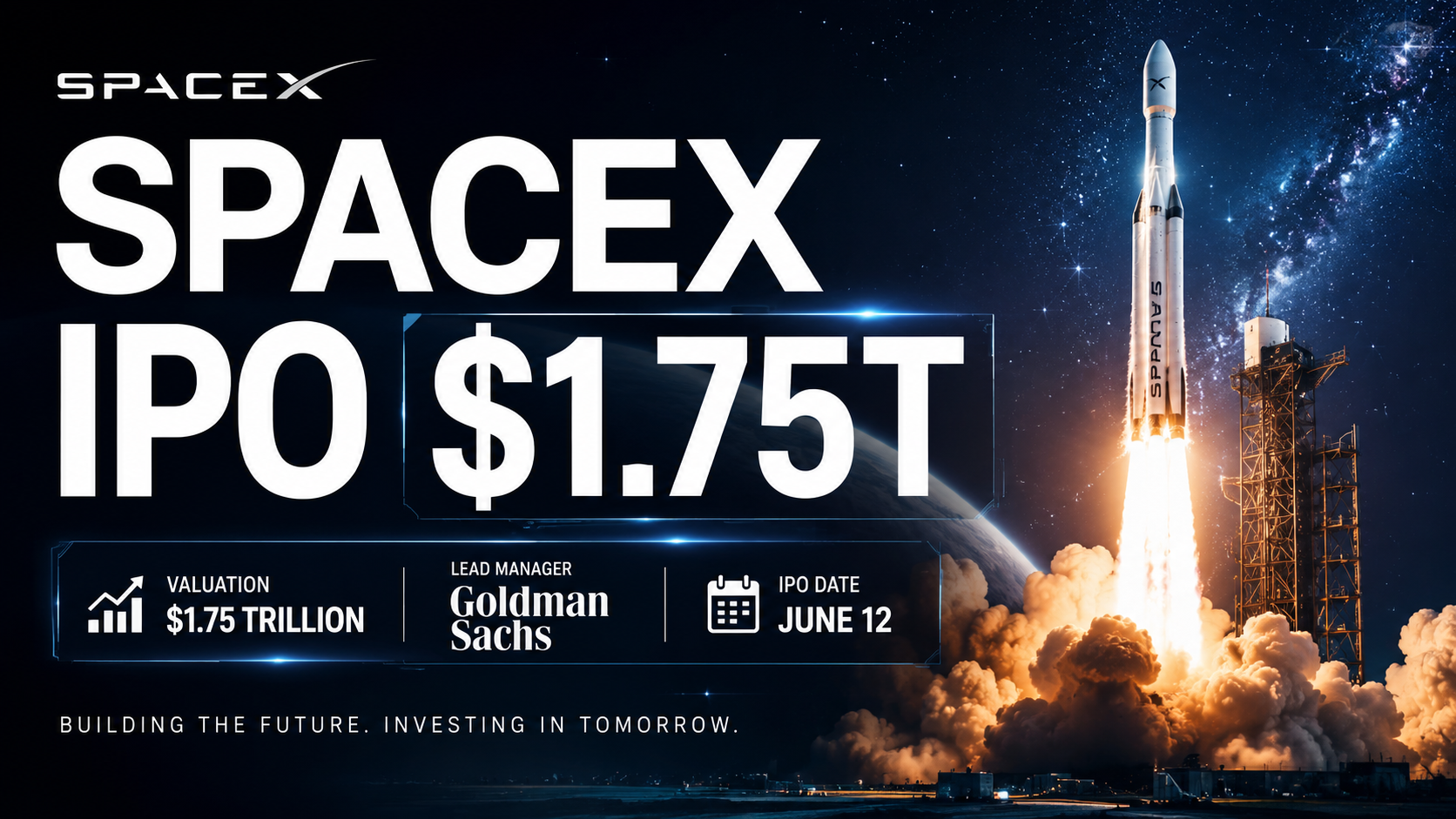
On June 12, 2026, one of the most anticipated events in financial history will unfold on the Nasdaq. SpaceX — now merged with Elon Musk’s AI company xAI — will begin trading publicly under ticker SPCX at a staggering $1.75 trillion valuation. Goldman Sachs has been named lead-left underwriter, with Morgan Stanley, Bank of America, Citigroup, and JPMorgan Chase filling out the banking syndicate.
If successful, this will be the largest IPO in stock market history — eclipsing Saudi Aramco’s $29.4 billion raise in 2019 and setting a new benchmark for tech listings. SpaceX is targeting up to $80 billion in proceeds, which would make it not just the biggest tech IPO ever, but the biggest IPO of any kind, anywhere.
How SpaceX Got to $1.75 Trillion
The story behind SpaceX’s astronomical valuation begins in February 2026, when Elon Musk orchestrated the largest corporate merger in history: SpaceX absorbed xAI — his Grok-building AI company — at a combined valuation of $1.25 trillion. Since that merger, as the IPO roadshow built momentum and Goldman Sachs came onboard, the valuation has risen further to a proposed $1.75 trillion.
At $1.75 trillion, SpaceX would be worth more than Alphabet, Amazon, or Meta on their debut days. It would instantly become one of the ten most valuable companies on the planet — on day one of trading.
The merger with xAI was strategic. Musk’s public rationale was building “orbital data centers” — combining SpaceX’s Starlink satellite internet infrastructure with xAI’s AI compute capabilities to create edge AI systems that operate in space. The private reality was simpler: xAI was burning through cash in its race against OpenAI and Anthropic, and merging it into SpaceX’s cash-generating launch and satellite business provided a financial lifeline while boosting the combined entity’s IPO appeal.
Goldman Sachs: The Lead That Matters
The selection of Goldman Sachs as lead-left underwriter is significant. In investment banking, “lead left” means Goldman’s name appears first on all transaction documents — it’s primarily responsible for coordinating the offering, managing the book, setting the final share price, and handling investor relations during the roadshow. That’s the most prestigious and most profitable position in any IPO syndicate.
Goldman’s involvement signals institutional credibility at the highest level. The bank’s equity research team has a global reach that will help SpaceX attract sovereign wealth funds, pension funds, and the world’s largest asset managers as anchor investors. Pricing is set for June 11 with trading beginning June 12 on Nasdaq.
The SpaceX IPO comes at an interesting moment. The AI investment wave — which has already pushed companies like Cerebras to a $26.6 billion valuation at IPO and driven OpenAI to a reported $1 trillion valuation — has primed institutional appetite for large AI-adjacent listings.
What SpaceX Actually Does (And Why Investors Care)
SpaceX’s revenue base is more diversified than most people realize. The company has four distinct business lines, each with significant scale:
- Launch Services: Falcon 9 and Falcon Heavy launch contracts for NASA, the DoD, and commercial customers. SpaceX now commands over 60% of the global commercial launch market.
- Starlink: The satellite internet constellation now has over 7 million subscribers globally, generating recurring subscription revenue and expanding rapidly in underserved markets.
- Starship: Still in development, but if it delivers on the promise of fully reusable heavy-lift launch, it could dominate the market for decades — including the emerging lunar economy.
- xAI / Grok: The AI division, contributing AI assistant subscriptions, enterprise API access for Grok, and the theoretical “orbital AI” play Musk has been pitching to investors.
Starlink alone is estimated to generate $8–12 billion in annual revenue by end of 2026, with strong margins and accelerating growth. That recurring revenue stream is the backbone of SpaceX’s valuation argument — it’s not just a rocket company; it’s a connectivity company and an AI company bolted onto a rocket company.
The xAI Factor: Blessing or Liability?
Here’s the uncomfortable truth that sophisticated investors will be probing: xAI is not profitable. The Grok chatbot competes in an increasingly crowded market against OpenAI’s ChatGPT, Google’s Gemini, and Anthropic’s Claude. None of these companies have definitively “won” the consumer AI market. Grok’s primary distribution advantage is through X (formerly Twitter) — which itself remains a money-losing platform with declining advertiser revenue.
Musk’s argument is that the orbital data center concept — using Starlink satellites as edge compute nodes running Grok inference — is a fundamentally differentiated AI infrastructure play. If that vision is credible, the xAI merger was a brilliant strategic move. If it’s vaporware, investors are paying a premium for an AI business that may never justify its inclusion in the SpaceX story.
The Pentagon’s recent AI deals with 8 tech giants notably excluded Anthropic — but SpaceX/xAI has long-standing DoD relationships via launch contracts that could serve as a pipeline for government AI contracts.
Will the $1.75 Trillion Valuation Hold?
The valuation math is aggressive. At $1.75 trillion, SpaceX is being priced as if it will dominate not just launch services and satellite internet, but also the AI and edge compute markets. That requires Starlink to keep growing at its current pace, Starship to deliver on its commercial promise, and Grok/xAI to carve out a meaningful position in enterprise AI.
Several things could go wrong. A major Starship failure before IPO pricing would be catastrophic for sentiment. An xAI partnership or customer announcement falling through would raise questions about the AI story. And if broader market conditions deteriorate between now and June 12, even Goldman Sachs can’t guarantee a smooth debut.
But the bull case is compelling. SpaceX has a track record of executing on seemingly impossible engineering goals. Musk has proven he can build multi-hundred-billion-dollar companies. And with the AI industry investing at unprecedented scale, any company with a credible AI infrastructure angle attracts premium valuations.
What the SpaceX IPO Means for Tech Markets
The SpaceX IPO isn’t just about SpaceX — it’s a signal about the entire risk appetite of institutional markets heading into the second half of 2026. If SpaceX prices well and trades strongly, it opens the door for other mega-cap private companies to go public. If it stumbles, expect a chilling effect on the IPO pipeline for the rest of the year.
For retail investors, the key question is whether they can get access. IPOs of this size tend to be heavily allocated to institutional investors in the book-building process, with retail getting a small slice via brokerage platforms. Expect heavy trading volume and significant volatility in SPCX’s first days of trading.
June 12 is three weeks away. The countdown has started.
Sources: CNBC — SpaceX picks Goldman Sachs for lead-left IPO role | HeyGoTrade — SpaceX IPO Eyes $80B Raise | CNBC — SpaceX xAI merger at $1.25T