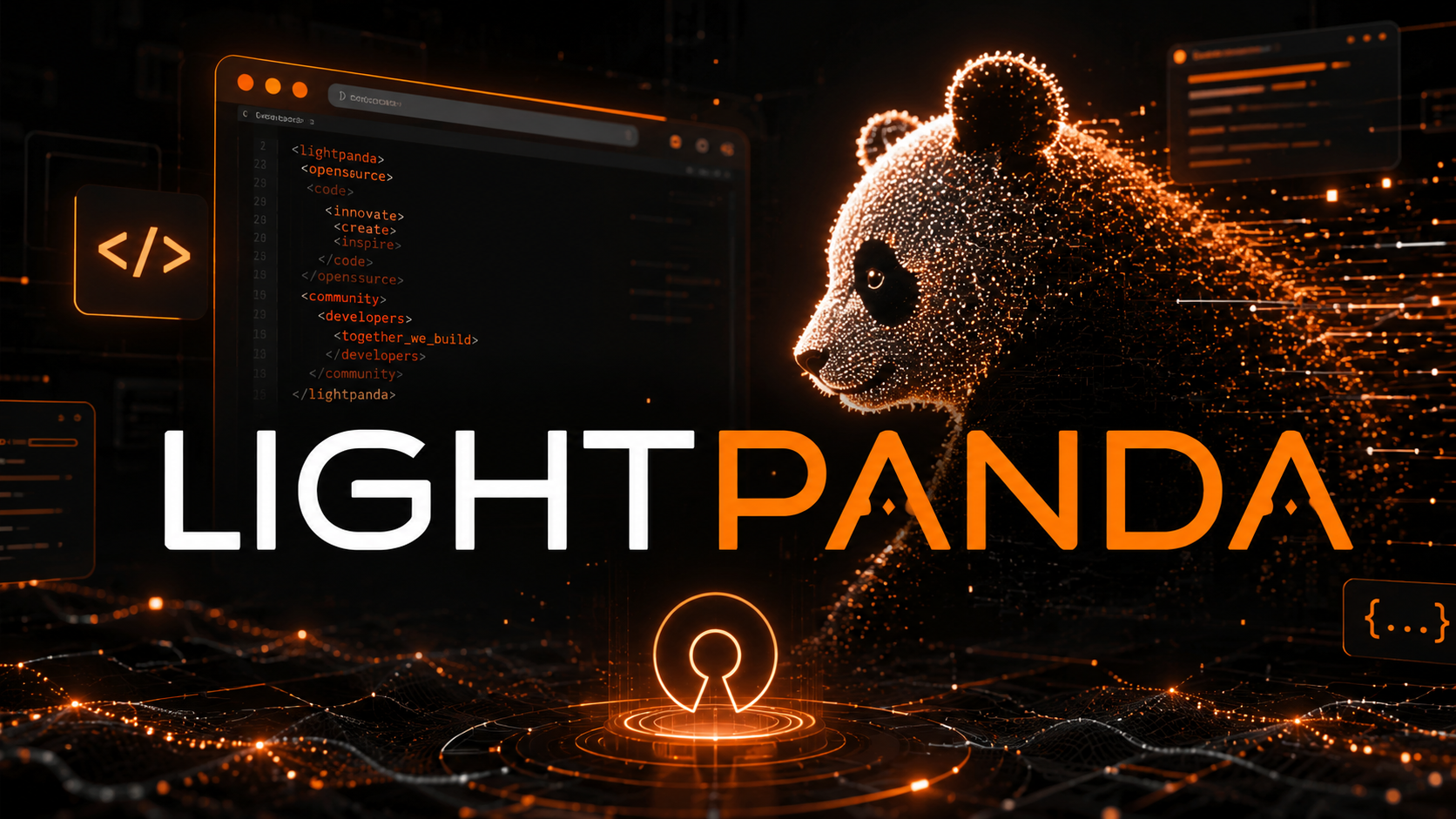
Lightpanda Is the AI Browser That’s 11x Faster Than Chrome — And It’s Completely Open Source
Table of Contents
Every AI agent that needs to interact with the web faces the same problem: headless browsers are painfully slow. Running a full Chrome instance in the background to scrape a web page, fill out a form, or navigate a site is like using a semi-truck to deliver a letter.
Enter Lightpanda — an open-source headless browser that runs 11x faster than Chrome, uses 9x less memory, and cuts server costs by 82%. And unlike Chrome, it was built from the ground up specifically for AI agents and automation.
What Is Lightpanda?
Lightpanda is a new browser written entirely in Zig — not a Chromium fork, not a WebKit patch. It’s a completely new browser engine built specifically for headless use cases: automation, scraping, testing, and AI agent workflows.
The project currently has over 17,000 GitHub stars and is attracting attention from the AI agent community as a lightweight alternative to running full browser instances.
The Performance Numbers
The benchmarks tell the story:
- 11x faster than headless Chrome for page loading and JavaScript execution
- 9x less memory consumption per browser instance
- 82% reduction in server costs for automation workloads
These aren’t marginal improvements — they’re order-of-magnitude gains. When you’re running thousands of browser instances simultaneously for web scraping or AI agent tasks, the difference between Chrome’s resource consumption and Lightpanda’s is the difference between needing 100 servers and needing 10.
Why This Matters for AI Agents
The AI agent revolution has created massive demand for browser automation. AI agents need to interact with the web — filling forms, clicking buttons, navigating pages, extracting information. Every major AI lab is building agent capabilities, and every agent needs a browser.
The problem is that existing headless browsers were designed for human browsing, not machine automation. Chrome’s headless mode carries the full weight of rendering engines, GPU acceleration, extension APIs, and features that AI agents don’t need. It’s massive overkill.
Lightpanda strips away everything a machine doesn’t need and keeps only what matters: JavaScript execution, DOM manipulation, network interception, and API compatibility. The result is a browser that’s purpose-built for the one thing AI agents need to do — interact with web content programmatically.
Built From Scratch in Zig
The choice to build in Zig is significant. Zig is a systems programming language designed as a practical alternative to C and C++, with a focus on safety, performance, and zero-overhead abstractions.
Building a browser from scratch is an extraordinarily ambitious undertaking. Chrome has millions of lines of code and has been developed by thousands of engineers over 15+ years. Lightpanda is attempting to create a viable alternative with a much smaller team by focusing narrowly on headless use cases.
The advantage of starting from scratch is that you don’t carry the technical debt and design compromises of a browser built for human interaction. Every architectural decision in Lightpanda was made with machine-first use cases in mind.
How It Works
Lightpanda provides compatibility with existing automation frameworks through the Chrome DevTools Protocol (CDP). This means it works with Puppeteer and Playwright — the two most popular browser automation tools.
For developers, this means you can switch from Chrome to Lightpanda with minimal code changes. Your existing Puppeteer scripts work. Your Playwright tests work. You just point them at Lightpanda instead of Chrome and get instant performance improvements.
Official Docker images are available for both Linux amd64 and arm64 architectures, making deployment straightforward for server-side automation workloads.
The Use Cases
Lightpanda is particularly compelling for several growing use cases:
- AI Agent Web Browsing — Agents like Claude and GPT need browsers to interact with websites. Lightpanda makes this 11x faster and 9x cheaper.
- Web Scraping at Scale — Companies scraping millions of pages daily can dramatically reduce infrastructure costs.
- Automated Testing — CI/CD pipelines running browser tests can execute test suites significantly faster.
- Data Extraction — Research and analytics workflows that need to process web content programmatically.
The Competition
Lightpanda isn’t the only project trying to make browsers lighter for automation. Alternatives include Playwright’s built-in browser, various Chromium Embedded Framework (CEF) implementations, and commercial headless browser services.
But Lightpanda’s approach — building a completely new browser engine from scratch — is unique. Most alternatives are still fundamentally based on Chrome or WebKit, carrying their overhead. Lightpanda is the only major project attempting a clean-room implementation optimized purely for machine use.
Current Status and Limitations
It’s important to note that Lightpanda is currently in beta. The project provides partial Web API support, and the team acknowledges that “stability and coverage are improving and many websites now work. You may still encounter errors or crashes.”
This means it’s not ready for production use in all scenarios. Complex web applications with heavy JavaScript frameworks may not work correctly yet. But for straightforward automation tasks — the bread and butter of AI agent workflows — it’s already usable.
The project raised pre-seed funding in mid-2025 to expand browser coverage and develop AI-specific features, indicating ongoing investment in development.
The Bottom Line
Lightpanda represents a fundamental shift in how we think about browsers. For 25 years, browsers have been built for humans — with rendering engines, visual layouts, and user interfaces. Lightpanda asks a simple question: what if we built a browser just for machines?
The answer is something that’s 11x faster, 9x lighter, and 82% cheaper to run. It’s open source, compatible with existing tools, and purpose-built for the AI agent era.
It’s still early. The beta has rough edges. But the project’s trajectory — 17,000+ GitHub stars, pre-seed funding, growing community — suggests this is more than a hobby project.
In a world where every AI company is building agents that need to browse the web, Lightpanda might be the most important browser you’ve never heard of.